In: Books
Titolo completo
Citizenship Education and Learning Mechanisms in the Post-Truth Era: A European Perspective
Citizenship Education and Learning Mechanisms in the Post-Truth Era: A European Perspective
Autori Alessia Chiriatti | Federico Castiglioni
Data pubblicazione
This chapter examines the evolving relationship between citizenship education and learning mechanisms in the post-truth era, focusing on the European dimension. Recent years have witnessed an intense scholarly debate on addressing the challenges of mis/disinformation and the resultant social polarization and fragmentation in contemporary society. Scholars have explored innovative approaches to tackle these issues, conceptualizing them as “epistemological vaccines” that aim to reinforce critical educational strategies. These strategies are designed to counteract the post-truth phenomenon (Valladares 2022). While education alone cannot fully resolve the long-term implications of post-truth dynamics, it holds significant potential to foster resilience through the development of “antibodies” against the manipulative effects of disinformation and the erosion of scientific evidence. As Giroux (2018) suggests, reconnecting liberal democracies with the virtue of truthtelling places education and its social role at the heart of this process. Moreover, education serves as a vital tool to combat illiteracy and weak knowledge frameworks, both of which hinder critical thinking. By empowering individuals to confront the challenges of the post-truth era, educational strategies—particularly those centered on learning and teaching mechanisms—are essential for developing critical competencies. These include media and digital literacy, social cohesion as well as more specific skills such as critical thinking. Such tools enable individuals of all ages to navigate the complexities of the information environment and debunk mis/disinformation effectively. This chapter explores how citizenship education processes have adapted to the post-truth age through an analysis of case studies from Italy, Germany, Iceland, Croatia, and Bulgaria. Specifically, it examines three different areas: 1) the difference between civic and citizenship education; 2) the skills associated with citizenship education; 3) the results of the analysis in the case studies under scrutiny. By offering an interdisciplinary perspective and incorporating empirical insights from diverse European contexts, this chapter seeks to contribute to the broader discourse on strengthening democratic resilience and fostering informed, critical, and engaged citizenship in the post-truth era.
Details
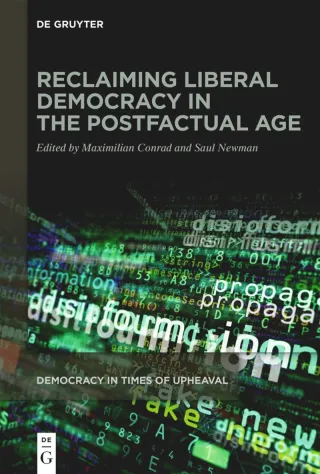
(with Maximilian Conrad) in Maximilian Conrad and Saul Newman (eds), Reclaiming Liberal Democracy in the Postfactual Age, Berlin, De Gruyter, 2026, p. 167-192 (Democracy in Times of Upheaval ; 12)
In
BooksISBN/ISSN/DOI
978-3-11-222296-6; 978-3-11-222283-6 (pbk); 978-3-11-222287-4 (ebk); 10.1515/9783112222874
Copertina pubblicazione
Image