Titolo completo
Venezuela: What Transition Ahead?
|
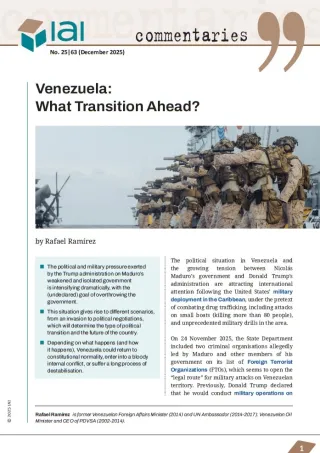
The political situation in Venezuela and the growing tension between Nicolás Maduro’s government and Donald Trump’s administration are attracting international attention following the United States’ military deployment in the Caribbean, under the pretext of combating drug trafficking, including attacks on small boats (killing more than 80 people), and unprecedented military drills in the area.
On 24 November 2025, the State Department included two criminal organisations allegedly led by Maduro and other members of his government on its list of Foreign Terrorist Organizations (FTOs), which seems to open the “legal route” for military attacks on Venezuelan territory. Previously, Donald Trump declared that he would conduct military operations on the ground “very soon” and warned that the country’s airspace should remain closed. On 10 December, US naval forces stormed and confiscated a ship carrying Venezuelan oil, further escalating the crisis.
For his part, Maduro maintains his military rhetoric, dressed as Commander-in-Chief and promising to resist any American aggression. These events are without the massive participation or popular fervour that one may expect. The Venezuelan government’s propaganda campaign is accompanied by intense military and police mobilisation, as well as repression. Nonetheless, the government has not managed to generate a wave of internal support. The population appears overwhelmed by the economic crisis, waiting for an outcome that could change the situation.
This increase in tension between Washington and Caracas has given rise to all kinds of conjectures, from political solutions to military attacks, with powerful forces at work masking the true political intentions. Yet, to avoid serious mistakes, the situation in Venezuela must be analysed in a lucid way, based on solid evidence, knowledge and expertise.
A (lack of) legitimacy issue
A first point is that none of the actors has the legitimacy to act: neither the US administration has the legitimacy to bomb or invade, nor does Maduro have the legitimacy to govern, since he was sworn into office on 10 January as a result of a massive electoral fraud. However, this will not stop the two parties, as the conflict has been reduced to a confrontation between them, without any diplomatic mediation or countries willing to intervene.
Maduro’s government has thrown away the complex system of alliances and support built by President Hugo Chávez. The destruction of Venezuela’s institutions and oil capabilities, as well as the massive violation of human rights and the rule of law, has placed the country in a situation of extreme weakness, unable to exercise its sovereignty over its territory or defend its national interests, as the cases of the Essequibo dispute and the oil deal with Chevron highlight. The collapse of the oil industry and its militarisation have led Venezuela to lose its fundamental strategic asset: its importance as an oil-producing country.
Today, Maduro’s government – which has closed the constitutional channels for resolving the crisis – is widely rejected in the region, not only by politically antagonistic governments, but also by countries headed by progressive governments, in addition to the hostility of the most important nations in the Caribbean and the prudent distance kept even by Nicaragua and Cuba. In a similar vein, major powers such as China and Russia are keeping a low profile on this, due to their own geopolitical priorities.
What scenarios for the transition?
Whatever the outcome of the current US-Venezuela crisis will be, there is widespread consensus that Venezuela’s internal situation is unsustainable if the status quo continues, as the collapse of the economy, the humanitarian crisis and the absence of the rule of law will eventually provoke a violent implosion affecting the entire region.
There is much speculation about what kind of action the US will ultimately take, something that only Trump and his senior officials can know, but what happens – and how – will ultimately determine the type of political transition that will follow.
The first scenario would be a US invasion of Venezuela, which is the most complicated and difficult of all. Of course, most political and social sectors in Venezuela (including the author), however much they oppose Maduro, reject the idea; only a few prominent opposition leaders have promoted or called for US military intervention, which however (fortunately) seems highly unlikely. A military ground operation in Venezuela must not only meet certain internal requirements in the US, such as a declaration of war, which faces not a few obstacles in Congress, but also opens up even complex scenarios that could turn it into a prolonged conflict that could even spread to Colombia.
Another scenario is selected air strikes, to target the most emblematic figures of the government. If this were to be a sustained campaign, it would probably cause the government to collapse, as its members are bound not by an ideological affinity but by shared interests and opportunism.
Another – and more likely – scenario is that political pressure and sanctions will increase, while the ongoing military operation, apparently focused on drug trafficking, will be extended to other sectors, like oil, to bring about a change of government, negotiating the departure of Maduro and his most prominent collaborators.
This scenario is complicated by the fact that Maduro’s government needs to maintain internal cohesion, but the most violent or corrupt elements know that they are excluded from the negotiations. That is why there is a veritable propaganda campaign – with powerful economic and media lobbying – by Maduro’s supporters to convince the US of the ‘need’ to keep certain government leaders at the helm of the transition, to protect their own interests, ignoring the extremely high level of rejection they face among the population. This would not be a solution, but rather a prolongation of the problem.
The final scenario is that the US administration eventually decides to back down and allow Maduro to remain in power. This seems unlikely, unless the White House obtains some extraordinary concession, as it would be a political defeat for Trump and Rubio.
The role of Chavismo
In all transition scenarios, two key but underdiscussed questions are the role of the army and Chavismo in the transition – a political and social reality that must be taken into consideration in any analysis.
All attempts by the opposition, as well as by both Trump and Biden, to overthrow Maduro’s government, including Juan Guaidó’s so-called “interim government”, have failed because they underestimated or ignored these two, deeply intertwined forces.
Chavismo as a political movement was born within the army as a Bolivarianism and later spread to the rest of the country and, under the leadership of President Chávez, became a powerful political movement with deep political and social roots.
Not rarely, for political reasons, the term Chavismo is incorrectly used to refer to Maduro. Maduro takes advantage of this situation manipulating this sentiment among the people and the army.
Maduro’s government, however, has actually destroyed the work and political legacy of President Chávez. This is why a significant sector of Chavismo is against the current government, which has unleashed a relentless persecution against its civilian and military representatives, including this article’s author.
That is why, under the rhetoric of “wiping out” Chavismo, repealing the Constitution, handing over oil and dismantling the army, some of the more intolerant members of the opposition are making a serious mistake. Not only because this is not possible, without a war, but also because this rhetoric causes those elements of Chavismo who are dissatisfied with the government – especially in the army – to continue supporting Maduro, as they see no political alternative that preserves the country’s fundamental achievements.
Indeed, in the last presidential elections, despite the obvious fraud, the army did not move to enforce the results, mainly because of its rejection of the leadership of the winning side, which has always been antagonistic to the armed forces.
The importance of the Bolivarian National Armed Forces (FANB) on the transition lies not only in the fact that it is the only institution that remains standing and has a constitutional mandate to enforce popular sovereignty, but also in its ability to guarantee internal peace and prevent violence by paramilitary, police and armed groups created by the government.
Even in the scenario of the collapse of the government as a result of a US military campaign, the army will maintain sufficient capabilities to create a significant situation of destabilisation.
Any political negotiation and transition of the country towards the restoration of constitutional order must involve all sectors of the political and social sphere, including Chavismo and the army. Failure to do so will open the door to internal confrontation.
This means that the political sectors of Chavismo that have opposed Maduro’s government or remained on the sidelines, as well as active members of the army, must participate in a transition agreement that is based on the Constitution and preserves the country’s fundamental achievements.
A model of “transition” that imposes leaders, including those from the current government, who do not enjoy the consensus in the country, that excludes the military and that fails to meet popular expectations for change, could lead the country to slide into a long process of armed confrontation or military destabilisation.
An inclusive transition process is even more important given that the country’s political and social fabric has been deliberately dismantled over the last decade. No leadership or political group can claim power or ensure stability through the transition without the support of all the political and social sectors that can genuinely contribute.
Rafael Ramírez is former Venezuelan Foreign Affairs Minister (2014) and UN Ambassador (2014-2017); Venezuelan Oil Minister and CEO of PDVSA (2002-2014).