Titolo completo
The House That Giorgia Built: Meloni’s Chameleonic Middle East Policy
|
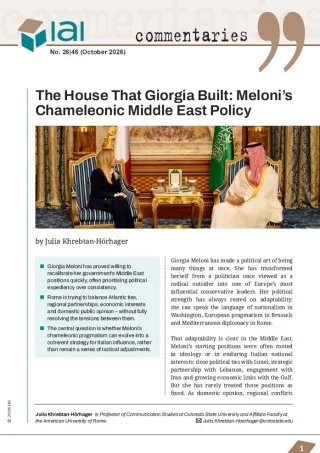
Giorgia Meloni has made a political art of being many things at once. She has transformed herself from a politician once viewed as a radical outsider into one of Europe’s most influential conservative leaders. Her political strength has always rested on adaptability: she can speak the language of nationalism in Washington, European pragmatism in Brussels and Mediterranean diplomacy in Rome.
That adaptability is clear in the Middle East. Meloni’s starting positions were often rooted in ideology or in enduring Italian national interests: close political ties with Israel, strategic partnership with Lebanon, engagement with Iran and growing economic links with the Gulf. But she has rarely treated those positions as fixed. As domestic opinion, regional conflicts and relations with Washington have shifted, Meloni has adjusted Italy’s posture with a degree of political ruthlessness. Each story reveals the same chameleonic instinct: an ability to adapt quickly to changing circumstances, even when the resulting policy does not add up to a coherent whole. The response to the recent verdict on Giulio Regeni’s kidnapping and murder in Egypt will test the limits of Meloni’s chameleonic foreign policy.
Israel: From alignment to recalibration
Meloni’s position toward Israel is the strongest case in point. Her government initially cultivated exceptionally close relations with Israel. For a leader of a party with roots in Italy’s post-fascist right, this helped demonstrate a decisive break with the past. Meloni has repeatedly condemned antisemitism and the racial laws of the Fascist regime. Yet strong support for Israel did not necessarily correspond to public opinion at home. As the conflict in Gaza dragged on, Italian public opinion moved against Israel, creating growing political pressure on Meloni. A 2026 Pew Research Center survey found that 75 per cent of Italians held an unfavourable view of Israel, up from 66 per cent per cent in 2025. In April 2026, following growing criticism of Israeli military actions in Gaza and Lebanon and tensions after an incident involving Italian UN troops, Italy suspended the automatic renewal of its defence cooperation agreement with Israel.
Meloni has not become an anti-Israel leader. Italy continues to recognise Israel’s security concerns and maintains diplomatic relations with the government. Foreign Minister Antonio Tajani has simultaneously emphasised support for Israel’s security and the creation of a Palestinian state, while positioning Italy as a facilitator between Israel and Lebanon. That apparent contradiction is precisely the point. Italy’s recalibration toward Israel does not amount to a strategic break: Meloni is trying to have it both ways. The Italian government wants to appease its public opinion and regional partners, while cultivating its relationship with Israel. The latter remains important for security, defence, technology and Italy’s wider ties with the United States. Meloni has no intention of sacrificing any of this.
From Jerusalem to Beirut
The other side of Italy’s balancing act over Israel is Lebanon. In August, Lebanese President Joseph Aoun came to Rome and thanked Meloni for Italy’s support. Their discussions focused on southern Lebanon, continuing Israeli attacks and the future of UNIFIL, the UN peacekeeping mission in which Italy has one of the largest contingents. This gives Italy an established presence on the ground and a strong voice in discussions with Tel Aviv, Washington and European capitals. But that role comes with a dilemma.
Italy cannot present itself as a credible interlocutor in Lebanon while ignoring what Lebanese leaders see as Israeli violations. But Meloni cannot simply abandon Israel without damaging a relationship she has spent years cultivating. Italy’s role rests on its ability to maintain channels with both sides. In a sense, this revives an old tradition of Italian Middle East diplomacy: “equivicinanza” – not equidistance from the parties, but an effort to remain close enough to both to preserve dialogue and influence. That is the essence of Meloni’s pragmatism: her objective is not to eliminate the contradictions, but to make them diplomatically useful.
Meloni’s Trump test
Iran brings the same balancing act into even sharper focus. Meloni had made political proximity to Donald Trump one of the pillars of her international strategy. But the US war with Iran exposed the limits of that choice. At first, her government stopped short of either supporting or condemning Washington’s actions. As the conflict dragged on, however, Meloni began to distance Italy more clearly from the US position – part of a broader deterioration in her relationship with Trump.
Italy has strong material reasons to favour de-escalation. Any prolonged confrontation threatens shipping, pushes up energy prices and destabilises a region on which Italy increasingly depends for trade, investment and energy. Meloni’s support for the US campaign was therefore distinctly lukewarm. She made clear that American forces could continue to use bases in Italy within the limits of existing bilateral agreements, but stopped short of allowing them to be used for strikes against Iran and increasingly criticised the war itself. The divergence soon became personal: Trump publicly lashed out at Meloni and blamed her political difficulties on what he described as her failure to support the US war in Iran.
At the same time, Meloni has deepened Italy’s ties with the Gulf monarchies. In January 2025, Italy and Saudi Arabia upgraded their ties to a strategic partnership and signed agreements worth around 10 billion US dollars. Italian exports to Saudi Arabia reached 6.2 billion euros in 2024, up 27.8 per cent from the previous year. The United Arab Emirates (UAE) has become another major market: Italian exports reached about 8 billion euros in 2024, up 19 per cent. During Meloni’s February 2025 visit, the UAE announced plans to invest 40 billion US dollars in Italy and signed more than 40 agreements covering investment, energy, defence, space and technology.
This leaves Meloni balancing interests that do not always sit comfortably together. She wants to preserve the Atlantic relationship and the political capital she has invested in ties with Trump; deepen economic and strategic relations with the Gulf; and at the same time prevent a regional confrontation that would damage Italian economic interests. The response has again been adaptation rather than a clean strategic choice: alignment where possible, distance where necessary, and a constant effort to adjust Italy’s position as circumstances change.
The house that Giorgia built
There is a famous British nursery rhyme, “This is the house that Jack built”, in which each verse adds another element to the same house until everything is connected to everything else. It is a simple rhyme, yet an apt metaphor for the political house Prime Minister Meloni has built.
This is the house that Giorgia built, or tried to build, for Italy’s foreign policy, in the Middle East and beyond. Meloni’s relationship with Donald Trump once appeared to be one of her greatest foreign-policy assets. But the political space between Trump’s America and Europe has become increasingly difficult to occupy.
Similarly, support for Israel helped reinforce Meloni’s relationship with Washington and contributed to her effort to normalise Italy’s conservative government within the transatlantic mainstream. But the political environment in Italy has changed, while the costs of being perceived as unconditionally aligned with Israel have increased.
Egypt now provides an equally important challenge. In September 2026, a Rome court convicted three Egyptian security officials in absentia over the aggravated kidnapping of Giulio Regeni. Meloni’s government has resisted turning the verdict into a broader diplomatic rupture, arguing that maintaining channels with Cairo is essential to pursuing truth and justice. The tension is clear. Egypt is a strategic partner on migration, energy and regional security. But the inability to bring the convicted officials before Italian justice risks making Meloni look weak in the eyes of the Italian public.
This is where the house that Meloni built begins to reveal its growing tensions. On the one hand, the Atlanticism that made Meloni acceptable in Washington and the rejection of antisemitism that helped make that transformation credible. On the other, some long-standing Italian interests and Italian public opinion. This is putting pressure on the same house from within.
The chameleon’s gambit
Meloni is best understood as a politician whose adaptability has been central to her rise and to her government’s ability to navigate competing pressures. She reads the environment, finds the room for manoeuvre and changes the narrative accordingly. That is the logic of the “chameleon”: survival depends on the ability to change. Meloni has turned that instinct into a governing strategy. But the Middle East may test its limits. Lean too far from Israel and Meloni risks Washington; lean too close and she risks losing credibility with Arab actors.
Yet there is a deeper question: what does Italy itself want? A chameleon can survive by changing colours. But foreign policy requires more than mere adaptation. It requires priorities, institutions and a willingness to shape events rather than merely respond to them. Meloni has demonstrated an ability to survive political shifts and exploit diplomatic openings. The next test – in the lead-up to next year’s general election – is whether she can turn that survival instinct into strategy, and Italy from a clever chameleon into an actor with integrity, agency and colours of its own.
Julia Khrebtan-Hörhager is Professor of Communication Studies at Colorado State University and Affiliate Faculty at the American University of Rome.