Titolo completo
Meloni between Trump and Europe: The Limits of Political Adaptability
|
Giorgia Meloni has built her political career by turning contradiction into an asset.
She is Italy’s first woman prime minister, yet she has never presented herself as a feminist. She is the daughter of a single mother from Rome’s working-class Garbatella neighbourhood who turned her outsider biography into political capital, yet once in office has followed a largely mainstream foreign policy course. She is a nationalist who has learned to operate effectively inside the EU; a social conservative who has cultivated an image of female independence; an Atlanticist who supports NATO and Ukraine while maintaining a close relationship with Donald Trump, who is a sceptic of NATO and generally hostile to the EU.
Meloni has repeatedly presented herself as an underdog: someone who came from the political margins and fought her way to the top, almost a story of rags to riches – or, more precisely, an American dream, all’italiana. Her biography is therefore part of her political argument. The girl from Garbatella became prime minister without ever belonging to the traditional establishment. In the United States, this story of individual advancement, personal independence and political rebellion has made her particularly legible to conservative audiences. For a time, this made her exceptionally useful on both sides of the Atlantic. In Washington, she could speak the language of nationalism, immigration control and cultural conservatism. In Brussels, she could present herself as a pragmatic European leader. She could criticise parts of the European establishment while remaining firmly inside its institutions.
This is why the “chameleon” remains a useful description of Meloni: not as a synonym for opportunism, but as a political skill – a form of strategic ambiguity and cultural diplomacy. She does not simply change positions. She recalibrates them, changing the political language through which the same, or subtly adjusted, position is presented.
The difficulty is that the political landscape is changing.
Meloni’s gender politics makes this adaptability particularly visible. Her famous formulation – “I am Giorgia. I am a woman. I am a mother. I am Italian. I am Christian” – transformed personal identity into political identity. Delivered at a 2019 rally, the phrase became arguably the most recognisable slogan of her political ascent. Her femininity is therefore not incidental to her political persona. Yet she has consistently rejected the feminist label. In a recent interview, she argued that feminists had fought “the wrong battles”, including over gender quotas, and emphasised instead the freedom of a woman to become prime minister, even within a society where patriarchy remains normalised.
There is nothing inherently contradictory about rejecting feminism while supporting women’s advancement. But the distinction matters in a country where violence against women remains a profound social problem. In November 2025, Italy’s parliament unanimously approved a law establishing femicide as a specific criminal offence, and Meloni welcomed the measure as an important defence of women’s freedom and dignity. The deeper question is how Meloni understands the causes of women’s vulnerability. Her politics tends to emphasise the exceptional woman who succeeds rather than patriarchy as a structure that limits women collectively. Her model is intensely individualist: I overcame the obstacles; women can overcome them too.
But not every woman can become Meloni.
Her rise is a genuine break with Italy’s overwhelmingly male political history. Yet it does not represent a rejection of the conservative gender order from which that history emerged. Instead, Meloni has found a particularly effective way of making traditionalism compatible with female political power.
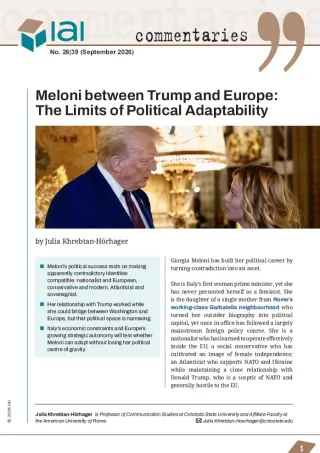
This ability to constantly renegotiate identities explains Meloni’s relationship with Trump. For much of Trump’s second presidency, Meloni appeared to have achieved something no other European leader could quite manage: she could speak Trump’s political language without becoming entirely Trumpian. She could maintain Washington’s confidence while reassuring European partners that Italy remained committed to the transatlantic relationship. Her very noticeable presence at Trump’s second inauguration, where she was the only EU head of government to attend, symbolised this exceptional position.
But the relationship has also exposed the limits of personal diplomacy. In August 2026, Meloni acknowledged that she had expected her relationship with Trump to be easier because of their convergence on immigration and “woke” culture, but that things had turned out differently. She also revealed that the two had not spoken for several weeks. The problem is not simply that two politicians have fallen out. It is that the political gap between “Europe” and “Trump” is becoming wider.
The contradictions are becoming harder to contain. Meloni thought she could be staunchly Atlanticist on Ukraine, defend the pope from Trump’s personal attacks, and still seek common ground with Trump on immigration and “woke” culture, but the Middle East increasingly exposes the limits of such ideological flexibility. The chameleon works best when the colours remain distinguishable; today, they are beginning to collide.
The G7 episode laid bare the limits of this balancing act. After Trump claimed that Meloni had “begged” for a photograph with him, she publicly rejected the allegation, insisting that neither she nor Italy “begs”. For a leader who has built her persona around independence and being “in the driver’s seat”, the suggestion is more than an insult: it reverses the power dynamic. Her proximity to Trump may bring access and visibility, but it does not make the relationship one of equals.
There is also a more material limit to Meloni’s balancing act between Trump and Europe: Italy itself. Meloni’s political language is built around sovereignty, national interest and independence from the EU technocracy, but Italy is deeply embedded in the European economy and constrained by its public finances. Government debt stood at 138.9 per cent of GDP at the end of the first quarter of 2026, the second-highest ratio in the EU after Greece. This does not make Italy weak, as its economy still remains one of Europe’s largest. But economic size is not the same as strategic autonomy. Italy’s fiscal position limits how far national sovereignty can be translated into independent economic policy.
Migration provides another revealing example of how hard it is for Meloni to balance between political and practical needs. Meloni’s government has made irregular migration a central political issue, including through its controversial Albania scheme. Yet Italy’s ageing population and labour shortages make legal immigration economically necessary. In the best neoliberal tradition, the government has therefore opened the door where the economy needs it: almost 500,000 non-EU workers are authorised to enter Italy legally between 2026 and 2028, including 164,850 in 2026.
The contradiction is telling. The political narrative says that migration must be controlled. The economy says that migrants are needed. This is where governing becomes harder than campaigning. Demographics, labour shortages and fiscal constraints do not necessarily vote the way political rhetoric does.
Perhaps the most interesting development is therefore not the cooling of Meloni’s relationship with Trump, but the strengthening of her European role.
The emerging relationship between Meloni and German Chancellor Friedrich Merz – the “Merzoni” pairing – deserves attention. In January 2026, Italy and Germany agreed to strengthen cooperation in security, defence and resilience, while their governments emphasised the need for a stronger European role in a changing international environment. The significance of this relationship is not that Meloni has suddenly become a European federalist. Rather, it suggests that she may be moving towards a different kind of European conservatism: one that wants a stronger Europe because Europe needs greater leverage in a more transactional international system. And this is where the Trump question becomes unavoidable: being simultaneously Washington’s ideological partner and Europe’s strategic interlocutor was once an advantage. It has now become a liability.
If Washington increasingly treats Europe as a competitor, criticises European institutions and pursues an “America First” agenda, a European leader cannot indefinitely serve as both translator and bridge without confronting the interests on either side. Meloni’s political talent has always been her ability to make contradictions appear manageable. She can be nationalist and European, conservative and modern, socially traditional and personally independent, close to Trump and committed to NATO. But political chameleons have a problem when the landscape changes.
So, who is Giorgia, and where is she taking Italy?
The question sounds almost trivial because Meloni herself made it famous “I am Giorgia. I am a woman. I am a mother. I am Italian. I am Christian”. It was an identity statement, a political slogan and eventually a cultural phenomenon. But it was also a promise: a declaration that politics could be organised around an authentic, recognisable self.
Today, the question has acquired a different meaning. Who is Giorgia when she speaks to Trump? The conservative European who understands his politics? Who is she when she speaks to Brussels? The pragmatic nationalist who can work within Europe? Who is she alongside Merz? A European leader helping to build greater continental autonomy? And who is she at home? The outsider who became the establishment, the traditionalist who became Italy’s first woman prime minister, the political chameleon who has made contradiction itself a governing strategy?
Meloni does not need to choose between America and Europe. Italy needs both. But she may soon have to choose where Italy’s political centre of gravity lies. Her greatest political achievement has been to make seemingly incompatible identities coexist. Her greatest challenge may be that the world in which they could coexist is disappearing. Meloni has made a political art of being many things at once: nationalist and European, conservative and modern, Atlanticist and sovereignist. But the world that allowed these contradictions to coexist is changing. The real test of her political adaptability is therefore no longer whether she can change colours, but whether she can decide where Italy is going or, better, where she wants to steer it.
Julia Khrebtan-Hörhager is Professor of Communication Studies at Colorado State University and Affiliate Faculty at the American University of Rome.