Titolo completo
The Heavy Price of the Iran War on the Energy Markets – and Beyond
|
The war in the Persian Gulf has spread throughout the Middle East region and threatens global energy security, as 30 per cent and 17 per cent of the world’s oil and gas production are concentrated there.
The military action was preceded by strong political tension and a concentration of US naval forces in the area, while diplomatic talks were taking place in Geneva. According to US Secretary of State Marco Rubio, Israel’s decision to attack Iran precipitated US intervention.
The conflict has soon taken an unexpected, bloody and possibly prolonged trajectory. The bombings by the US and Israel have been devastating and have not diminished so far. Iran, however, has responded and is showing resilience. The assassination of Ayatollah Khamenei, the explicit threat to assassinate his successor and to seek the annihilation of the Islamic Republic, has elevated the conflict to one of survival for Tehran.
It seems that Trump underestimated the situation in Iran, thinking that after Khamenei’s assassination, the “Venezuela model” could be applied, installing a government under US tutelage. He has said this time and again, but the Iranian response shows that this will not be the case.
The impact on the energy markets
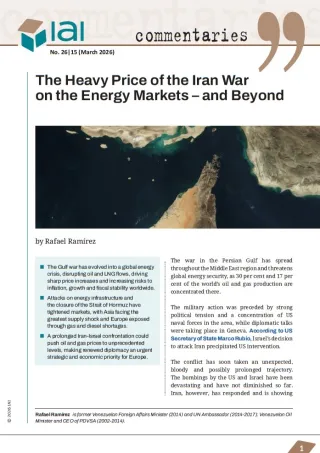
While Israel is bombing Lebanon, Iran has decided – for the first time – to strike those Gulf countries that host US bases or that it considers legitimate targets, turning the conflict into a regional one. Iran’s military response includes attacks on oil and gas facilities, as well as the closure of the Strait of Hormuz, through which 20 per cent of global oil and liquefied natural gas (LNG) exports pass, causing an 80 per cent decrease in traffic through the Strait since the beginning of the conflict and tension in the market.
The increase in oil prices during the first week of the conflict has been 35 per cent for WTI and 27 per cent for Brent. Market operators thought that the conflict would be short-lived and of a similar intensity to that of July 2025. However, this perception has changed and at the start of the second week of the conflict, oil prices opened at peaks of 117 and 120 dollars per barrel, before settling at 100 dollars per barrel – that is, an increase or “war premium” of between 30 and 40 dollars per barrel, which means instability.
Despite the abundant supply of oil on the market, the evolution of the conflict, the closure of the Strait of Hormuz and the attacks on oil facilities in the region have set off alarm bells: with demand at 105 million barrels per day, any restriction on supply will put upward pressure on prices.
On 3 March, Iraq announced a cut of 1.5 million barrels in its production; four days later, Kuwait Petroleum announced “force majeure” on its oil exports, followed by Bahrain within of two days. On 2 March, Qatar announced the total suspension of its LNG production and exports, which has caused the price of gas in Europe to skyrocket by 75 per cent. Finally, on 10 March, Bloomberg reported that Saudi Arabia, Iraq, the United Arab Emirates and Kuwait had reduced production by 6.7 mbd, while Saudi Aramco warned of a market “catastrophe” if the Strait of Hormuz was not unblocked.
The closure of the Strait of Hormuz affects all Gulf countries, bolstering diplomatic efforts to end the conflict – or turn it into an international one. President Trump said that his naval forces will escort tankers crossing the strait and offered insurance through the US International Development Finance Corporation. France also proposed sending a naval force to ensure passage through the Strait.
In parallel, on 7 March, Israel attacked tank farms in Aghdasi, Shahran and Karaj and the Tehran refinery, prompting an Iranian response with an attack on the Haifa refinery in Israel. These attacks on oil infrastructure follow on those that occurred on 2-3 March at the Fujairah terminal, the Ras Tanura refinery in Saudi Arabia and the Ras Laffan and Mesaieed LNG facilities in Qatar, which were forced to halt operations.
The impact on the economy
The effects of rising and unstable oil and LNG prices have been felt globally, raising fears about economic performance and inflation, which in turn will have political and fiscal impacts on major consumer economies. In the US, fuel prices rose by 20 per cent (diesel by 30 per cent), which is hurting Trump’s electoral prospects ahead of the midterm elections in November. Faced with the prospect of a prolonged conflict, IMF President Kristalina Georgieva stated: “My advice to policymakers in this new global environment? Think the unthinkable and prepare for it.”
Both OPEC+ and the IEA have sent reassuring messages to the market, the former announcing a production increase of 200 thousand barrels per day from April and the latter releasing strategic reserves. On 10 March, at a joint meeting between the G7 and the IEA, it was decided to release 400 million barrels from strategic oil reserves, the largest volume in history. However, a greater effect on economic operators was generated by Trump’s successive statements on 9-11 March insisting that the war would “end very soon”, which hinted that he was seeking a way out of the conflict at low political cost. This possibility caused oil prices to fall and remain below the psychological threshold of 100 dollars per barrel, although still fluctuating due to instability, while gas in Europe fell by 20 per cent.
However, the market remains unstable, as Gulf producing countries have been prevented from crossing the Strait of Hormuz and their tankers remain safely in their terminals or outside the conflict area, while attacks on oil facilities in the region continue.
Market adaptation
At the same time, the oil market is resilient enough to adapt to geopolitical shocks, albeit at a high initial cost. With the conflict in the Persian Gulf and the closure of the Strait of Hormuz, the markets in Asia and Europe are the most affected. The supply of oil and related products crossing the Strait of Hormuz is 21 million barrels per day (mbd), of which 14.7 mbd is oil and 6.1 mbd is related products. Of the oil volumes, 74 per cent goes to China, India, Japan and South Korea.
Undoubtedly, a restriction of this magnitude causes a redirection of oil flows and competition for these volumes to meet demand, with an impact on freight costs and the price of energy. However, each market has its own (mainly political) restrictions.
The main alternative supplier to meet part of this oil demand in Asia, particularly in China and India, is Russia, which maintains production at 9 mbd, despite the massive sanctions imposed on Moscow by Western countries after the invasion of Ukraine in 2022. The Chinese and Indian markets will absorb as much Russian oil as they can, especially now that the White House has lifted restrictions on India importing Russian oil for 30 days.
The European market is less affected. 3.2 mbd of oil (2 mbd) and products (1.2 mbd) flow to Europe across the Strait of Hormuz. Oil imports account for 22 per cent of the total, while products, especially jet fuel and diesel, which are essential for transport, account for 15 per cent. However, for Europe, alternative supplies are hampered by EU sanctions against Russia, including the January 2026 bans on products containing Russian crude oil, which have pushed up prices, especially as Europe has a structural deficit in diesel.
As for the gas market, 75 per cent of LNG exports go to Asia, mainly to China, Japan, South Korea and India. The blockade of the Strait of Hormuz is causing a substantial price increase due to the fact that this market has little capacity to adapt to geopolitical impacts.
Again, the blockade mainly affects Asian economies, which, despite having long-term contracts with Qatar, will seek to secure larger volumes of LNG or substitute fuels.
Although Europe only receives approximately 7 per cent of its LNG volumes from Qatar, the conflict coincides with a seasonal decline in the continent’s gas inventories and subsequent competition with Asia for supplies, which explains the 75 per cent rise in gas prices since the start of the conflict.
Also for natural gas, political restrictions prevent greater volumes from being made available to make up for the shortfall of supply from the Persian Gulf.
Outlook
A conflict that involves Iran and Israel could be prolonged and as destructive as they are capable of (and allowed to make it), since they both see this as an existential conflict. Israel has military air superiority and – currently – the unrestricted support of the US, thus the prospects for damage to Iran are enormous. Tehran’s response is already being felt throughout the whole region, in order to raise the costs of the aggression.
The price of oil and gas could then reach unprecedented levels, depending on the extent and severity of the conflict, including the closure of the Strait of Hormuz. And yet, the consequences for the global economy of a prolonged war scenario should be an incentive to seek a diplomatic solution.
Although the US is now the world’s largest oil producer and second-largest LNG exporter, meaning the “deterrent” of oil no longer directly affects its decisions, the effect of oil prices is global. The impact that the war is already having on the US, with rising fuel prices, should be an incentive for Trump to seek a cessation of hostilities, forcing Israel to stop the war.
Faced with this new crisis – a kind of “déjà vu” for Europe – the EU does not have a single, firm position on the conflict, unlike what happened with Ukraine, even though international law has been violated in both conflicts. Relaunching diplomatic efforts should be a political and economic priority for Europe. After all, what is at stake is no less than a new world order, with new doctrines and rules that threaten peace.
Rafael Ramírez is former Venezuelan Foreign Affairs Minister (2014) and UN Ambassador (2014-2017); Venezuelan Oil Minister and CEO of PDVSA (2002-2014).