Titolo completo
The Case for an EU–Indo-Pacific Critical Maritime Infrastructure Partnership
|
Critical maritime infrastructure (CMI) such as undersea communication cables, port facilities and energy conduits underpins the modern global economy, enabling over 95 per cent of international data traffic. CMI therefore bears momentous implications for international security broadly understood. For all its importance, however, the security of this complex infrastructure is uneven and highly dependent on regional contexts. In an increasingly volatile strategic landscape, damage to undersea cable networks or other maritime infrastructure can rapidly affect communication, trade, and state prerogatives more in general, as evidenced by recent incidents across both Europe and the Indo-Pacific (the Baltic,[1] the Red Sea[2] and the Taiwan Strait).[3]
The maritime domain’s critical infrastructure faces a spectrum of threats ranging from environmental accidents and blue-water crime to deliberate attacks and grey-zone operations,[4] which require coordinated multilateral responses to address them effectively.[5] The main challenges lie in the difficulty of actively patrolling large bodies of water, effectively tackling attribution problems, and acknowledging that different actors possess different technical capabilities.
In other words, malicious state (or state-affiliated) actors engaging in grey-zone activities or fully-fledged hybrid warfare – chiefly Russia and China, more rarely Iran-backed militias – exploit the maritime environment’s opacity and complex governance to challenge infrastructure resilience, blurring lines between civilian and military targets. Given that both key shipping lanes and sea cables span from European to Indo-Pacific waters, infrastructure security is rapidly emerging as a major, joint Europe–Indo-Pacific concern. Moreover, it should not go unnoticed that such waters are invariably security flashpoints (see Figure 1), as they comprise the Gulf of Aden and Bab el-Mandeb, the Gulf of Oman and the Strait of Hormuz, the South China Sea and the East China Sea.[6]
Figure 1 | The nexus between four key regional flashpoints and their sea cable-intense areas
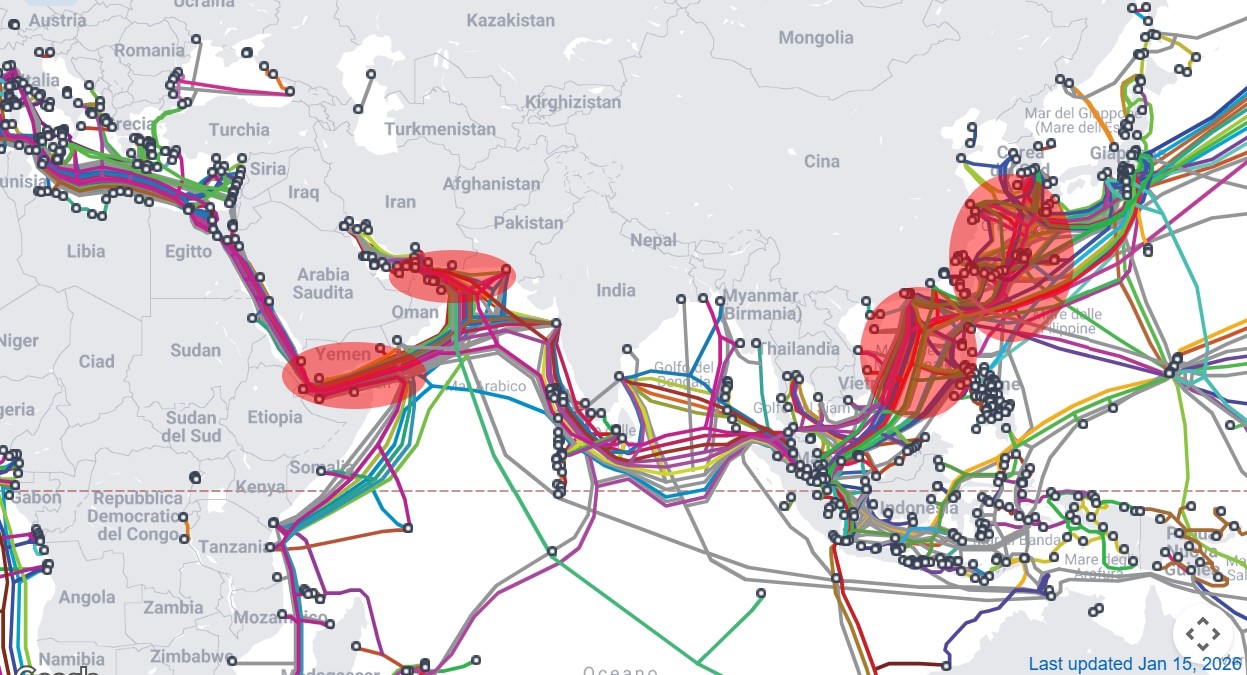
Source: map from TeleGeography modified by the author in terms of size and content.
As a consequence, for regions with a high intensity of incidents, such as Europe and the Indo-Pacific, defending the integrity of such infrastructure is not just a technical challenge but a geopolitical imperative that links infrastructural and economic stability with national security and regional stability. Consequently, a new transregional platform aiming at addressing such risks while enhancing cooperation, dubbed here the EU–Indo-Pacific Critical Maritime Infrastructure Partnership (EUIP-CMIP), is presented here as a potential solution.
EUrope–Indo-Pacific cooperation and its limits
The two regions display numerous and growing instances of transregional cooperation.[7] To begin with, the EU has spearheaded a number of initiatives spanning the economic, political and security areas. Key examples include the EU Global Gateway, the EU Strategy for Cooperation in the Indo-Pacific and its seven priorities (prosperity, green transition, ocean governance, digital governance, connectivity, defence and human security),[8] the yearly EU-Indo-Pacific Ministerial Forum, formal cooperation with Indo-Pacific institutions such as the Association of Southeast Asian Nations (ASEAN) and the Indian Ocean Rim Association (IORA), several free trade agreements between the Union and Indo-Pacific nations (both concluded and under negotiation) and bilateral defence partnerships such as those with Japan, Australia and India. Additional initiatives, which more directly address CMI, comprise the EU Maritime Security Strategy[9] and cooperative initiatives like EU CRIMARIO (Critical Maritime Routes in the Indian Ocean),[10] which reflect growing recognition that infrastructure protection ought to integrate defence, diplomacy and infrastructure resilience across interconnected regions.
Such efforts are further supported by individual EU member states, many of which interact and cooperate with the Indo-Pacific and its countries with varying degrees of intensity. To name the most prominent examples, Europe’s “big four” (France, the UK, Germany and Italy) engage with the region with significant initiatives, both bilateral and multilateral, across the economic, political and security spheres. The continent’s middle powers, too, are increasingly interacting with the world’s new geopolitical and geoeconomic epicentre, as evidenced by the unfolding foreign policies of the Netherlands, Sweden and, to a lesser extent, Spain. Moreover, Europe’s smaller powers are gradually pivoting to the Indo-Pacific as well, as attested by Czechia, Lithuania and Ireland, all of which have published regional strategies. With the exception of these three countries, all the aforementioned European states are contributing to the Indo-Pacific’s freedom of navigation and overflight, capacity building and naval diplomacy.[11]
However, for all this remarkable growth in EUrope–Indo-Pacific cooperation, several major limitations persist. First, internal divisions in terms of European states’ economic and technological strategy, which directly impacts security cooperation. Second, the fragmentation of Europe’s defence industry. Third, the risk of alienating Indo-Pacific states or institutions if the EU is perceived to be too close to the US’s regional goals. Fourth, internal disagreements over investment and deployment priorities, including failure to build redundancies. Fifth, weakened transatlantic cooperation in the Indo-Pacific due to the unpredictability of the US under the second Trump administration. Sixth, strategic distraction due to nearer crises (e.g. Ukraine, MENA, Sahel, Palestine-Israel, Red Sea). Lastly, the limited military readiness and technical capability of some European countries.[12] While these risks already exist and have not curbed EUrope–Indo-Pacific cooperation so far (if anything, the latter has grown), they might pose newer obstacles in the future, especially when trying to face complex challenges to CMI.
A potential EU–Indo-Pacific Critical Maritime Infrastructure Partnership
To address the above, an EU–Indo-Pacific Critical Maritime Infrastructure Partnership (EUIP-CMIP) is here advanced as a potentially-useful initiative. Its goal would be to create an EU-driven and partner-led platform fostering the following activities: i) pooling maritime domain awareness; ii) strengthening both military and civilian maritime interoperability; iii) sharing legal and technical expertise; iv) boosting capacity building and resilience (redundancy, routing, hardening, emergency repair, etc.); v) formalising joint maritime governance; and vi) providing targeted finance to better deter, detect, attribute and address hybrid attacks – and accidental or natural damage – across European and Indo-Pacific sea spaces.
To gradually achieve these objectives, EUIP-CMIP ought to rely on eight key components:
1. An EU–Indo-Pacific Legal Forum, whose aim would be to produce the overarching cooperation agreements, guidance on lawful countermeasures and stronger capacity-building for maritime prosecutors, coast guards and regulatory agencies.
2. Tailored financing systems, such as grants or soft loans for redundancy projects aimed at small island and vulnerable states with less developed technical capability. This could be done by leveraging institutions such as the European Investment Bank, the Asian Development Bank, the African Development Bank, or the World Bank, as well as national institutions or sovereign funds from participating countries investing in EUIP-CMIP.
3. Two EUIP-CMIP pilot hubs – one in the Indian Ocean and one in the Pacific Ocean – integrating automatic identification system, hydroacoustic sensors, seabed survey data, satellite imagery, commercial undersea mapping and operator telemetry. The two hubs’ data would be shared with all partner countries on an automated basis and would be staffed and operated 24/7 by both European and Indo-Pacific analysts.
4. Public-private partnerships, to gather cable operators, telecom, shipping and offshore energy firms, insurers and governments to share threat intel, incident reporting and co-finance resilience measures.
5. Recommended resilience standards, such as best practice-based routing planning, burial depths, markings on charts, exclusion zones, hardening for fixed platforms, etc.
6. Joint technical rapid-response and repair teams (specialised survey ships, remotely operated vehicles, cable repair vessels, etc.). These would be deployed in both real emergencies and joint drills to enhance operational readiness and capacity building.
7. Coordinated international initiatives, building on the Legal Forum and the public-private partnerships, to conceive multilateral proposals clarifying norms on undersea infrastructure protection, acceptable state behaviour and transregional cooperation.
8. Joint exercises, training and capacity building, complementing the other economic and political initiatives through joint technical deployments, forensic salvage, incident attribution workshops, technical papers, legal training and information-security best practices for operators. Additionally, scholarships and secondments for Indo-Pacific partners into EU technical centres and vice versa would further strengthen transregional cooperation.
Membership of EUIP-CMIP would comprise the EU itself and EU countries on a voluntary basis, in addition to willing member states of relevant Indo-Pacific organisations such as ASEAN+6 (which also comprises Australia, China, India, Japan, South Korea and New Zealand), IORA, and the Pacific Island Forum. This broad configuration would not only allow for a highly diverse membership, but would also contribute to more effectively pooling the expertise of technically advanced states with the goal of supporting more vulnerable nations.
In terms of governance, EUIP-CMIP could draw on the experience of existing platforms such as NorthSeal and be steered, in this case, by a board comprising three main groupings, namely European, Indo-Pacific and industry representatives. Decisions and data would be either unclassified, for wider sharing, or classified, thus restricted to authorised partners. Inclusive participation – often a challenge for smaller states – would be ensured by rotation-based representation in the steering board. The partnership’s output indicators would need to prove tangible improvements in addressing CMI risks, and would need to comprise parameters such as the average time that is necessary to identify and classify undersea incidents, the average time required to begin the first repair, the number of public and private actors adopting EUIP-CMIP resilience standards, the number of capacity-building events and trained personnel, and, more broadly, the reduction in service outage durations for the two pilot regions.
Looking ahead
The hypothetical EU–Indo-Pacific Critical Maritime Infrastructure Partnership proposed here recognises that collaborative efforts are becoming essential to uphold freedom of navigation, safeguard trade routes and global value chains, and mitigate the asymmetric risks that continue to arise in an increasingly contested global order. It is understood that its ambitious goals are riddled with difficulties, chiefly revolving around the substantial political, legal, financial and technical challenges that lie behind such a complex project. Even so, EUIP-CMIP – or a comparable platform – would openly serve European and Indo-Pacific interests while further elevating their level of cooperation. In this respect, there is some reason for cautious optimism, since the dedicated ministerial meeting at the Council of the European Union, for which this research was prepared, included 70 between senior European and Indo-Pacific public servants (deputy prime ministers, foreign ministers, ambassadors), all of whom agreed on the necessity to tackle challenges to CMI jointly, effectively and within reasonable time frames.[13] With this shared desire in mind, this brief hopes to contribute to such ongoing discussions with an innovative yet feasible proposal.
Gabriele Abbondanza is Assistant Professor of International Relations at Comillas Pontifical University, Associate Fellow at the Istituto Affari Internazionali (IAI) and GEMI Researcher at the Complutense University of Madrid.
This brief draws on the author’s research prepared for a dedicated ministerial meeting at the Council of the European Union, which took place on 21 November 2025 as part of the 4th EU Indo-Pacific Ministerial Forum. The author wishes to thank Yves Postec, Nelly Ratabou and the entire ESIWA+ team for their kind invitation and excellent work, as well as Karolina Muti for facilitating the connection.
[1] Cassetta, Marco, “How to Respond to the Emerging Threats to Critical Underwater Infrastructure at the Time of Russia’s War Against Ukraine”, in IAI Commentaries, No. 24|31 (June 2024), https://www.iai.it/en/node/18635.
[2] Leccese, Giacomo, “Chokepoint Above and Below the Surface: The Red Sea’s Emerging Infrastructure Challenge”, in IAI Briefs, No. 25|08 (December 2025), https://www.iai.it/en/node/21206.
[3] Insisa, Aurelio, “What Lies Beneath: Hybrid Threats to Taiwan’s Submarine Cables and the Contest in the Information Domain”, in IAI Papers, No. 26|01 (January 2026), https://www.iai.it/en/node/21439.
[4] Bueger, Christian and Tobias Lievetrau, “Critical Maritime Infrastructure Protection: What’s the Trouble?”, in Marine Policy, No. Vol. 155 (September 2023), Article 105772, https://doi.org/10.1016/j.marpol.2023.105772.
[5] Cannon, Brendon J. et al., “Mapping Undersea Cable Risk from Bathymetry to Geopolitics: Evidence-Based Rankings and Tailored Resilience Strategies”, in Marine Policy, Vol. 186 (April 2026), Article 107012, https://doi.org/10.1016/j.marpol.2025.107012.
[6] See the useful and up-to-date maps provided by TeleGeography in Submarine Cable Map: https://www.submarinecablemap.com.
[7] Abbondanza, Gabriele and Thomas Wilkins, “Europe in the Indo-Pacific: Economic, Security, and Normative Engagement”, in International Political Science Review, Vol. 45, No. 5 (2024), p. 640-646, https://doi.org/10.1177/01925121231202694.
[8] European External Action Service (EEAS), EU Indo-Pacific Strategy, 6 November 2024, https://www.eeas.europa.eu/node/445611_en.
[9] European Commission DG for Maritime Affairs and Fisheries website: Maritime Security Strategy, https://oceans-and-fisheries.ec.europa.eu/node/1730_en.
[10] EU CRIMARIO website: Mission and Objectives, https://crimario.eu/?p=149.
[11] Abbondanza, Gabriele and Gorana Grgić, Europe’s Indo-Pacific Pivot. Navigating New Horizons, Singapore, Palgrave Macmillan, 2025, https://doi.org/10.1007/978-981-95-0273-8.
[12] Abbondanza, Gabriele and Gorana Grgić, “Fragmentation, Distractions Weaken Europe’s Indo-Pacific Pivot”, in The Strategist, 27 November 2025, https://www.aspistrategist.org.au/?p=97442.
[13] EEAS, Working Together to Protect Critical Maritime Infrastructure in the Indo-Pacific, 20 November 2025, https://www.eeas.europa.eu/node/458765_en.