Titolo completo
Breaking the “Walled Garden”: The Challenge of Interoperability under the EU’s Digital Markets Act
|
The implementation of the new digital regulatory framework of the EU has entered a critical phase.[1] After years of legislative development, landmark instruments such as the Digital Markets Act (DMA) have now moved from legislative design to enforcement, putting the EU’s ambition to reshape digital markets to the test. In an increasingly complex international environment – marked by deepening geopolitical tensions and concerns over the broader economic and trade implications of digital development[2] – the central challenge is no longer the adoption of rules, but their consistent and effective enforcement at a pace compatible with rapid technological change.
Although European policymakers have referred to the DMA as a regulatory success story,[3] the first years of implementation suggest that the transition is proving more complex than anticipated. In April 2026, the European Commission published the first statutory review of the DMA,[4]concluding that the Regulation remains fit for purpose, has already generated measurable positive effects and does not require legislative revision.[5] At the same time, the review acknowledged that several provisions are still in the process of being fully implemented, with interoperability emerging as one of the most technically and legally challenging areas.
A growing number of enforcement proceedings are testing the practical application of the DMA. Among them, the investigation launched by the Italian Competition Authority (Autorità Garante della Concorrenza e del Mercato – AGCM) into Apple’s cloud interoperability practices is particularly significant. The case – the first to be initiated at the national level, alongside several proceedings launched by the European Commission – comes at a time when cloud computing services have become an increasingly important component of the DMA framework, reflecting their strategic role in Europe’s digital economy.[6] The investigation provides a first opportunity to reflect on the practical scope of interoperability obligations, the role of national competition authorities within the DMA’s multi-level enforcement architecture, and the extent to which the EU’s emerging model of digital governance can deliver on its objectives.
Enforcing DMA’s obligations
The DMA represents a major shift in the EU’s approach to regulating digital markets, moving from ex post competition enforcement to an ex ante framework that imposes specific obligations on designated gatekeepers – i.e. the largest tech companies that act as vital “gateways” between businesses and consumers. On 6 September 2023, the European Commission designated six gatekeepers: Alphabet (Google’s parent company), Amazon, Apple, ByteDance (TikTok’s parent company), Meta (owner of Facebook, Instagram and WhatsApp), and Microsoft.[7] Since then, additional core platform services have been brought within the scope of the DMA, including Apple’s iPadOS, Booking’s online intermediation service Booking.com and Meta’s online intermediation service Facebook Marketplace,[8] bringing the total number to 23. Moreover, on 25 June 2026, the Commission informed Amazon and Microsoft of its preliminary view that they should also be designated as gatekeepers for their cloud computing services: Amazon Web Services (AWS) and Microsoft Azure (Azure) respectively.[9]
The DMA seeks to ensure that these companies do not leverage their gatekeeper position to foreclose competition or reinforce user dependence within their ecosystems. To this end, it establishes a differentiated system of obligations. Article 5 prohibits specific practices considered inherently unfair – such as combining users’ personal data across core platform services without their consent or preventing business users from offering their products and services through alternative channels. Article 6 aims to reshape the structure of digital ecosystems by requiring changes in how gatekeepers interact with competitors and users – including obligations to ensure interoperability with third-party services, allow the installation and effective use of third-party applications and app stores, and provide business users with access to data generated through their activities on the platform.
Given their technical complexity, many of these requirements cannot be implemented through a purely formal compliance exercise. Instead, they often require an iterative dialogue between the European Commission and gatekeepers themselves and, where appropriate, the adoption of specification measures under Article 8 to clarify how compliance should be achieved in practice. Since the DMA entered into force, the European Commission has opened several investigations, many of which remain ongoing at the time of writing, concerning these obligations (see Annex for details).
Within this framework, Article 6(7) establishes one of the DMA most technically demanding – and highly contested[10] – obligations for the gatekeepers: ensuring free and effective interoperability.[11] This provision obliges gatekeepers to grant third parties access to the same hardware and software functionalities that are available to the gatekeeper’s own hardware and services, under equivalent conditions. A key objective is the so-called “device neutrality”,[12] i.e. to prevent “lock-in” effects that tie users to a specific ecosystem not because of competitive superiority, but due to structural and technical barriers that make switching to other service providers costly or functionally incomplete. Interoperability obligations are intended to lower switching costs and enable “multi-homing”, allowing users to adopt alternative services without losing access to their digital data, settings or applications. In this sense, the DMA explicitly links technical design choices to market outcomes, treating system architecture as a determinant of competitive structure.
The Apple case
Apple represents one of the earliest and most significant test cases for assessing how these obligations will be implemented in practice. The case is not just one single lawsuit; it spans multiple landmark European court rulings, regulatory fines and antitrust investigations over ecosystem interoperability and anti-steering rules. Following the confirmation of its gatekeeper designation by the Court of Justice of the EU on 8 July 2026,[13] Apple is required to ensure interoperability across its core platform services, including iOS and iPadOS. Given the company’s vertically integrated ecosystem, control over the operating system effectively determines the conditions under which third parties – including cloud storage providers, messaging applications, wearable devices and other connected services – can access essential device functionalities.
Rather than providing interoperability by default, Apple has adopted a request-based mechanism under which developers must individually seek access to specific functionalities,[14] retaining considerable discretion in assessing whether individual requests fall within the scope of Article 6(7). According to the company’s transparency reporting, by 22 March 2026, Apple had received 56 interoperability requests since May 2025 and had closed 43 of them. However, 27 decisions remain confidential and, among the sixteen publicly disclosed outcomes, none resulted in the introduction of a new interoperability solution. Ten requests were rejected on technical grounds, two were considered already addressed through existing functionalities and three were deemed to fall outside the scope of the DMA.[15]
In response, the European Commission launched specification proceedings (Case DMA.100204), adopting two binding decisions that specify the measures that Apple must implement to comply with certain aspects of its interoperability obligations, particularly with regard to nine iOS connectivity features predominantly used by connected devices such as smartwatches, headphones and TVs.[16] In addition to that, Apple was required to introduce greater transparency, more predictable timelines and a public tracker for interoperability requests. However, Apple has consistently argued that these obligations entail significant security and privacy risks.[17] According to the company, without appropriate safeguards, granting third parties access to certain functionalities or components of users’ devices could create opportunities for unauthorised access to, theft of, or exposure of personal information. Apple has also warned that interoperability requirements could be exploited by data-driven companies to expand data collection and profiling practices, potentially undermining users' privacy on a broader scale. In its judgment of 8 July 2026, the Court rejected Apple’s arguments that the interoperability obligations infringed its fundamental rights, holding that such claims could not be examined in the context of the gatekeeper designation decision.[18] While the Court did not rule on the substantive interpretation of Article 6(7), it confirmed Apple’s gatekeeper status, leaving the interoperability obligations fully applicable.
Italy’s investigation into Apple’s cloud ecosystem
On 16 June 2026, AGCM launched an investigation into Apple Inc., Apple Distribution International Ltd and Apple Italia, to assess the company’s compliance with the interoperability obligations set out in Article 6(7) DMA, focusing specifically on cloud storage services.[19]
The investigation is significant not only for the subject matter, but also for its institutional implications. While the European Commission retains exclusive competence to adopt decisions under the DMA, Article 38(7) empowers national competition authorities to conduct preliminary investigations. Although these investigations cannot lead to binding decisions, they reflect the cooperative enforcement model underpinning the DMA, combining central enforcement with the technical expertise, investigative capacity and market proximity of national authorities. Italy is the first member state to activate this mechanism following the adoption of Law No. 214 of 30 December 2023, which conferred such investigative powers on the AGCM. The investigation – expected to conclude by March 2027 – will therefore provide an important first indication of how this enforcement architecture operates in practice.
The focus of the investigation is on Apple’s alleged failure to ensure effective interoperability between iOS and iPadOS and competing cloud storage providers. The main argument, according to information collected through the AGCM’s whistleblowing platform, is that Apple restricts third-party providers’ access to the application programming interfaces (APIs) necessary to perform complete device backups. While iCloud can automatically back up application data, device settings, messages and other system information through seamless background processing, competing cloud services remain limited to storing individual files, such as photographs or documents, without access to equivalent system-level functionalities. If confirmed, these technical asymmetries would prevent competing providers of consumer cloud from offering services functionally comparable to iCloud, thereby reinforcing Apple’s ecosystem and increasing users’ dependence on its services.
The case therefore provides the opportunity to clarify the practical meaning of “effective” interoperability under Article 6(7). The issue is not simply whether some degree of access is formally granted, but whether third-party providers of consumer cloud are able to achieve functional equivalence with the gatekeeper’s own services. In other words, interoperability cannot be regarded as effective if competitors receive access that is incomplete, degraded or technically insufficient to compete on equal terms. The alleged restrictions on access to Apple’s APIs are therefore central to determining whether compliance with the DMA requires mere formal access or genuine technical parity. In this respect, the AGCM’s investigation extends beyond a dispute over cloud storage, representing one of the first concrete attempts to assess how technical design choices can shape competition, consumer behaviour and market contestability under the DMA.
Broader implications for DMA enforcement
Beyond its immediate implications for Apple’s cloud services, the Italian investigation provides an early indication of both the challenges and the transformative potential of the DMA as it moves from a regulatory framework towards an effective instrument of digital market governance. Three main points emerge from the case:
• First, the investigation highlights the need to clarify the practical scope and implementation of “effective” interoperability under Article 6(7) DMA. While the provision itself clearly goes beyond formal or purely technical access, the case may help define how far the requirement of effective interoperability extends in specific technical and competitive circumstances. At the same time, the way in which Apple ultimately responds to the Commission’s requirements will provide an important test of the credibility and effectiveness of the DMA enforcement framework.
• Second, the investigation constitutes an important test of the DMA’s cooperative enforcement model, highlighting the role that national competition authorities can play in assisting the European Commission through technically complex and evidence-based assessments. While this decentralised approach may enhance the effectiveness and responsiveness of DMA enforcement, it also raises questions concerning the consistency of enforcement practices across member states and the extent to which particularly active national authorities may, through their technical assessments and case work, contribute to shaping the practical interpretation and application of the DMA at the EU level.
• Third, the case illustrates the growing connection between competition policy, consumer protection and the behavioural dynamics of digital markets. Interoperability should not be viewed solely as a technical obligation, but as a policy tool aimed at limiting dependency on dominant digital ecosystems, strengthening user choice, and enabling consumers and businesses to access alternative services without facing artificial barriers to switching.
The implications of the case extend well beyond Apple and the cloud storage sector. As digital ecosystems increasingly rely on the integration of hardware, software, data and infrastructure layers, the principles emerging from this investigation may shape future enforcement debates concerning app stores, artificial intelligence services, digital assistants, connected devices and other critical platform services. More fundamentally, the DMA enforcement agenda reflects the growing convergence between competition policy and digital sovereignty: in digital markets, openness increasingly depends not only on access to individual services, but also on the infrastructures and technical conditions that determine portability, interoperability and the ability of users and businesses to move across ecosystems. In this sense, promoting interoperability to reduce user lock-in is not an end in itself, but an instrument for fostering more open and contestable digital markets. By lowering barriers to entry and expansion, these obligations aim to create more favourable conditions for providers – particularly European ones – to compete with the dominant non-EU platforms that continue to hold significant market power, at the same time expanding users’ ability to choose alternative digital services without being constrained by proprietary ecosystems.
Annex | Cases filed and decided under articles 5 and 6 DMA
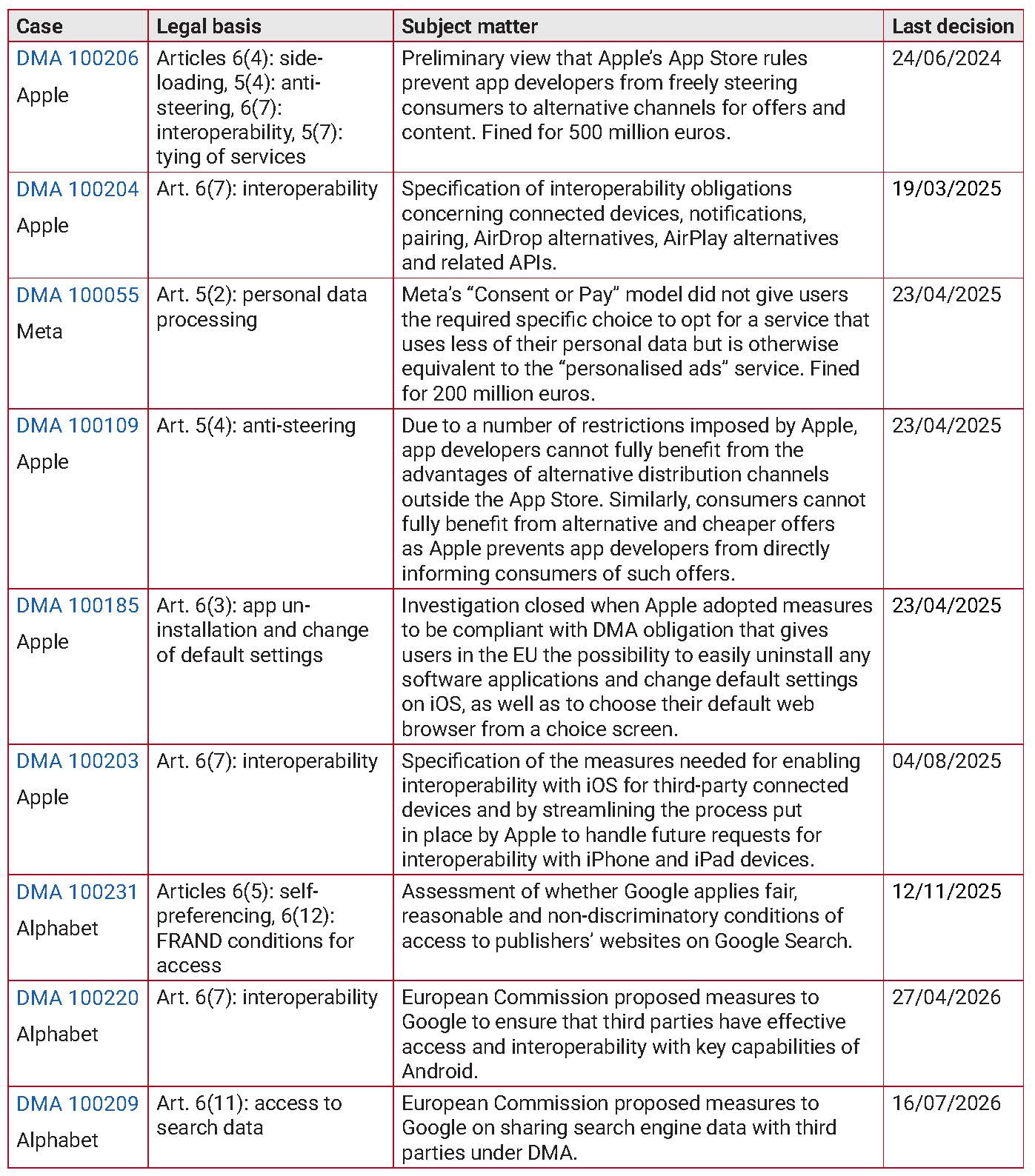
Source: Author’s elaboration using the filtering option on the European Commission Competition Policy portal.
Federica Marconi is Research Fellow for Digital Governance in the Geoeconomic and Global Governance programme at the Istituto Affari Internazionali (IAI).
[1] Interoperable Europe Portal: Landscape of EU Digital Regulations, https://interoperable-europe.ec.europa.eu/node/734343.
[2] Pollet, Mathieu, “EU Plots Long Game against US Digital Supremacy”, in Politico EU, 3 June 2026, https://www.politico.eu/?p=8529995.
[3] Parry, Jacob and Laura Greenhalgh, “The EU’s Big Tech Rulebook Is Shifting the Digital Economy, Says Ribera”, in Politico EU, 10 April 2026, https://www.politico.eu/?p=8251520.
[4] European Commission, Commission Staff Working Document Accompanying the Report on the Review of Regulation (EU) 2022/1925 on Contestable and Fair Markets in the Digital Sector…, 28 April 2026, https://eur-lex.europa.eu/legal-content/en/TXT/?uri=celex:52026SC0123.
[5] Kirkwood, Megan, “What the EU’s First Digital Markets Act Review Actually Changes”, in Tech Policy Press, 30 April 2026, https://www.techpolicy.press/what-the-eus-first-digital-markets-act-review-actually-changes.
[6] European Commission DG for Communications Networks, Commission Reaches Preliminary Position that Amazon’s and Microsoft’s Market Leading Cloud Services Should Be Designated under the DMA, 25 June 2026, https://digital-strategy.ec.europa.eu/en/node/16993.
[7] European Commission, Digital Markets Act: Commission Designates Six Gatekeepers, 6 September 2023, https://ec.europa.eu/commission/presscorner/detail/en/ip_23_4328.
[8] European Commission, Commission Designates Apple’s iPadOS under the Digital Markets Act, 29 April 2024, https://ec.europa.eu/commission/presscorner/detail/en/ip_24_2363; Commission Designates Booking as a Gatekeeper and Opens a Market Investigation into X, 13 May 2024, https://ec.europa.eu/commission/presscorner/detail/en/ip_24_2561; Commission Finds Apple and Meta in Breach of the Digital Markets Act, 23 April 2025, https://ec.europa.eu/commission/presscorner/detail/en/ip_25_1085.
[9] European Commission, Commission Reaches Preliminary Position that Amazon’s and Microsoft’s Market Leading Cloud Services Should Be Designated under the DMA, 25 June 2026, https://ec.europa.eu/commission/presscorner/detail/en/ip_26_1444; Datta, Anupriya, “Amazon and Microsoft Cloud Services Targeted under EU Big Tech Rules”, in Euractiv, 25 June 2026, https://www.euractiv.com/news/amazon-and-microsoft-cloud-services-targeted-under-eu-big-tech-rules.
[10] Yagi, Teruki, “The ‘Exit Penalty’: Why the DMA’s Interoperability Rules Fail the Reality Test of Platform Migration”, in Internet Policy Review, 20 February 2026, https://policyreview.info/node/2086.
[11] European Commission website: Interoperability, https://digital-markets-act.ec.europa.eu/node/86_en.
[12] Colangelo, Giuseppe and Alba Ribera Martínez, “Vertical Interoperability in Mobile Ecosystems: Will the DMA Deliver (What Competition Law Could Not)?”, in International Review of Law and Economics, Vol. 83 (2025), Article 106267, https://doi.org/10.1016/j.irle.2025.106267.
[13] Court of Justice of the EU (CJEU), Judgment of the General Court of 8 July 2026 in Cases T-1079/23 and T-1080/23: Apple Inc. v European Commission, https://eur-lex.europa.eu/legal-content/en/TXT/?uri=celex:62023TJ1079.
[14] Free Software Foundation Europe (FSFE), Apple Keeps Challenging Its Interoperability Obligations under the DMA, 20 April 2026, https://fsfe.org/news/2026/news-20260420-01.html.
[15] Presutti, Dario et al., The Challenges of Regulating Interoperability. Analysing Apple’s Request-based Approach under the Digital Markets Act, Berlin, FSFE, April 2026, p. 10, https://download.fsfe.org/campaigns/device-neutrality/FSFE-DMA-AppleReport-v1.pdf.
[16] European Commission, Commission Provides Guidance under Digital Markets Act to Facilitate Development of Innovative Products on Apple’s Platforms, 19 March 2025, https://ec.europa.eu/commission/presscorner/detail/en/ip_25_816.
[17] Apple, It’s Getting Personal. How Abuse of the DMA’s Interoperability Mandate Could Expose Your Private Information, December 2024, https://developer.apple.com/support/downloads/DMA-Interoperability-Dec-2024.pdf.
[18] CJEU, Judgment of the General Court of 8 July 2026 in Cases T-1079/23 and T-1080/23, cit.
[19] AGCM, IDMA1: The Italian Competition Authority Launches Investigation into Apple under the Digital Markets Act on the Interoperability of Apple’s Designated Operating Systems iOS and iPadOS with Alternative Consumer Clouds, June 2026, https://en.agcm.it/en/media/press-releases/2026/6/IDMA1.