Titolo completo
A Tale of Two Shores: The EU-UK Reset between Brexit and Brejoin
|
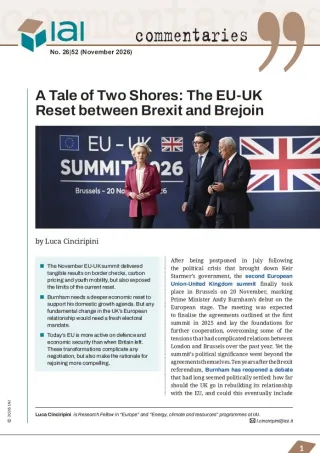
After being postponed in July following the political crisis that brought down Keir Starmer’s government, the second European Union-United Kingdom summit finally took place in Brussels on 20 November, marking Prime Minister Andy Burnham’s debut on the European stage. The meeting was expected to finalise the agreements outlined at the first summit in 2025 and lay the foundations for further cooperation, overcoming some of the tensions that had complicated relations between London and Brussels over the past year. Yet the summit’s political significance went beyond the agreements themselves. Ten years after the Brexit referendum, Burnham has reopened a debate that had long seemed politically settled: how far should the UK go in rebuilding its relationship with the EU, and could this eventually include rejoining the Union? Against this backdrop, the summit produced tangible results but offered few indications about the future direction of the relationship. While London appears increasingly willing to reconsider the limits of its post-Brexit arrangements, Brussels remains interested but cautious about the prospects of deeper integration.
A summit of gains and compromises
The summit confirmed the conclusion of negotiations on three agreements initially envisaged in 2025.
The first concerns sanitary and phytosanitary (SPS) rules, with the aim of removing most certification requirements and routine checks on agricultural and food products traded between the UK and the EU from March 2028. The agreement will require London to align dynamically with relevant EU legislation, while allowing British representatives to contribute to the shaping of new rules without enjoying the decision-making rights of a member state.
The second agreement links the respective emissions trading systems (ETSs), with the aim of exempting goods traded between the two sides from their carbon border adjustment mechanisms from 2028.
The third establishes a Youth Experience Scheme, allowing up to 100,000 young people from each side, aged between 18 and 31, to spend up to three years working, studying or travelling in the other’s territory.
These are not negligible achievements. According to British government estimates, the package could increase UK GDP by up to 0.5 per cent by 2040. However, while removing some of the obstacles created by Brexit, the agreements leave the fundamental structure of the relationship largely unchanged, particularly in areas such as services. Moreover, some of the most contentious issues remain unresolved. The most immediate concerns university tuition fees, with Brussels seeking more favourable treatment for EU students attending British universities. The parties have agreed to conclude negotiations within six months, but differences remain over whether the implementation of the three agreements should depend on a satisfactory settlement of this issue.
Other questions, including British access to the EU’s emerging Made in Europe industrial framework, have been left for further discussion. Security and defence cooperation, meanwhile, has continued to advance, particularly through support for Ukraine and commitments to deepen industrial and capability cooperation, although without a decisive breakthrough on access to European defence financing instruments.
Perspectives from the two shores of the Channel: The UK
For Burnham, the summit produced mixed results. The agreements provide concrete achievements to present to the British public, particularly in economic terms. At the same time, the unresolved tuition fees dispute and the uncertainty surrounding future industrial cooperation illustrate the difficulties that continue to accompany the reset. More importantly, these developments come at a delicate moment in British domestic politics. Since September, Burnham has progressively changed the tone of his approach towards the EU, openly acknowledging that Brexit has done more harm than good and suggesting that all options for the future relationship should be considered, including the possibility of rejoining.
Such statements represent a significant departure from the cautious approach that characterised Starmer’s premiership. The three red lines established in Labour’s 2024 manifesto (no return to the single market, the customs union or freedom of movement) remain in place for the current Parliament. Yet Burnham has effectively reopened a debate that Labour had previously sought to contain. This is not without political risks. Conservatives and Nigel Farage have reacted strongly, seeking to revive the divisions that characterised the Brexit debate. Within Labour itself, there are different views on the timing and political implications of reopening such a contentious question.
Public opinion offers opportunities, but not necessarily an unequivocal mandate. Recent polling suggests growing dissatisfaction with Brexit and greater openness towards rejoining the EU. However, support for a possible return does not automatically translate into agreement on its terms or on whether it should become an immediate political priority. Burnham appears aware of these difficulties. He has acknowledged that rejoining would require a new referendum and that any fundamental change in the UK’s European relationship would need a fresh electoral mandate. At the same time, the summit has arguably demonstrated the limits of what can be achieved within the existing political framework.
The dilemma for Burnham is therefore increasingly evident. He needs a deeper economic reset to support his domestic growth agenda, but achieving significantly greater integration may require him to reconsider the very political constraints that have so far defined Labour’s approach to Europe. The question is whether he will be prepared to take that step, and at what political cost.
Perspectives from the two shores of the Channel: The EU
The EU seems to share the feeling that the summit represents an intermediate step rather than a decisive turning point. The willingness to conclude negotiations on the three agreements despite the unresolved tuition fees dispute suggests an interest in consolidating relations with London and preserving the momentum. Yet the EU cannot simply wait for Burnham to clarify his intentions. It retains considerable influence over the conditions under which closer cooperation can take place, particularly where British access to European markets and programmes requires regulatory alignment or financial commitments. The negotiations themselves offer several examples. The SPS agreement requires British alignment with EU rules without restoring the decision-making powers associated with membership. The possibility of UK participation in the EU’s internal electricity market is similarly linked to a financial contribution towards European cohesion funds. The unresolved discussion over Made in Europe reflects the broader difficulties of reconciling British industrial interests with the EU’s evolving economic-security agenda.
Beyond these negotiations lies a more political question. Brussels has reasons to welcome a more constructive British approach, particularly at a time when cooperation on security, defence and economic resilience is becoming increasingly important. However, the experience of Brexit has also exposed the risks of building long-term arrangements on a British domestic consensus that may prove fragile. Burnham may be willing to reconsider the UK’s European future, but a change of government could once again alter London’s position. For the EU, any prospect of significantly deeper integration would therefore require not only clarity about British intentions, but also sufficient confidence in the durability of the commitments undertaken. Current positions from opposition parties’ leaders are not encouraging in this sense.
European politics, moreover, will not stand still while London debates its options. The electoral cycle beginning in 2027, particularly in France, could reshape the Union’s internal priorities.
Beyond the reset
The summit has delivered something close to the maximum that could be achieved without revisiting the political foundations of the UK’s post-Brexit relationship with the EU. The agreements reached are relevant, but they do not resolve the broader economic difficulties that have progressively pushed London towards reconsidering its European choices. The alternatives, however, are far from straightforward. A customs union could reduce trade frictions but would constrain Britain’s independent trade policy. Participation in the single market would offer potentially greater economic benefits, while requiring a much more extensive acceptance of EU rules and obligations, including free movement. Other forms of differentiated integration could be explored, but neither the Norwegian nor the Swiss model provides an easily transferable solution.
Rejoining the EU remains an even more politically demanding prospect. It would require a new electoral mandate, negotiations with Brussels and an agreement on conditions that would almost certainly differ from those enjoyed by the UK before Brexit. Questions concerning budgetary contributions, the euro, Schengen and the special arrangements previously granted to London would inevitably return to the forefront of the debate.
Yet there is another element worth considering. The Union that the UK would potentially seek to rejoin is increasingly different from the one it left: more active in defence and security, more attentive to industrial protection and economic resilience, and operating in an international environment shaped by growing geopolitical competition. These transformations complicate any discussion about rejoining, but they also reinforce the rationale for closer cooperation. For London, remaining outside decisions that increasingly affect its economic and security interests carries unbearable costs.
Ten years after the referendum, the question is no longer simply how to mitigate Brexit’s economic costs. What level of integration does Britain want with a European Union that has changed substantially since it left? And under what conditions would Brussels be willing to deepen that relationship? The summit has shown that practical cooperation can advance even without answering these questions. Yet it has also made clear why they cannot be avoided indefinitely.
Luca Cinciripini is Research Fellow in “Europe” and “Energy, climate and resources” programmes at the Istituto Affari Internazionali (IAI).