Titolo completo
For Stability, Bahrain and the Gulf Need Democratic Accountability
|
The recent 12-Day War between Israel and Iran represents a watershed moment for the Gulf. On the night of 23 June 2025, air raid sirens blared throughout Bahrain, compelling civilians to seek shelter, with a possible assault on US bases incoming. While Bahrain was spared an attack, the entire region was placed on the verge of a regional conflict as Iranian missiles struck Al-Udeid Air Base in Qatar. This near miss occurred despite support for the US among all Bahrainis having recently declined, with only 12 per cent of respondents considering it a friendly country. In contrast, sympathies towards Iran had grown in recent years, with 52 per cent of Shi’a respondents viewing Iran as a friendly country. Meanwhile, normalisation between Bahrain and Israel is widely unpopular among Bahrainis, with 76 per cent holding negative views on the Abraham Accords. Although voters, even in liberal democracies, do not fully determine their government’s foreign policy, the gulf between Bahrain’s leadership and its people continues to widen, with Bahrainis having few means to voice their concerns or objections.
A spiral of repression
This voicelessness amidst the possibility of war represents a grim reminder to Bahraini voters that they bear the brunt of decisions made by the Bahraini government that its citizens are never consulted on or have agency over, following a trend of wider democratic disempowerment since mass protests were suppressed in 2011. In Bahrain, the two largest opposition parties, Al-Wefaq and Wa’ad, are banned, and thousands had their voting rights revoked. 322 political prisoners remain incarcerated for taking part in the mass protests, with an additional 40 prisoners part of the country’s open prisons programme. In addition, over 1,000 citizens have been arbitrarily stripped of their nationality since 2011. While some have sought asylum in Europe and North America, many continue to face transnational repression from the Bahraini authorities, either in exile or through the harassment of family members in Bahrain.
In the aftermath of the 2011 protests and their suppression via military intervention from the Gulf Cooperation Council, Bahrain and its Gulf neighbours have developed extensive surveillance states, where repression can be levied at any time. In Bahrain, this includes arbitrary arrests, night raids into neighbourhoods and sophisticated digital censorship. In 2023, at least 57 individuals, including 25 minors, were arrested for having attended gatherings in support of Gaza or for having posted pictures on the internet. There are severe restrictions on political speech, expression and freedom of assembly. Acts as innocuous as calling for greater electoral freedoms on social media result in arrest and torture in custody. Protests are often violently dispersed. In July 2025, during an Ashura procession, Hassan Al-Anfouz was beaten so severely by security forces that he was hospitalised with a skull fracture, having fallen into a coma. With no independent media in the country, these actions are typically justified as necessary for countering Iranian influence or ignored entirely by pro-government outlets.
A shrinking role for Parliament
Elected officials are not protected from government reprisals. After officially calling for the release of political prisoners, including opposition leader Sheikh Ali Salman, in April 2024, Mohammed Al-Husseini was expelled from parliament, stripped of his Bahraini citizenship and deported to Pakistan. Al-Husseini’s children, whose citizenships were also revoked, only had their Bahraini nationalities restored and were thus spared deportation, after his wife publicly pleaded with King Hamad bin Isa Al-Khalifa for clemency. The incident laid bare the severe restrictions and consequences that even elected officials face, where the power of the executive, headed by the ruling Al-Khalifa dynasty, eclipses that of the legislative branch. Moreover, Al-Husseini, a Sunni Salafist, cannot be labelled a possible agent of Iranian influence. His crime appears to have been challenging the prerogatives of the government and royal family, above all else. His painful odyssey now serves as a reminder to other Bahraini MPs of what could happen to them if they do the same.
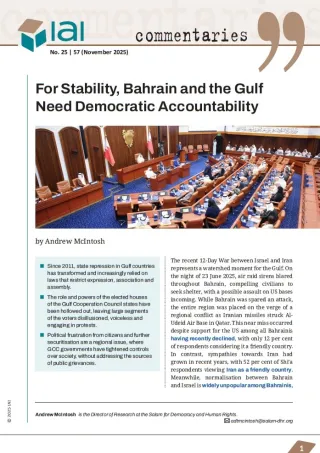
Following the suspension of Kuwait’s National Assembly in May 2024, Bahrain is the last remaining Gulf country with a functional parliament. Despite this, the country’s democracy is facing a legitimacy crisis. A 2024 survey by Salam for Democracy and Human Rights revealed serious public concerns about democratic shortcomings in Bahrain’s elected lower house, the National Assembly: 76 per cent of Bahrainis surveyed stated that parliament members have little influence on legislation; 84 per cent believe parliament cannot hold the executive to account, with power almost entirely concentrated in the King, who appoints the upper house, the Shura Council. Furthermore, the Cabinet is led by the Prime Minister, who is the Crown Prince and the King’s son. Additionally, political parties currently hold minimal to no influence in parliament. An analysis of the parliament revealed that most MPs are independents and often inexperienced, which limits their ability to form effective coalitions or pass legislation.
Although Bahrainis surveyed about representation express frustration with the limitations of what MPs and the National Assembly could do, their primary grievance is that they feel unheard: 81 per cent claim they do not believe they are represented in parliament. Paired with bans on major opposition parties, it’s easy to understand why they feel voiceless on domestic issues and foreign policy. This has led to disenchantment with and disengagement from the Bahraini parliament and MPs. Numerous participants either view the legislative branch as ineffective or a tool designed by the executive branch, used to create the veneer of democracy in the country. Several Bahrainis pointed to the Bahraini government’s lack of consultation with parliament over the normalisation with Israel as a glaring example.
The impact of international politics
Although the Bahraini and Emirati governments became founding members of the Abraham Accords to ensure stability, that decision, made without input from citizens, risks having the opposite effect. In Bahrain, normalisation of relations with Israel has galvanised people onto the streets, resulting in marches and sit-ins. These increased dramatically following the Hamas-led attacks on 7 October and Israel’s subsequent campaign against Gaza, Lebanon and Yemen, where rallies protesting normalisation between Israel and Bahrain occurred almost nightly throughout 2024. Bahrain’s allies in the GCC and the West have no doubt looked on with concern as segments of the Bahraini street appear to be moving closer to the so-called pro-Iranian Axis of Resistance, which has tapped into issues like normalisation and democratic deficits to win support.
The result has been a campaign of mass arrests and police summonses in Bahrain, where activists, journalists and clerics face travel bans, police summonses, and arrest for voicing their opinions on Bahrain’s foreign policy. In October 2024, security forces shuttered Imam Al-Sadiq Mosque, Bahrain’s largest Shi’a site of worship, where clerics frequently encouraged protests against normalisation. The unannounced blocking of entrances resulted in clashes with worshippers, who were violently dispersed. Friday prayers continue to be banned at the mosque, with worshippers blocked from entering. Authorities have provided no indication when or if these restrictions will end. The mosque remains a site of protests, with Shi’a worshippers believing they have been systematically targeted and silenced, fuelling communal resentment and empowering militant actors, who may reach other disaffected citizens throughout the region.
In the UAE, the result has been the self-reinforcement of securitisation, where access to advanced surveillance technologies was a driving factor in the country’s normalisation with Israel. Israeli spyware such as Pegasus was sold to GCC countries as early as 2013, at Israel’s encouragement, to increase economic and security ties, in what some activists have referred to as “Pegasus diplomacy”. Although some Emiratis are wary of normalisation, they fear the consequences of speaking out. This is part of a broader phenomenon of sectarian hyper-securitisation throughout the Gulf, where the governments, fearing a 2011-like uprising, have dramatically increased surveillance, security and repression. This is empowered and maintained by suspicion of how large, alienated segments of citizens will react if they are allowed to express their opinions, much less vote. While Saudi Arabia, Qatar, the UAE and Bahrain have publicly championed forms of social and economic liberalisation, their systems remain fixated on maintaining a draconian social order at the expense of human rights and suffrage.
Attempting to preserve order, stability and control, these governments risk undermining their legitimacy, however, because these conditions compel protests. Systematic repression in Bahrain, both in parliament and the streets, has stimulated identity-based protests among Shi’a youths. Young Shia Bahrainis and Saudi Arabians have grown up in the shadow of mass arrests and have never known a fully functional democracy. Their faith in the system is faltering, putting them at risk of radicalisation and militancy. Further acts of repression from the government could potentially destabilise the country, shattering the limited trust rebuilt between the government and people since 2011, when protests were violently suppressed. Trapped in cycles of unrest and suppression, the Gulf risks repeating history by failing to factor in public opinion, which increases popular resentment and necessitates further surveillance and securitisation from states.
Bahrain’s upcoming 2026 parliamentary election presents an opportunity to break these cycles. However, this requires acts of good faith that engender an environment of trust between voters and the government. The first major steps the Bahraini government could take to restore this trust are a gradual process of re-engagement with voters, emphasising that democracy is an instrument of their empowerment, and a means to hold the powerful to account, not merely a gift from the King. Providing a voice to voters who feel disenfranchised would play a considerable role in stabilising Bahraini society, knowing that representation and accountability now exist in the country. This would act as a release valve for social tensions and set an example for other GCC nations to follow. This is critical to ensuring that trust is rebuilt between voters and the government, and that cycles of unrest, repression and violence are no longer viewed as inevitable.
Andrew McIntosh is the Director of Research at the Salam for Democracy and Human Rights.