Titolo completo
“No to War” Again? Spanish Foreign Policy vis-à-vis the Iran War
|
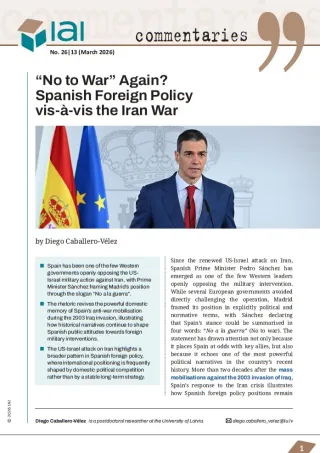
Since the renewed US-Israel attack on Iran, Spanish Prime Minister Pedro Sánchez has emerged as one of the few Western leaders openly opposing the military intervention. While several European governments avoided directly challenging the operation, Madrid framed its position in explicitly political and normative terms, with Sánchez declaring that Spain’s stance could be summarised in four words: “No a la guerra” (No to war). The statement has drawn attention not only because it places Spain at odds with key allies, but also because it echoes one of the most powerful political narratives in the country’s recent history. More than two decades after the mass mobilisations against the 2003 invasion of Iraq, Spain’s response to the Iran crisis illustrates how Spanish foreign policy positions remain deeply intertwined with domestic political competition, and how foreign policy rhetoric can also serve to reinforce Sánchez’s emerging role as a visible voice of the European centre-left in international debates.
Spain’s stance in a strained transatlantic context
In recent months, relations between the Spanish government and the administration of Donald Trump have experienced several moments of tension, particularly regarding defence spending within NATO. Washington has called on allies to significantly increase their defence expenditure, as high as 5 per cent of GDP. The Spanish government, however, has reiterated its commitment to the Alliance’s established benchmark of 2.1 per cent, rejecting higher targets. This position has placed Madrid at odds with some of its allies within the Alliance. Prime Minister Pedro Sánchez has nevertheless insisted that Spain remains fully committed to NATO while arguing that additional defence spending cannot come at the expense of the country’s social welfare model.
The debate has also unfolded in a context of improving economic forecasts for Spain, which the government has used to reinforce its argument that sustained growth should translate into continued investment in public services and social protection. Protecting these policies has been a central pillar of Sánchez’s political agenda and a key element of the government’s strategy to counter the growing increase of the far-right in the Spanish political arena. At the same time, Madrid has sought to avoid a direct rupture with Washington. Spanish officials have repeatedly emphasised the country’s reliability as an ally and its continued participation in NATO operations. The government’s position therefore reflects an attempt to navigate growing transatlantic pressures while preserving domestic political priorities, particularly in the run-up to the expected general elections in 2027.
In this context, the government’s rhetoric has increasingly drawn on a familiar narrative in Spanish politics: the longstanding public sensitivity toward military interventions abroad.
From Iraq to Iran: The return of “No to war”
Spain’s reaction to the United States-Israel military intervention against Iran has been framed in clear political terms by Sánchez. While his “No-to-war” statement responds to the immediate escalation in the Middle East, it also resonates strongly with a familiar political narrative in Spain, where opposition to military interventions abroad has long played a central role in public debate. This sensitivity is rooted in the political legacy of the 2003 invasion of Iraq. Spain’s participation in that intervention under the conservative government of José María Aznar triggered massive public protests and became a defining moment in Spanish politics. The anti-war mobilisation that followed contributed to a profound shift in public attitudes towards foreign military engagements and reinforced a political culture in which calls for diplomatic solutions tend to resonate strongly with domestic audiences. In the subsequent 2004 Spanish general election, the conservative government lost power and the leader of the Spanish Socialist Party (PSOE) – José Luis Rodríguez Zapatero – came to office on a platform that included the immediate withdrawal of Spanish troops from Iraq. The episode reinforced a political culture in which opposition to military intervention and calls for diplomatic solutions continue to resonate strongly with domestic audiences.
More than two decades later, this legacy still influences how political actors and the public interpret Spain’s role in international conflicts. References to “No to war” therefore evoke a memory of collective mobilisation and political change, transforming the slogan into a powerful symbolic marker within Spanish domestic politics. By reactivating this narrative, the government presents its position not only as a defence of international law and diplomatic conflict resolution, but also as one that resonates with long-standing societal sensitivities toward military engagement abroad. In doing so, the current rhetoric links present policy choices to a broader expectation that Spain’s foreign policy should prioritise diplomacy and multilateral solutions over participation in military escalation.
This mnemonic framing also carries a clear partisan dimension: Spain’s conservative opposition and the far-right have been more inclined to emphasise support for stronger military responses to Iran, aligning themselves more closely with the prevailing transatlantic security agenda.
At the same time, Spain has sought to signal that its opposition to the intervention does not imply disengagement from European regional security. Madrid has announced the deployment of the naval asset Christopher Columbus to Cyprus as part of broader European efforts to reinforce stability in the Eastern Mediterranean flank. By supporting defensive measures in European borders while distancing itself from the military campaign against Iran, Spain seeks to differentiate between participation in escalatory military action and contributions to regional stability. In this sense, Spain’s response can be understood as a form of selective security alignment: resisting involvement in the intervention itself while continuing to signal reliability within European and alliance security frameworks.
When foreign policy becomes domestic politics
Spain’s response to the crisis over Iran can be read not only as a reaction to a specific episode of regional escalation, but also as a symptom of a broader feature of its foreign policy tradition: the difficulty of sustaining a stable foreign policy agenda across governments. While Madrid has periodically identified priority regions – the Mediterranean, Latin America and, more recently, Africa – these priorities have often remained politically contingent and vulnerable to changes in domestic leadership and partisan competition. Even where strategic frameworks have been articulated, such as the Spain-Africa Strategy 2025-2028 and the Foreign Action Strategy 2025-2028, the challenge has lain primarily in the uneven continuity of political ownership and long-term execution across electoral cycles.
Spain’s external positioning has often been reactive, shaped less by a durable strategic doctrine than by the domestic political incentives of the government of the day. This does not mean that Spain lacks diplomatic capacity; rather, it suggests that its foreign policy has frequently struggled to project a stable hierarchy of priorities that survives partisan alternation. The result is that international crises can be more easily absorbed into domestic political contestation.
The debate on Iran illustrates precisely this pattern. Rather than being framed primarily through a settled Spanish doctrine on the Middle East, the crisis has been filtered through the enduring symbolic resonance of the Iraq War in Spanish political memory. Seen in this light, the current government’s rhetoric is not only about opposing a military intervention. It also reflects a recurrent pattern in which foreign policy becomes a vehicle for domestic political differentiation.
At the same time, this positioning also serves to reinforce Sánchez’s growing role as one of the most visible figures of the contemporary European centre-left on the international stage. By articulating a clear normative stance centred on diplomacy, international law and opposition to military escalation, the Spanish Prime Minister projects a political profile that resonates beyond Spain’s domestic debate and aligns with broader currents within the transnational progressive camp. In this sense, the government’s rhetoric operates simultaneously at two levels: it mobilises a powerful historical narrative within Spanish politics while also contributing to Sánchez’s effort to consolidate Spain’s voice within international debates among progressive actors.
Sánchez’s appeal to the language of “No to war” is significant not simply because of what it says about Iran, but because of what it reveals about the broader construction of Spanish foreign policy: a field in which international positioning is repeatedly mediated by internal political competition, rather than consistently embedded in a long-term state strategy. In this sense, the Iranian crisis is less an exception than a revealing example of the continued domestication of Spanish foreign policy.
Diego Caballero-Vélez is a postdoctoral researcher at the University of Latvia.