Titolo completo
The Mattei Plan after the Addis Ababa Italy-Africa Summit
|
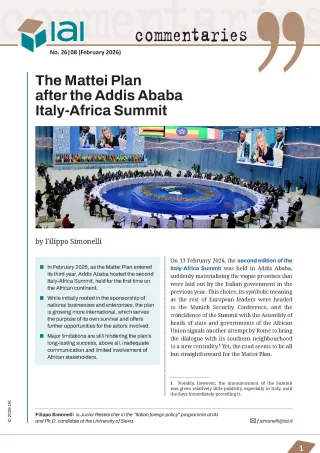
On 13 February 2026, the second edition of the Italy-Africa Summit was held in Addis Ababa, suddenly materialising the vague promises that were laid out by the Italian government in the previous year. This choice, its symbolic meaning as the rest of European leaders were headed to the Munich Security Conference, and the coincidence of the Summit with the Assembly of heads of state and governments of the African Union signals another attempt by Rome to bring the dialogue with its southern neighbourhood to a new centrality.[1] Yet, the road seems to be all but straightforward for the Mattei Plan.
The Mattei Plan’s evolution in 2025
In 2025, the Mattei Plan evolved in different respects, although not without blind spots. Its territorial expansion was notable, up to fourteen countries from the initial nine.[2] Operationally, the Italian government outlined a set of criteria to evaluate projects and their relative impact: efficacy, integration and flexibility, added value, incremental potential, sustainability and replicability. Equally significant has been the development of an official section on the government’s website dedicated to the Plan, which consolidates most information in one place, although in Italian only. This seems to suggest that the accountability Rome is looking for is primarily inward looking, which may hinder the reception of the plan abroad and thus its success.
The Global Gateway-Mattei Plan Summit on 20 June 2025 was perhaps the spotlight event of the year. Hosted in Rome, the Summit was a further attempt by the government to shape the European discourse on Africa. In terms of policy, internationalisation activities continued, following up on the premises set out during the Italian-led G7, positioning the country at the centre of major global initiatives such as the Lobito Corridor, an infrastructural project linking the Lobito port on the Angolan coast with Zambia’s Copperbelt regions, which are particularly rich in mineral resources and rare earths. Rome’s commitment to this project is substantial, up to 250 million euros.
Other relevant pledges added in 2025 included debt conversion initiatives for African countries classified as low-middle income, for a total estimated value of around 230 million euros.[3] The Italian initiative is surely limited resource-wise but remains significant as it lends itself to reach out to a group of countries that are not involved in the Plan, such as those in the Sahel region;[4] a similar commitment was reiterated during Meloni’s speech in front of the Addis Ababa audience.
The Addis Ababa Summit: The Mattei Plan at a turning point?
Speaking with the press in Addis Ababa, Italian Prime Minister Giorgia Meloni reiterated the key rhetorical points of the Plan: equal-to-equal cooperation, a non-predatory approach and tackling the root causes of migration. Meloni’s speech in front of the Assembly of Heads of State and Government of the African Union was saluted with applause, particularly as she emphasised cooperation as opposed to charity as a strategy of approach to Africa. More broadly, the Plan’s vision seemed to resonate with that of some African leaders. Ethiopian Prime Minister Abiy Ahmed Ali, for example, elaborated on the relevance of the choice of his country’s capital to host the Italy-Africa meeting, underlining the mutual benefits of strengthened cooperation. Angola’s João Lourenço, leader of one of the newly involved countries in the Plan and rotating chairman of the African Union, seemed to embrace the core concepts underlying the Plan – namely, cultivating human capital in the continent as a means of better cooperation and as long-term commitment against the root causes of migration, underlining Italy’s more constructive approach to the continent when compared to other European counterparts.
African Commission President Mahamoud Ali Youssouf was more critical, instead, stressing the need for Rome to better align with preexisting African initiatives and policy instruments, particularly to address long-term necessities that go beyond immediate deliverables. This last point is crucial to Rome, both in order to maintain its ground on the continent and to the survival and future development of the Mattei Plan as a national strategy rather than a mere flagship programme of a single government.
A capital to be handled with care
Overall, the Addis Ababa meeting seems to confirm that Italy is building political capital for itself with African counterparts, both in terms of credibility and trust, but it needs to handle it carefully. Youssouf’s words recall those of his predecessor Moussa Faki, who criticised Italy in 2024 for the lack of involvement of African counterparts. While different in tone, the basic message remains the demand by African leaders to be listened to and to be included more in the Mattei Plan-building process. If the aim is to achieve long-term mutual benefits, then Italy’s commitment must go beyond symbolic celebration and short-lived processes; it must instead address structural problems and listen to African voices to better identify local priorities.
Indeed, a related limitation that Italy has failed to address so far is that of limited transparency and insufficient information-sharing mechanisms. If Rome wants to gain further credibility in African capitals, the lack of clear information available to all the stakeholders involved is an enormous limitation and could eventually backfire. The lack of an English-language website dedicated to the Plan, for example, significantly hampers the informative potential for stakeholders and international civil societies. More importantly, the absence of an open consultation mechanism with African counterparts may create the perception that the Plan is yet another means of imposing decisions from abroad and limiting African agency.
Overall, the Mattei Plan is built around a strong narrative with clear talking points, but the latter are not adequately reflected in Italian official communication. No soft power strategy is detectable, and no local involvement of African counterparts is to be seen, neither off- nor online. In a continent which is increasingly interconnected, a vital battleground for confrontation between international actors is the perception field, winning hearts and minds, to quote the late Joseph Nye. A multilingual landing page, for instance, could prove a useful tool to provide official and shared information, in consultation with African counterparts and to the benefit of international and African stakeholders, to begin with.[5] This is all the more urgent in light of the increasing body of evidence that international powers are taking advantage of the West’s inaction to carry out influence operations aimed at African publics. Cooperation projects that are not adequately supported from this point of view may well risk being heavily impacted both in the digital and physical space – a threat to the political capital built through the Mattei Plan that the government should urgently address.
Filippo Simonelli is Junior Researcher in the “Italian foreign policy” programme at the Istituto Affari Internazionali (IAI) and Ph.D. candidate at the University of Siena.
[1] Notably, however, the announcement of the Summit was given relatively little publicity, especially in Italy, until the days immediately preceding it.
[2] Angola, Ghana, Mauritania, Senegal and Tanzania were added to the list already comprising Algeria, Egypt, Tunisia, Morocco, Ivory Coast, Ethiopia, Kenya, Mozambique and the Republic of the Congo.
[3] The most relevant one was the Seville Conference on Financing for Development of June 2025.
[4] The Italian commitment to this initiative has been also reiterated by President Meloni’s address to the G20, a speech with an even higher symbolic value given that it was made during the first summit of this format ever held in the Continent.
[5] China’s Belt and Road initiative has two such pages, although they are available in English and Chinese only. Spain’s Africa strategy has official documents available in English as well.