Titolo completo
Maduro’s Fall: Russia’s Strategic Defeat in a World Without Rules
|
Donald Trump’s military strike on Venezuela – carried out in open violation of international law and ending with the capture of Nicolás Maduro – marks another step in the steady erosion of the rule-based international order. It reinforces a worldview in which power trumps law, force replaces norms, and outcomes are determined not by rules but by coercion. This is the logic of “might is right” – a logic Russia embraced as early as the 1990s, when it launched a series of wars in its immediate neighbourhood, intervening militarily in sovereign states. At the time, a wilfully shortsighted West chose to describe these conflicts as “secessionist wars”, rather than acknowledge them for what they were: clear violations of international law by one state against another.
Trump’s move follows that same trajectory, accelerating the slide toward a world that is more unstable, more violent and increasingly jungle-like in its disregard for rules and constraints. It is precisely the kind of international environment the Kremlin has long advocated and sought to legitimise, both for itself and for others. Yet even in this lawless setting, Maduro’s downfall marks a strategic setback for Moscow as well – a defeat it shares with the rest of us, but for fundamentally different reasons.
The Kremlin’s crumbling global ambitions
Once, Barack Obama called Russia a regional power: the Kremlin bristled. Moscow aspired to be a global actor and sought to prove it by launching a war against Ukraine. The result? Ukraine was not conquered; Russia was pushed out of Syria, Armenia and Central Asia (where China remains the dominant player); it has been unable to do much even to sustain the Iranian regime last year, and now, with Nicolás Maduro’s fall, Venezuela must be added to the list.
Obama’s 2014 remark was perceived in Moscow as a strategic insult. It was not merely a symbolic slight, but a diagnosis that challenged the very foundations of Russia’s post-Soviet geopolitical ambitions. Since then, the Kremlin has sought to disprove it, demonstrating – or at least believing it could – that Russia was not just a regional power, but a global player capable of intervening, influencing and shaping international affairs. The invasion of Ukraine in February 2022 was the most ambitious and risky attempt to validate that claim. It is also the point from which Russia’s global strategic defeat now emerges with increasing clarity.
The Ukrainian case lies at the heart of this defeat. After four years of war – a war that was originally expected to last a few weeks – Russia has failed to subdue Ukraine, either militarily or politically. Kyiv did not fall; the Ukrainian government has not been overthrown; the armed forces have not collapsed. On the contrary, Ukraine has strengthened its national identity, deepened its ties with the European Union and turned the war into a structural pillar of European security. Russia, meanwhile, has expended enormous human, economic and military resources, thereby weakening its capacity to project power elsewhere. Even partial territorial gains came at an immense cost, with no strategic payoff: Ukraine was not broken, Europe was not divided and no new regional order was imposed.
This failure has produced cascading effects across other theatres. Syria, once cited as proof of Russia’s “return” to the global stage, has become its mirror image. Moscow once portrayed its intervention there as evidence of being a reliable power, capable of saving an ally and stabilising a regime. Yet when Bashar al-Assad’s regime fell, Russia proved powerless to protect him. The most it could offer the Syrian dictator was exile in Moscow. With attention and resources absorbed by Ukraine, Russia’s presence in Syria had gradually been hollowed out, and the balance of power on the ground returned to other actors – regional and beyond – while Moscow lost both influence and credibility as a security guarantor.
Even more striking is the failure in the South Caucasus. Armenia, formally allied with Russia and a member of the Collective Security Treaty Organisation, found itself largely alone when Azerbaijan, openly backed by Turkey, launched a campaign to reclaim territories lost in the 1990s. Russia, long claiming the role of arbiter and protector in the region, did nothing. It neither intervened nor deterred Baku, and it failed to defend Yerevan. The political and symbolic defeat was clear, and it has deeply shaken Armenia’s trust in Moscow. Today, Armenia is increasingly looking to Europe and rebuilding cooperation with Azerbaijan and Turkey, likely reopening borders with Ankara that have been closed for more than thirty years.
In Central Asia, Russia’s retreat is quieter but no less consequential. Its influence is eroding steadily rather than collapsing in a single crisis. China has emerged as the dominant power, economically and infrastructurally. Moscow retains a military presence and some cultural sway, but the region’s centre of gravity has shifted. Central Asian states are diversifying their partnerships, reducing dependence on Russia and increasingly looking to Beijing as their strategic anchor. The war in Ukraine has accelerated this trend, exposing a Russia that is weaker, more isolated and less capable of offering stability and development.
Venezuela: Another brick in Russia’s strategic defeat
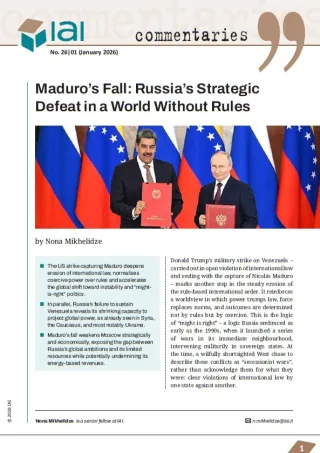
Taken together, these examples paint a clear picture: Russia has sacrificed its global position in the very effort to assert it. And now, with Venezuela, the pattern continues. Just two months ago, Putin ratified a law on a treaty with Venezuela on strategic partnership and cooperation, including defence and security collaboration. Symbolic, more than substantive, this gesture sought to project influence where Russia was already fragile and largely ceremonial. That is why the notion of some secret deal between Putin and Trump – simplified as “you take Venezuela, I take Ukraine” – now looks absurd. How could Putin have defended Maduro? With the same tools he used to “defend” Assad? Russia no longer has the military, logistical or economic capacity to sustain a distant ally under international pressure. Moscow can offer statements, limited advice, perhaps some constrained material support, but it can no longer guarantee a regime’s survival when that regime is seriously challenged.
Maduro’s overthrow carries serious consequences for Russia. Economically, a new Venezuelan government could unleash a surge in oil production, especially if the United States and other Western actors resume large-scale investments. A significant increase in global supply would depress oil prices, hitting Russia’s heavily energy-dependent economy directly. In this scenario, Moscow suffers a second blow: the loss of a symbolic ally compounded by structural damage to its revenues. Venezuela, once a symbol of Russia’s global reach, becomes yet another multiplier of its vulnerabilities.
The Kremlin’s strategic defeat is not a single lost battle or an abandoned ally – it is cumulative, structural and inseparable from the broader unravelling of the international order described at the outset. From Ukraine to the Middle East, from the Caucasus to Central Asia, and now across the Atlantic to Latin America, each crisis has further exposed the gap between Russia’s ambitions and its real capacity to shape outcomes. Having embraced early on a world in which power overrides law and coercion replaces rules, Moscow now operates in an environment of its own making – one that renders the international system more unpredictable, more violent and less constrained for all actors. In this context, in trying to prove it was more than a regional power, Russia has instead entrenched – if not actively undermined and compromised – even that very status. It remains potent in its destructive capacity, yet increasingly unable to translate force into lasting influence or recognised power. This is not merely a defeat across multiple theatres, but the strategic exhaustion of a model that bet on the erosion of rules and now helps produce a world in which even its own architects end up paying the highest price.
Nona Mikhelidze is a senior fellow at the Istituto Affari Internazionali (IAI).