Titolo completo
Germany’s Leverage with China: Responding to Beijing’s Export Dominance
|
This October, China will hold talks with the European Union as part of a Trade and Investment Consultations programme. Bilateral trade will be high on the agenda: EU’s goods trade deficit with China stood at 230 billion US dollars in the first half of 2026, an increase of 31 billion compared to the same period in 2025 (Eurostat). This growing EU deficit is a flashpoint between the two economies. A growing number of governments and experts in Europe are calling for European measures to reverse it.
Recent proposals by European officials on measures to curb Chinese export power range from trade defence measures, addressing the undervaluation of the yuan, and the implementation of new EU instruments designed to curb a country’s exports if they threaten European manufacturers (Steel overcapacity instrument, Diversification instrument). China has responded to European Russia-related sanctions which affected Chinese firms with export control measures, targeting 14 major companies across the European continent.
As the EU weighs new ways to respond to China’s growing export power, Berlin is taking a closer look at Germany’s own position in the bilateral trading relationship. The German government is currently mapping Chinese trade weaknesses in relation to German exports and imports. By understanding any Chinese dependencies in terms of goods and commodities, Germany could identify economic and political options to help rebalance trade.
Scale of the trade imbalance
Germany is China’s largest trading partner within the EU, with total trade exceeding 285 billion dollars in 2025 (UN Comtrade data). Germany’s trade deficit with China is on a sharp upward trajectory. In the first half of 2026, the imbalance reached 61 billion dollars, up 39 per cent compared to the first half of 2025.
These high-level numbers can often obscure the wider picture of a more complex trade relationship between the two countries. There are areas where Germany still retains a leading role, exporting in significant volumes and value to China. While China is enlarging its trade surplus or narrowing deficits in many areas, it still depends on Germany’s supply in a few categories. In 2025, Germany recorded surpluses with China in chemical products, optical and photographic items, transport equipment and precious metals, yet this was offset by China’s huge surplus in machinery and electrical items.
A key feature of Germany-China trade, unlike China-United States trade, is the predominance of industrial products, intermediate goods and equipment, with relatively little trade in energy, agricultural products or other natural resources. This creates deep supply-chain interdependence, often within individual sectors. Machinery and electronics account for 40 per cent of China’s import from Germany and over 50 per cent in the reverse direction. In chemicals, for instance, China records surpluses in several individual product lines, but Germany retains an overall 6 billion-dollars surplus of all chemical goods traded.
German leverage
Items where Germany holds leverage are featured primarily in the technology intensive and precision manufacturing space. This list of goods (see Figure 1), although not long, connects to several industries and value chain stages.
High purity silicon is a critical input in the semiconductor value chain, with global supply concentrated in the United States, Germany and Japan. China imported 54 per cent of its total supply in 2025 from Germany with the company Wacker among the industry leaders. Quality requirements and a limited pool of mature suppliers make substitution difficult in the short term.
Machining centres for working metal have wide industrial applications and vary significantly in quality and sophistication. China ships 11 per cent of the world’s total exports of machining centres but its average unit price is only 50,000 dollars. Germany exports machining centres to China at an average unit price of 450,000 dollars. The gap points to Chinese demand for high-end German equipment, consistent with the latest Five-Year Plan’s focus on advanced manufacturing.
The test and checking of instruments plays a critical role ensuring calibration and standardisation. Germany holds a leading role in this field and a significant share in China’s import numbers. Leverage in such products lies in the level of engineering that Germany excels in and China has not yet fully matched.
Specific end-products such as airplanes and their parts form the highest-value category of Chinese imports from Germany, worth over 2.5 billion dollars in 2025. However, their traded value has steadily decreased since 2015. Airbus has meanwhile expanded its industrial presence in Tianjin, supported by 23 first-tier suppliers and greater local research and development. This localised aviation supply chain is likely to further reduce the scope for direct German exports to China.
Overall, apart from gear boxes and airplanes as the two largest categories, German leverage largely resides in their traditionally strong sectors such as machinery and chemicals. The degree of Chinese dependence, however, varies considerably across these categories.
Figure 1 | Germany’s trade leverage: Goods that Germany exports to China in large quantities or values
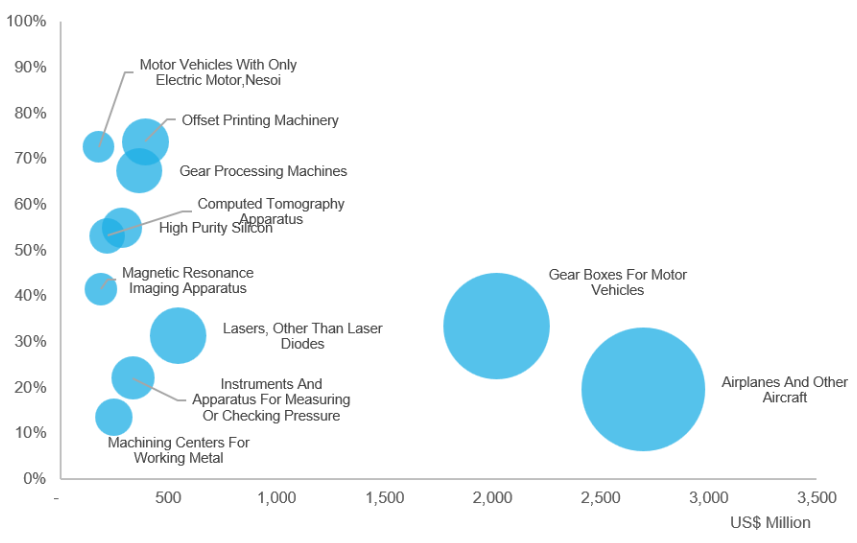
Note: The larger the bubble the bigger the US dollar traded value in goods. The greater the percentage, the more dependent China is on Germany for the overall imported value of those goods.
Source: UN Comtrade, ITC.
Chinese leverage
In comparison, China’s leverage is more concentrated on specific value chains, but its dominance is often deeper. Typical items include rare-earth metals, magnets and natural graphite. Rare-earth metals, for instance, are traded in relatively small volumes but are crucial to industries ranging from aerospace to ceramics. Last year, 88 per cent of rare-earth metals imported by Germany came from China, which dominates global supply, making it a ‘bottleneck’ category. The import value was only 572,000 dollars, mainly due to China’s current export controls (all data are from the UN Comtrade database).
A similar pattern applies to permanent magnets, where China holds more than 60 per cent of world export share and has repeatedly included them in export-control measures. Beijing has already deployed export controls on certain European companies such as Sindlhauser Materials, a major German firm specialising in chemical coatings. The number of items for which Germany depends on China for more than 50 per cent of imports is large and growing, including sensitive technologies important to the German economy.
Lithium batteries are the single largest category of German imports from China but demonstrates a complicated partnership. On one side, lithium is a key component of electric vehicle manufacturing. To protect its domestic manufacturing hubs, the EU has rolled out regulations such as the Digital Battery Passport and its environmental disclosure requirements. On the other hand, critical materials used to produce lithium batteries were added to China’s export control list from July 2025. Both are non-tariff measures and point to the same puzzle: China is moving from being a pure supplier of raw materials to a high-end product manufacturing centre. Europe is adapting, and needs to do it quickly.
Figure 2 | China’s trade leverage: Goods that China exports to Germany in large quantities or values
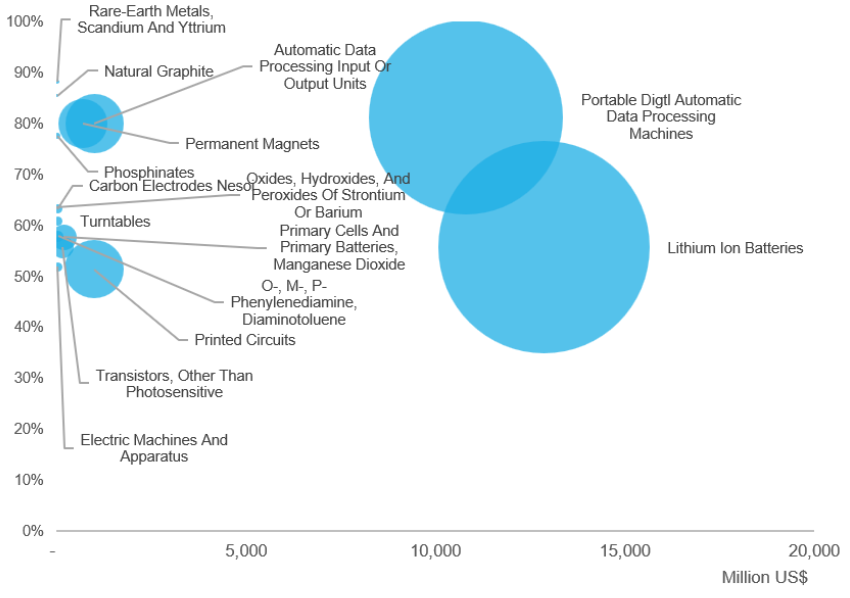
Note: The larger the bubble the bigger the US dollar traded value in goods. The greater the percentage, the more dependent Germany is on China for the overall imported value of those goods.
Source: UN Comtrade, ITC.
Possible outcomes
Germany’s leverage is eroding as the trade imbalance increases, but Berlin does have some capacity to negotiate with China in high-tech sectors for machinery and electronics. This pushes Germany into a wider geopolitical situation that spans the EU and the United States. The latter has already pressured other European capitals into enacting export restrictions. The Netherlands-based ASML has recently been induced to stop exporting the most sensitive chip-making machinery to China. German goods could face similar pressures.
However, the German government faces a number of constraints to using its leverage. One comes from national industries. The car sector is often used as a case study for the growing influence of Chinese exports to Germany. However, major German car manufactures have considerable factory and plant investment in China. Several of them import Chinese batteries and other vehicle software into Europe. Some of these German firms have stated an aversion to tariffs and restrictive trade practices on China, preferring to find more moderate solutions to the trade imbalance.
Beyond the car sector, the battery, robotics and semiconductor industries have also placed strong emphasis on partnering with China. The same applies in established sectors such as chemicals and machinery. BASF has major operational sites established in China, while ZF Group has completed new projects with substantial capital investment in China.
Both sides have leverage. China remains a market of major importance for Berlin, but the German manufacturing base is under growing pressure from Chinese trade. Germany must navigate this tightrope with less economic and political weight than the United States. Opening a new economic front with China – at a time of Russian energy constraints and disputes with the United States over tariffs – would carry significant costs. Germany has few easy options. It may have even fewer in the future.
Yingzhi Zhang is a specialist in trade and shipping at S&P Global. Byron McKinney is a senior director for global risk at Dow Jones.