Titolo completo
Diplomacy’s Dead End: Why Talks with Moscow Keep Failing
|
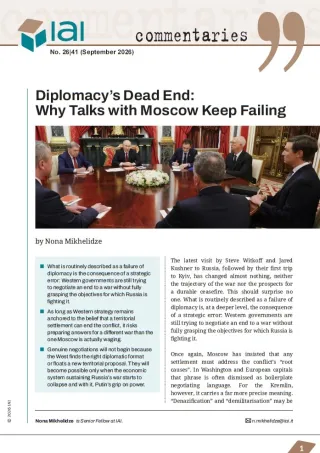
The latest visit by Steve Witkoff and Jared Kushner to Russia, followed by their first trip to Kyiv, has changed almost nothing, neither the trajectory of the war nor the prospects for a durable ceasefire. This should surprise no one. What is routinely described as a failure of diplomacy is, at a deeper level, the consequence of a strategic error: Western governments are still trying to negotiate an end to a war without fully grasping the objectives for which Russia is fighting it.
Once again, Moscow has insisted that any settlement must address the conflict’s “root causes”. In Washington and European capitals that phrase is often dismissed as boilerplate negotiating language. For the Kremlin, however, it carries a far more precise meaning. “Denazification” and “demilitarisation” may be propaganda terms, but translated into concrete political goals, they amount to bringing Kyiv back under Moscow’s control and denying Ukraine any real chance of existing as a sovereign state, free to chart its own geopolitical course. This is the starting point for understanding why Western strategy has failed to achieve its central aim: bringing Putin to the negotiating table.
For nearly five years, military aid to Ukraine and sanctions on Russia have been increased incrementally on the assumption that a slow deterioration of Russia’s economic and military position would eventually force the Kremlin to revise its calculations. In effect, the West applied its own logic of costs and benefits to an adversary who does not share it. It assumed that mounting losses, domestic discontent and international isolation would compel Moscow to scale back its ambitions. The failure here is not that too little pressure was applied. The failure is that the strategy was built on the expectation that Putin would respond to pressure the way a Western leader might. Instead, he has shown a willingness to absorb costs far greater than anticipated.
Against this backdrop, a change of course is overdue and it must begin with a clearer view of what this war actually is. It is not, at its core, a war about territory. Therefore, framing it around Donbas risks obscuring Russia’s deeper strategic objective. The region matters enormously militarily, economically, symbolically, but it has never been the ultimate reason for the invasion. The real issue is Kyiv itself. Territorial control without political control over Ukraine would leave unresolved what Moscow regards as the fundamental problem: the existence of an independent Ukrainian state integrated into the Western political, economic and security order.
This is also why international attention on Donbas has quietly served Moscow’s interests. Russia needs to keep its channel to Washington open and present itself as a rational actor willing to negotiate, particularly in the eyes of the Trump administration. Donbas gives the Kremlin a seemingly concrete basis for that narrative: contested land implies, at least in theory, room for compromise. But this framing risks becoming a distraction from what Russia is actually after.
The question worth asking is simple: if Russia conquered the whole of Donbas, why would it stop there? From Moscow’s vantage point, such a conquest would mean far more than a territorial gain. It would eliminate one of Ukraine’s principal defensive lines, built up since 2014 and open easier access to the rest of the country. Once that barrier fell, there is little reason to expect the Kremlin to abandon the goal it has pursued since the war’s first days: imposing its political will on Kyiv.
As long as Western strategy remains anchored to the belief that a territorial settlement can end the conflict, it risks preparing answers for a different war than the one Moscow is actually waging.
That misunderstanding feeds directly into a second transformation now under way. The war is entering a new phase of escalation and that escalation may unfold less on Ukrainian soil than in Europe itself. Inside Ukraine, the room for further conventional escalation is increasingly narrow. Russia has already committed much of the military power at its disposal and it keeps intensifying missile and ballistic strikes largely because it knows Ukraine’s stock of interceptors is running low. The toll on civilians and infrastructure is severe, yet these attacks have not translated into a decisive breakthrough along the front; territorial gains remain very limited and are being bought at enormous cost in soldiers and equipment.
Meanwhile, Ukraine has extended its own reach deep into Russian territory, targeting logistics and industry. Its medium- and long-range strikes aim to disrupt supply lines in occupied areas and to damage refineries and plants that feed the Russian war effort, directly or otherwise. The result is a war in which Moscow cannot secure a decisive victory yet shows no inclination to accept a ceasefire.
Faced with this stalemate, Putin has essentially two options: negotiate along the current line of contact or pursue a new form of escalation capable of altering the broader strategic environment. The Witkoff-Kushner mission only confirmed how remote the first option remains, which makes the second increasingly plausible and its likely arena may not be Ukraine but Europe. This does not necessarily mean a conventional invasion of the continent. Escalation can take many shapes, from the drone incursions already occurring to actions designed to probe how well European states coordinate their response.
One aim could be to test the credibility of European deterrence and the durability of NATO’s Article 5 commitment. A direct confrontation with Europe would also hand Putin a useful domestic advantage. Nearly five years into the war, ordering another wave of mobilisation of 300,000 or 500,000 soldiers would be increasingly hard to justify to the Russian public as merely a continuation of the campaign against Ukraine. It would be far easier, politically, to present such a mobilisation as a response to a broader and more existential threat – Europe and NATO itself.
This possibility takes on added weight given the gradual erosion of confidence in NATO’s deterrent power. In recent years, and especially under Trump, the credibility of America’s commitment to European defence has been questioned more openly than at any point in decades. What matters here is not whether that perception is accurate, but how it registers in the Kremlin. If Moscow concludes that the United States might hesitate to confront a limited strike on the Baltic states, the temptation to test Article 5 grows accordingly.
Russia also believes it has gained a real edge over European militaries in the conduct of modern warfare, particularly in drone technology and that belief is not without foundation. The Ukrainian battlefield has become a vast laboratory for contemporary conflict, giving both sides direct experience of high-intensity warfare on a scale no European military can match. Moscow has adapted its tactics, developed new capabilities, scaled up industrial production and accumulated a body of combat experience that could be applied well beyond Ukraine’s borders. Seen in this light, the drone attacks and sabotage operations attributed to Russia – including the Leipzig/Halle incident – along with the Kremlin’s increasingly bellicose rhetoric, take on a different meaning. When Sergey Lavrov answers Germany’s accusations by suggesting that Berlin’s belief in Russian responsibility already amounts to a state of war, he is not merely sparring diplomatically; he is normalising the idea of direct confrontation between Russia and Europe.
This leads to a third dimension of Russian strategy, closely tied to the first two and perhaps the one Europe most underestimates: Moscow’s effort to fracture the European Union politically. It is in this context that the Kremlin’s ability to find sympathetic voices across radically different corners of Europe’s political spectrum becomes significant. On one side sit forces from the radical right and sovereigntist movements – Germany’s AfD, France’s National Rally under Marine Le Pen, Italy’s Roberto Vannacci and the broader populist right. On the other are pro-Russian currents and firm opposition to arming Kyiv within segments of the European left – Germany’s Die Linke, Jean-Luc Mélenchon in France and Italy’s Five-Star Movement with its leader Giuseppe Conte.
These movements differ enormously in history, programme and ideology and lumping them together would be simplistic. But from the Kremlin’s perspective, ideological pedigree matters less than political effect. If a substantial share of Europe’s political landscape calls for cutting military aid to Ukraine, slowing rearmament and blocking deeper integration, the outcome serves Russian interests regardless of the label attached to it.
Moscow’s minimum objective, then, is to halt military assistance to Ukraine. Its more ambitious aim is to prevent the war from producing the opposite of what it intends: a more integrated, militarily capable and politically autonomous Europe. If this reading is correct, Europe’s own approach must change in turn. It is time to accept that, as long as Putin remains in the Kremlin, this war is unlikely to end on its own and he is unlikely to come to the table simply because economic pressure has grown heavy enough.
The stability of Russia’s economy remains one of the essential conditions allowing the regime to survive and sustain the war, which is why Europe’s economic strategy needs rethinking. By now, the European Union has lost count of its own sanction packages: there are well over twenty. That number is not a mark of strength; it may instead reflect an excess of caution. Each package has followed the same pattern: new measures introduced gradually, pressure increased by degrees. This approach has given Russia time to adjust. Moscow has found alternative markets, built new supply chains and steadily converted its economy into a wartime one, even as Europe has continued buying vast quantities of Russian liquefied natural gas. Cutting off those purchases entirely would carry real costs, including higher energy prices, but Europe must abandon the pretence that inaction comes free. A price is already being paid: Ukrainians pay it in lives and Europe risks paying an ever-steeper one in insecurity and instability.
Incremental sanctions packages are no longer sufficient. Europe needs to deploy every available instrument as part of a single package and a coherent strategy aimed at the collapse of Russia’s economic system.
The second pillar of such a strategy concerns Russia’s frozen assets. More than 200 billion euros immobilised in Europe should be put directly toward financing Ukraine’s defence, giving Kyiv a sturdier financial footing and reducing its exposure to shifting political winds in European capitals. This decision should not be delayed, especially given what 2027 may bring, when several European countries face major national elections. The prospect of radical-right, populist or anti-Ukraine parties entering government in some of those capitals is real and, in that scenario, financing Ukraine through fresh loans or politically fraught agreements could become considerably harder.
In sum, if Russia continues to pursue political control over Ukraine, prepares new forms of pressure against Europe and simultaneously works to divide and weaken the European Union, then Europe’s response has to change to match that reality. Gradualism must give way to a strategy grounded in Russia’s actual objectives, not in the hope that the Kremlin will decide on its own to negotiate an end to the war. Genuine negotiations will not begin because the West finds the right diplomatic format or floats a new territorial proposal. They will become possible only when the economic system sustaining Russia’s war starts to collapse and with it, Putin’s grip on power.
Nona Mikhelidze is Senior Fellow at the Istituto Affari Internazionali (IAI).