Titolo completo
The Diplomacy of Survival: Kyiv’s War Beyond the Battlefield
|
When Russia launched its full-scale invasion in February 2022, Kyiv found itself fighting on multiple fronts: the battlefield, the information sphere and the diplomatic corridors of Western capitals. In the following years, Ukraine not only held its ground militarily but also waged a sustained diplomatic campaign aimed at mobilising Western support that has been quintessential to the national survival. This campaign, often underestimated as a complement to battlefield resistance, has produced tangible results that reshaped the war dynamics: massive Western arms supplies, (for now) a notable recalibration of US policy and rhetoric, growing cooperation with Washington on strikes against Russian energy infrastructure, a revised agreement on strategic minerals and reconstruction, and an effective humanitarian diplomacy that has driven attention to the plight of Ukrainian children deported to Russia.
Securing arms supplies
At the outset of the war, Ukraine could rely only on limited stockpiles, some inherited from its Soviet past, others provided by the US. Yet its leadership, most visibly President Volodymyr Zelensky, quickly mounted an intense diplomatic offensive: frequent visits to European capitals and Washington, a relentless public diplomacy campaign and the meticulous cultivation of parliamentary majorities in donor countries. The result was a steady increase in military assistance from the first anti-tank weapons in 2022 to larger and more sophisticated systems. According to the international analysts, between 2022 and 2025 Ukraine became one of the world’s largest importers of heavy weaponry, while Western suppliers ramped up deliveries of artillery, air-defence systems and ammunition. This arms flow was the outcome of a targeted diplomacy that translated front-line needs into procurement packages and political agreements with donor governments.
Two features have made Kyiv’s approach effective. First, it personalised the conflict: Zelensky’s charisma and ability to speak to foreign legislatures and the public helped shape political will abroad. Second, Kyiv tailored its requests – specific systems, compatible munitions and timelines – to the procurement and budgetary realities of partners. The diplomatic choreography – visits timed to budget votes, briefings by Ukrainian officers to parliamentary defence committees and daily public appeals – has kept the issue at the top of donor agendas and converted sympathy into supplies.
Engaging with two (very different) US Presidents
While the Biden administration ensured a steady flow of weapons that enabled Kyiv to stabilise the front, these deliveries came with strict limitations, especially on the use of long-range missiles to strike targets inside Russia. Washington’s official position emphasised the need to avoid escalation, but from Kyiv’s perspective these restrictions prolonged Moscow’s ability to launch attacks from the safety of its own airfields and logistics hubs. Biden’s support was crucial yet carefully circumscribed, and never fully embraced Ukraine’s demand for strategic parity.
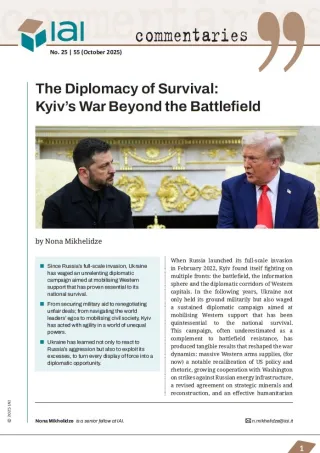
With Donald Trump’s return to the White House, Kyiv has faced a different and more volatile scenario. Given Trump’s long-standing admiration for Vladimir Putin and scepticism toward America’s international commitments, both Ukraine and its European allies feared that Washington might pursue a deal with Moscow over Kyiv’s head. These concerns deepened after a tense first meeting between Trump and Zelensky, during which the US president appeared intent on publicly humiliating his Ukrainian counterpart. However, Trump’s behaviour drew widespread criticism at home and abroad, while Zelensky emerged as one of the few leaders willing to contradict him openly – something few Europeans, often eager to accommodate Trump’s ego, dared to do.
In the aftermath of that meeting, Trump sought to impose a ceasefire on Ukraine as a precondition for “peace talks”. Kyiv initially refused, as any pause in hostilities would grant Russia the strategic breathing space it needed to rearm and relaunch its offensives. Yet Ukraine soon made a counterintuitive diplomatic move, by agreeing in principle to an unconditional ceasefire – knowing that Putin would never accept it while still far from achieving his war aims. The strategy of strategic patience was designed to let Trump follow a diplomatic path that would inevitably reveal who was truly blocking peace. The outcome vindicated this approach: the much-publicised Trump-Putin summit in Alaska ended without results, exposing that it was the Kremlin, not Kyiv, that rejected any compromise.
Soon after, signs of a shift appeared in US rhetoric: more assertive statements about Ukraine’s right to reclaim occupied territories, and indications that Kyiv had managed to penetrate the calculations of the new administration. Through skilful manoeuvring, Ukraine neutralised a most dangerous scenario – a ceasefire imposed to its disadvantage – while strengthening its image as a rational, consistent actor genuinely seeking peace. This also showed how, amid the turbulence of US politics, Kyiv had learned to turn personality-driven diplomacy into a strategic tool.
So far, the most tangible result has been Ukraine’s increased ability to strike Russian military and energy infrastructure, especially oil refineries. According to multiple sources, since summer 2025 the US has progressively expanded intelligence sharing used by Kyiv to plan such attacks. It was not a sudden concession, but the cumulative outcome of successive, discreet diplomatic gains: clearer authorisations, defined rules of engagement and more efficient targeting cooperation. These adjustments widened Ukraine’s operational reach and slowed Russia’s energy recovery, reflecting Kyiv’s ability to push its allies to reconsider their thresholds of caution.
Reframing the deal on strategic minerals and reconstruction
Among Ukraine’s most notable diplomatic achievements was also the reformulation of the US-Ukraine deal on strategic minerals and reconstruction. What initially appeared as a highly asymmetric deal – described by many as “colonial” in spirit – was gradually transformed into a more balanced framework. The first draft would have granted US companies near-unrestricted access to Ukraine’s subsoil resources, effectively handing strategic control to American investors. For Kyiv, such terms risked reproducing the very dependency it sought to escape – trading economic sovereignty for elusive security guarantees.
Ukraine’s response was firm and unusually coordinated across ministries, parliament and civil society. Leveraging public opinion and the growing awareness among European partners of the deal’s implications, Ukrainian negotiators managed to stall the process and push Washington back to the table. What followed was a series of revisions that gradually redefined the agreement’s tone and terms. The final version, signed in April 2025, still binds Ukraine to deep cooperation with US entities in the fields of critical minerals and reconstruction financing, but under a new framework of joint management and oversight.
Sure, the agreement remains partially opaque, especially regarding profit-sharing, environmental standards, and dispute mechanisms, but it no longer enshrines unilateral American control over Ukrainian assets. Cooperation is now framed as a reciprocal investment in reconstruction rather than mere extraction of resources. The shift marks Kyiv’s growing diplomatic confidence and its ability to resist dependency, even in dealings with its most powerful ally.
Enhancing humanitarian diplomacy
Ukraine’s diplomatic success, however, has not been confined to government halls or international summits. A crucial, though often overlooked, dimension has been humanitarian diplomacy, where state institutions and civil society acted in concert, reinforcing one another’s narratives and objectives.
From the first months of the invasion, Ukrainian civil society organisations, veterans’ groups and diaspora networks played a central role in shaping Western perceptions of the war. They organised grassroots campaigns, documented war crimes and lobbied parliaments across Europe and North America. While their focus was humanitarian in nature – protecting civilians, securing the return of deported children and seeking justice for victims – it also carried strategic weight: by highlighting the human cost of Russia’s aggression, they helped legitimise Ukraine’s call for more weapons. It was a subtle but effective form of pressure – turning compassion into military capability.
Among the most powerful causes is the deportation of Ukrainian children to Russia, which Kyiv and international institutions have denounced as both a war crime and a tool of cultural erasure. Civic organisations collected testimonies, identified abducted minors and worked with international NGOs to keep the issue in the spotlight. On this front, Ukrainian officials realised that a direct appeal to Donald Trump – on moral or legal grounds – would be futile.
Kyiv thus chose a more creative path. Understanding the symbolic importance of President Trump’s family image, Ukrainian diplomacy reached out to Melania Trump, whose involvement was seen as both emotionally compelling and politically advantageous for her husband’s entourage. It was an astute move: engaging the US first lady has allowed Ukraine to satisfy the vanity and sensitivity of the Trump family while advancing a humanitarian agenda. The results, though limited in scale, are symbolically potent. A number of family reunifications has been achieved, and the issue of deported children has returned to the forefront of international attention.
Diplomacy as a survival instrument
The vast diplomatic toolkit that Kyiv has built will not end the war by itself. Yet taken together, these efforts reveal how Ukraine has turned diplomacy into a genuine instrument of strategic survival. From securing ever-larger military aid packages to renegotiating a near-colonial minerals deal; from navigating the egos of Trump and Putin to mobilising civil society for humanitarian and political causes, Kyiv has learned to act with agility in a world of unequal powers.
Of course, part of this success owes something to Vladimir Putin himself: his constant overreach, his misreading of Ukrainian and Western resolve, his inability to anticipate how brutality breeds resistance. Yet it is equally, and perhaps more profoundly, a testament to Kyiv’s capacity to read and anticipate him better than anyone else. Ukraine has learned not only to react to Russia’s aggression but to exploit its excesses, to turn every display of force into a diplomatic opportunity. Its success lies not only in obtaining material support, but in mastering the languages, psychologies and timing of international politics: transforming vulnerability into leverage, and moral capital into concrete political results.
Nona Mikhelidze is a senior fellow at the Istituto Affari Internazionali (IAI).