Titolo completo
From Closeness to Strategic Partnership: Fincantieri’s Shipyard Project and a New Vision for the Future of Italy-Albania Relations
|
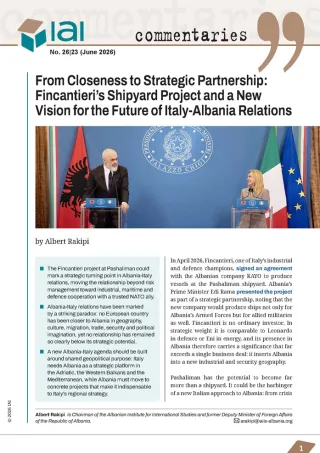
In April 2026, Fincantieri, one of Italy’s industrial and defence champions, signed an agreement with the Albanian company KAYO to produce vessels at the Pashaliman shipyard. Albania’s Prime Minister Edi Rama presented the project as part of a strategic partnership, noting that the new company would produce ships not only for Albania’s Armed Forces but for allied militaries as well. Fincantieri is no ordinary investor. In strategic weight it is comparable to Leonardo in defence or Eni in energy, and its presence in Albania therefore carries a significance that far exceeds a single business deal: it inserts Albania into a new industrial and security geography.
Pashaliman has the potential to become far more than a shipyard. It could be the harbinger of a new Italian approach to Albania: from crisis management to industrial partnership; from border control to maritime production; from migration anxiety to defence cooperation; from Albania as a fragile neighbour to Albania as a capable ally. This is why Fincantieri’s arrival should be read as a strategic question: can Italy finally see Albania not merely as a country to be stabilised, but as a platform with which to build influence, security and industrial capacity in the Adriatic and the wider Mediterranean?
So far, so close
For over 30 years since the fall of communism, Albanian-Italian relations have carried a striking paradox. No other European country has been closer to Albania in geography, culture, migration, trade, security and political imagination. Yet the relationship has consistently remained below its strategic potential. Italy was Albania’s first window to the West. During the long decades of communist isolation, Italian television, language, music, culture and lifestyle shaped the Albanian idea of Europe more than any official doctrine could. For many Albanians, Italy was not simply a neighbouring country across the Adriatic; it was the visible West, the accessible Europe, the natural partner for Albania’s post-communist rebirth.
This explains why expectations after 1990 were so high, and why their partial disappointment carried a deeper moral weight. Ismail Kadare argued in the early 1990s that Italy had remained silent for too long about Albania’s suffering under one of Europe’s harshest communist regime. Through Italy, Kadare was in fact addressing the whole West, because for Albanians Italy had been its most immediate image. The hope was that, after decades of silence, Italy would now care for Albania almost as an elder brother.
After the communist regime crumbled, Italy provided assistance and support for institutional reconstruction and for Albania’s Euro-Atlantic path. But Albania was seen above all as a possible source of instability. The first migration waves, weak state institutions, organised crime, trafficking networks and the political fragility of the 1990s turned it into a security concern for Rome. In 1997, a large scale Ponzi scheme that almost led to the country to the brink of anarchy. In response, Italy took the lead of Operation Alba, a UN-sanctioned multinational mission that helped restore order in Albania. It was a decisive and necessary intervention, but it also reinforced the perception of Albania as a fundamentally unstable country.
This logic persisted even after Albania changed. It joined NATO, becoming a reliable partner in regional security and aligned itself with the Euro-Atlantic agenda. Yet the mental map in Rome struggled to keep pace with change on the ground. The relationship remained close, friendly and useful, but too often reactive, cautious and modest. The central question today is whether Italy has truly moved beyond the old doctrine of threat management toward a doctrine of strategic opportunity. The answer is not yet clear.
Great potential, limited outcome
Politically, Albania and Italy enjoy excellent relations. There is no bilateral dispute. They share broad positions on foreign and security policy. Italy has consistently backed Albania’s NATO membership and its European integration, and Albania regards Italy as one of its principal advocates inside the EU. The societal relationship runs even deeper: more than half a million Albanians live and work in Italy, creating one of the strongest social bridges between the two countries. Albania has also shown exceptional trust toward Italy, the most recent and politically sensitive example being Tirana’s acceptance of the controversial agreement on Italian migrant processing centres in Albania. Whatever one thinks of that agreement, it demonstrates the degree to which Albania is willing to accommodate Italy’s domestic concerns.
Yet the economic and industrial dimension tells a more complicated story. Italy remains one of Albania’s most important trade partners. But for a relationship so often described as strategic, Italy’s economic presence in Albania has been surprisingly limited, concentrated largely in trade, services, small and medium-sized enterprises, fashion production, restaurants and other low- or medium-value activities. These are important, but they do not constitute a strategic partnership, which requires investment in strategic sectors: defence, energy, ports, infrastructure, maritime economy, logistics, transport corridors, advanced manufacturing, technology, education and professional training. At present, in the hierarchy of strategic foreign direct investment in Albania, Italy does not rank among the top five, where Hungary, Turkey, the Netherlands, Switzerland, and even distant Canada now stand out. Italian strategic policy toward Albania requires not only exchange, but transformation; not only proximity, but vision.
In search of a vision
Italy’s geography demands a vision for the future of the Balkan region. A country that wants to be strategically relevant in the Mediterranean cannot treat the Adriatic and the Western Balkans as peripheral spaces. On the map of strategic investments in the Balkans, Albania is not the only country where Italy does not appear as a strategic actor. The same is true of Serbia, the largest investment market in the Balkans, where Italy, although it remains an important and well-established investor, ranks roughly fourth or fifth, behind more aggressive actors such as China, Russia and others. From a geopolitical perspective, the vacuum created in part by the absence of a stronger Italian presence is being rapidly filled by third powers.
A truly strategic Italy needs a serious Balkan policy, and any serious Italian Balkan policy must place Albania near its centre. Albania offers Italy something few countries in the region can provide simultaneously: geographic proximity, deep cultural affinity, a strong diaspora in Italy, political goodwill, NATO membership, a pro-European orientation, a long coastline, ports, maritime infrastructure and a consistent readiness to cooperate with Rome. It is difficult to imagine a more natural platform for an Italian strategy in the southeastern Adriatic.
Nor can Albania afford a passive Italy policy. For too long, Albania has relied on the assumption that geography, history and affection would naturally produce a strategic relationship with Italy. They have not. Affinity is not strategy. Migration is not strategy. Trade alone is not strategy. Even friendship is not strategy unless it is translated into projects, institutions and long-term commitments. Albania should approach Rome not only through the language of gratitude, cultural closeness or political support for EU integration. It should offer concrete strategic platforms: maritime industry, defence production, port development, energy cooperation, vocational education, university partnerships, infrastructure corridors and joint regional initiatives.
A turning point?
The Fincantieri project could become the foundation for such a platform, but only if Albania builds around it the necessary ecosystem: technical schools, engineering capacity, maritime training, defence procurement planning, port modernisation, transparent regulation and protection from clientelist or short-term political interference. If Albania wants to be treated as a strategic partner, it must behave as a strategic state. The old formula of Albanian-Italian relations was built on proximity, emotion and emergency. The new formula must be built on industry, security, technology and shared geopolitical purpose.
Italy and Albania can build together a maritime industrial hub in the Adriatic, a defence cooperation model within NATO, a stronger southern axis for European integration. They can connect Italian industrial capacity with Albanian geography and human capital. But this requires political imagination on both sides. Italy must stop seeing Albania mainly through the old categories of migration, borders and risk. Albania must stop waiting for Italy’s attention as if historical closeness alone were enough. Strategic partnerships are not inherited. They are constructed.
For the moment, the Fincantieri project remains part of a strategic political imagination shared by both sides. The same was true of the Italy-Albania-United Arab Emirates agreement on renewable energy and the Vlora-Puglia submarine interconnector, worth around 1 billion euros, signed a year earlier, in 2025, with the involvement of Italy’s Terna and the UAE’s TAQA. But political imagination alone is not enough. As an Albanian proverb says, there is a whole sea between saying and doing.
King Zog once wrote that he did not fear a strong Italy; he feared a weak one. A strong Italy, he argued, was an Italy that wanted a stable, organised and independent Albania. That idea remains remarkably relevant. But today it should be taken further: a truly strategic Italy is one that sees Albania not only as stable and independent, but as useful, capable and necessary. And a truly strategic Albania is one that knows how to make itself indispensable.
Albert Rakipi is Chairman of the Albanian Institute for International Studies and former Deputy Minister of Foreign Affairs of the Republic of Albania.