Titolo completo
Why Europe May Pay the Price of the Trump-Xi Summit
|
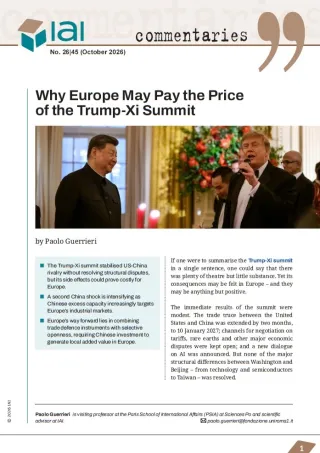
If one were to summarise the Trump-Xi summit in a single sentence, one could say that there was plenty of theatre but little substance. Yet its consequences may be felt in Europe – and they may be anything but positive.
The immediate results of the summit were modest. The trade truce between the United States and China was extended by two months, to 10 January 2027; channels for negotiation on tariffs, rare earths and other major economic disputes were kept open; and a new dialogue on AI was announced. But none of the major structural differences between Washington and Beijing – from technology and semiconductors to Taiwan – was resolved.
The summit should therefore be seen as an exercise in stabilisation rather than reconciliation. The United States and China have certainly not established a new alliance, and we remain far from a genuine G2 capable of governing the world jointly. What is emerging instead is an attempt by the two superpowers to manage their rivalry so that it does not repeatedly degenerate into potentially devastating crises.
Yet this is precisely where the problems for Europe begin. When Washington and Beijing seek to stabilise their disputes bilaterally – particularly in areas such as trade, technological competition and access to critical raw materials – Europe risks being forced to adjust to decisions already taken elsewhere and paying a significant price in the process. This risk is heightened following the recent summit – with more Chinese goods flooding European markets.
A second China shock
Relations with China have become a central issue on the European Union’s economic and political agenda. This is not only due to Europe’s high dependence on China for many critical raw materials and strategic components. It is also due to the huge and increasing trade deficit with China, that reached almost 360 billion euros in 2025 – close to 1 billion per day, as Commission President Ursula von der Leyen recently underlined.
Hence the growing debate over a “second China shock”: the surge in imports of Chinese manufactured goods that is already putting increasing pressure on European industries and is likely to intensify further.
Unlike the first China shock 20 or 25 years ago, which mainly involved low-cost, relatively low-tech manufactured goods, today’s challenge increasingly concerns sectors in which Europe until recently possessed important industrial and technological advantages: automobiles, batteries, solar panels, machinery, chemicals, semiconductors and, increasingly, digital technologies.
And the outcome of the Trump-Xi summit could add further momentum to this influx of Chinese products and technologies into European markets.
The bill for Europe
The extension of the US-China trade truce is undoubtedly good news for the stability of the global economy. Europe has no interest in seeing the world’s two largest economies plunge into another uncontrolled trade war.
But there is a downside. The United States will continue to impose high tariffs on many Chinese products, while China will preserve its growth model which remains heavily dependent on manufacturing and exports to the rest of the world. As a result, a growing share of Chinese excess production capacity will seek alternative outlets in third markets – and the wealthy European market is an obvious destination. The consequences could be increasingly serious for European firms, investment and industrial employment.
Even more alarming is what has happened in the field of artificial intelligence (AI). The United States and China are engaged in a fierce technological competition. The summit opened a new channel of dialogue between Washington and Beijing on AI, although its scope and prospects remain uncertain. Indeed, President Trump’s subsequent remarks have already cast doubt on how far bilateral cooperation on AI governance will extend. Nevertheless, the strategic dialogue on AI is effectively becoming the exclusive domain of China and the United States.
The underlying message for Europe remains uncomfortable. Europe may be a leader in regulating AI, but unless it develops its own industrial, infrastructural and technological capabilities, it risks increasingly regulating technologies designed and produced elsewhere.
The broader risk, therefore, is not only an escalating conflict between the United States and China. There is another, less discussed possibility: a succession of selective bilateral deals in which Washington and Beijing reach compromises on trade, technology, rare earths, or other strategic issues according to their own interests, without creating a genuinely multilateral framework. Europe would be left to deal with the consequences of decisions in which it had little or no influence.
What policy towards China?
One important lesson from the summit is therefore that Europe needs to develop a much stronger autonomous negotiating capacity towards China, clearly defining its interests and acquiring the means to defend them.
Simply following US policy towards Beijing will not be sufficient. This is especially true under President Trump, whose approach to China is explicitly bilateral and transactional. His administration may seek cooperation from allies on defence or supply commitments, but Washington will ultimately negotiate with Beijing according to its own priorities and no consideration of allies.
What, then, should Europe’s policy towards China be?
Neither full decoupling nor a return to the old policy of unconditional engagement appears realistic. Given the scale of economic relations, genuine decoupling would be extraordinarily costly. Trade will remain substantial, but economic-security considerations will increasingly reshape the nature of European interdependence with China.
Semiconductors, rare earths, permanent magnets, batteries, inverters, telecommunications, cloud computing and certain dual-use technologies will increasingly be treated not simply as commercial goods but as essential components of economic security.
China’s industrial overcapacity and large trade surplus will remain another central issue. Europe should consequently move towards a stronger combination of trade-defence measures, local-content requirements, European preferences in public procurement, investment screening, and targeted sectoral measures in areas such as automobiles, batteries, solar technologies and chemicals.
The European Commission’s proposed Industrial Accelerator Act already points in this direction, including “Made in EU” provisions and conditions designed to ensure that major foreign investments generate employment, local value creation and technology transfer within Europe.
At the same time, Europe should increasingly favour “localised” Chinese investment: encouraging Chinese firms seeking access to the European market to produce more in Europe, employ European workers, develop local supply chains and, where appropriate, transfer technology and know-how.
This is very different from indiscriminate protectionism. Indeed, it resembles in several respects the strategy China itself pursued towards Western investors for decades.
Transforming interdependence into negotiating power
The future EU-China relationship is therefore likely to become more confrontational, selective and transactional – and consequently more difficult to manage. But its importance will not diminish. On the contrary, it will increase. Commissioner Stéphane Séjourné recently described the need to rebalance trade with China as “existential for Europeans”.
The Commission has made clear that the present trade imbalance is unsustainable and has called for concrete results on Chinese exports, market access and critical raw materials. President von der Leyen has warned that the EU will use the instruments at its disposal if dialogue fails to produce results.
However, China is currently refusing to engage. It is unwilling to even acknowledge the problem. This is demonstrated by its refusal to sign the G20 declaration on excessive external imbalances.
The real question is whether Europe possesses not only the instruments but also the political capacity to use them coherently.
In today’s global economy, economic and industrial dependencies have become instruments of power. China has learned to transform interdependence into negotiating leverage. The United States is increasingly attempting to do the same.
Europe has far less capacity to respond in kind. Yet it possesses a market comparable in size to China’s, enormous industrial and technological capabilities, and substantial private savings. Its fundamental weakness is its much more limited capacity to transform these economic assets into political and negotiating power.
To do so, Europe must increasingly present itself as a single interlocutor rather than, as too often in the past, as 27 countries pursuing separate policies. The EU member states are reluctant to do so. In a world increasingly shaped by strategic competition between the United States and China, Europe’s real risk is not that it is too small. It is that it continues to behave as if it were.
Paolo Guerrieri is visiting professor at the Paris School of International Affairs (PSIA) at Sciences Po and scientific advisor at the Istituto Affari Internazionali (IAI).