Titolo completo
China’s Building Blocks for an Alternative Monetary System
|
The People’s Republic of China has decided that it cannot be a hegemonic power without an international currency. So much is increasingly recognised abroad. What is far less understood is the route it has chosen, because it bears little resemblance to how the dollar, the pound or the euro became international currencies.
The standard route runs through the capital account. The issuer opens its financial markets, supplies its currency to the world through external deficits, and lets non-residents accumulate claims on it. China’s starting conditions rule that out. It is a net external creditor with a persistent and large current account surplus, and its currency is not fully convertible. It cannot supply renminbi to the world by running deficits, and it will not supply them by opening the capital account.
So, it is doing something else. It is pushing the renminbi (RMB) abroad through trade settlement and through funding extended by its own banks, and it is building the payment, custody and – increasingly – trading infrastructure to carry those flows outside the dollar system. The result looks less like the internationalisation of a currency and more like the construction of an alternative monetary system for the renminbi’s cross-border use: one in which Chinese entities supply, Chinese entities absorb, and Chinese infrastructure clears.
The conventional scoreboard remains unflattering
The renminbi is not yet a relevant reserve currency especially considering the huge size of the Chinese economy. With a 19 per cent share of global GDP and more than 12 per cent of world trade, the renminbi accounts for about 2 per cent of official foreign exchange reserves and somewhere between 2 and 3 per cent of payment value on the SWIFT payment system.[1] As of the first quarter of 2026 the renminbi’s share of SWIFT payments hovered around 3 per cent, well behind the US dollar, close to half of total, and the euro, around a fifth of total. Only 2.1-2.3 per cent of total official foreign reserves are allocated in renminbi, according to International Monetary Fund (IMF) data.[2] Most importantly, this very tiny share has barely moved since the currency entered the IMF’s Special Drawing Rights (SDR) basket[3] in October 2016.[4]
Figure 1 (left) | Share of payments via SWIFT (%); Figure 2 (right) | Share of global allocated reserves (%)
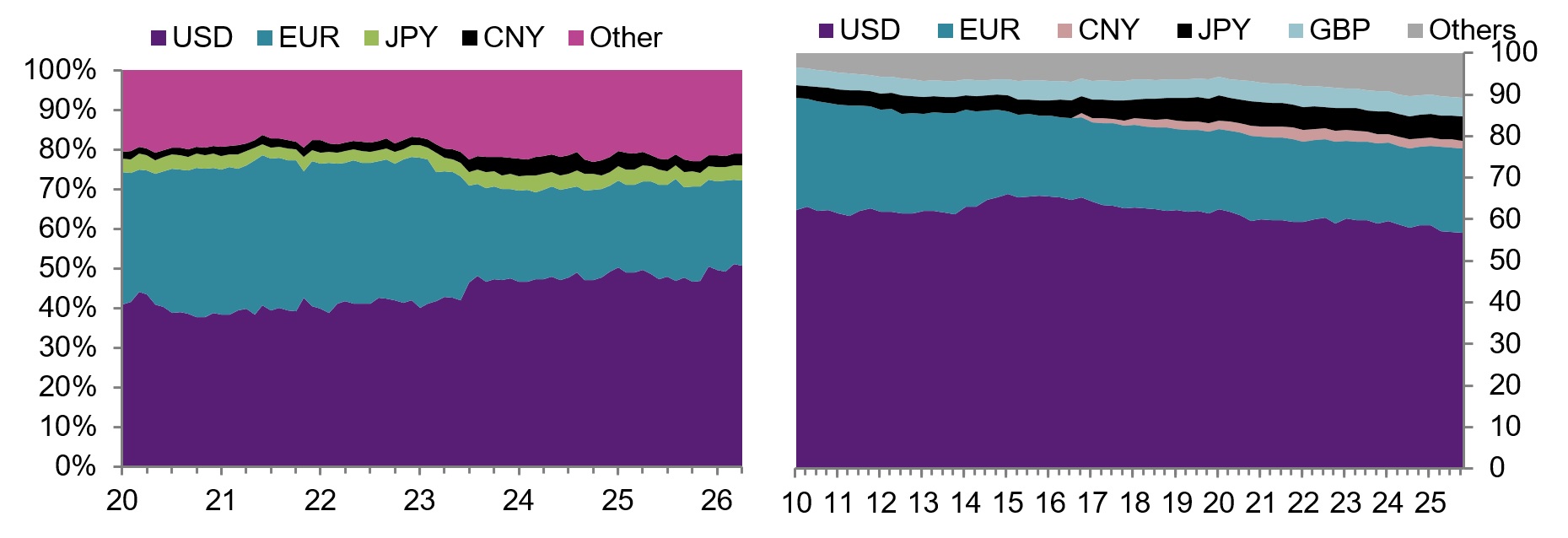
Sources: Natixis, SWIFT (left); Natixis, SWIFT, IMF, PBoC (right).
The lack of convertibility is very much behind the poor appetite for the renminbi as investment currency. Reserve managers and global asset managers do not judge a currency by the size of the economy behind it; they judge it by whether they can get in and, more importantly, out of the domestic market, but also how liquid financial markets are. In additional, the return of such investment is also relevant and there the renminbi fares increasingly poorly given the very low returns of renminbi investments as a consequence of China’s structural deflationary pressures from excess savings.
There is, however, a specific area where the renminbi has made great strides, namely on trade finance. In fact, the renminbi had overtaken the euro as the second most-used currency in global trade finance.[5] The gap between the use of renminbi as trade finance currency and as an investment currency captures the lopsided nature of the renminbi rise. What has enabled it is not capital account but trade and funding.
Trade-driven traction
The first leg of the renminbi’s alternative route to internationalisation is trade. After having fully liberalised its current account as part of its commitments to enter the World Trade Organization (WTO), China has been pushing for its own trade to be invoiced and settled in renminbi since 2010, when it launched a strategic plan to liberalise its currency. The push suffered a severe setback in 2015: after the surprise devaluation of the renminbi on 11 August 2015, capital outflows surged and the People’s Bank of China (PBoC) lost 1 trillion US dollars of its reserves from a peak of about 4 trillion in June 2014. Beijing was forced to tighten capital controls, and the renminbi internationalisation drive stalled for several years.
The limited progress in the renminbi internationalisation for more than a decade turned into a success after Covid and, especially, Russia’s invasion in Ukraine and the abrupt increase in Western sanctions on Russia. The weaponisation of the US dollar – as well as other G7 currencies, so that sanctions on Russia could bite – helped China promote the use of the renminbi. In particular, renminbi settlements in goods trade have risen from roughly 12-13 per cent of the total in 2018 to close to 30 per cent today,[6] and the renminbi’s share of global trade finance instruments has climbed to the high single digits, placing it second worldwide behind an overwhelmingly dominant dollar.
Figure 3 | Renminbi settlement in trade of goods
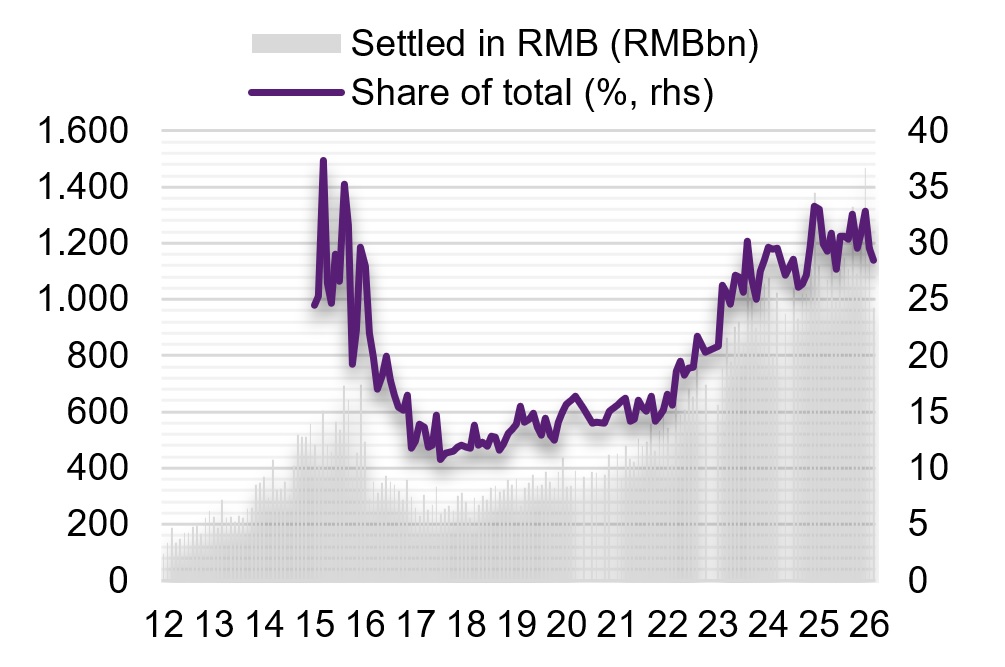
Sources: Natixis, PBoC, HKMA.
This conversion of China’s trade dominance into currency share is the least surprising part of the story. The more interesting driver emerged in 2022, when Chinese policy rates fell as US and European ones rose. Against the backdrop of disinflation, the PBoC has cut the key interest rate from 2.2 per cent to 1.4 per cent since 2022 while the US Federal Reserve raised its policy rate to as high as 5.5 per cent and the European Central Bank to 4 per cent (Deposit Facility Rate) to cap the rampant price increase, opening gaps of several hundred basis points. As a result, the renminbi traded persistently as a discount funding currency, and Chinese onshore government-bond yields fell below comparable US Treasury yields for the first time in the modern era, a gap which has only increased as China’s government yields have continued to trail downwards.[7] As a consequence, the renminbi became one of the cheapest funding currencies in Asia. This has clearly helped lift the use of the renminbi as funding currency, especially for trade.
Figure 4 | Ten years Treasury Bond yield (%)
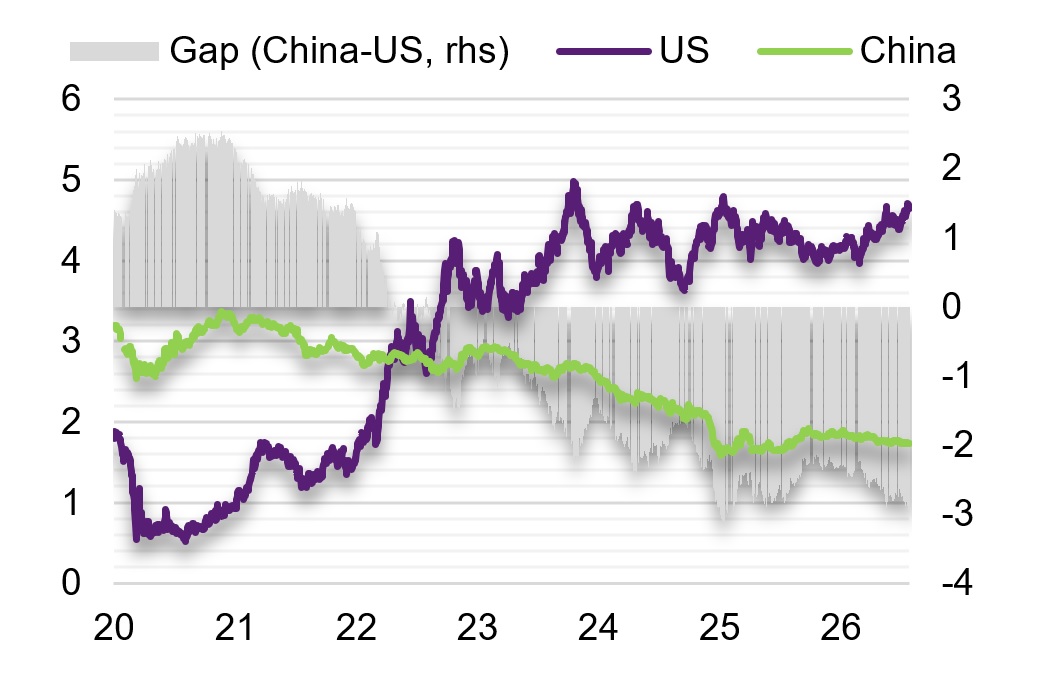
Sources: Natixis, New York Fed, CFETS. Data as of 7 July 2026.
From surplus to overseas assets
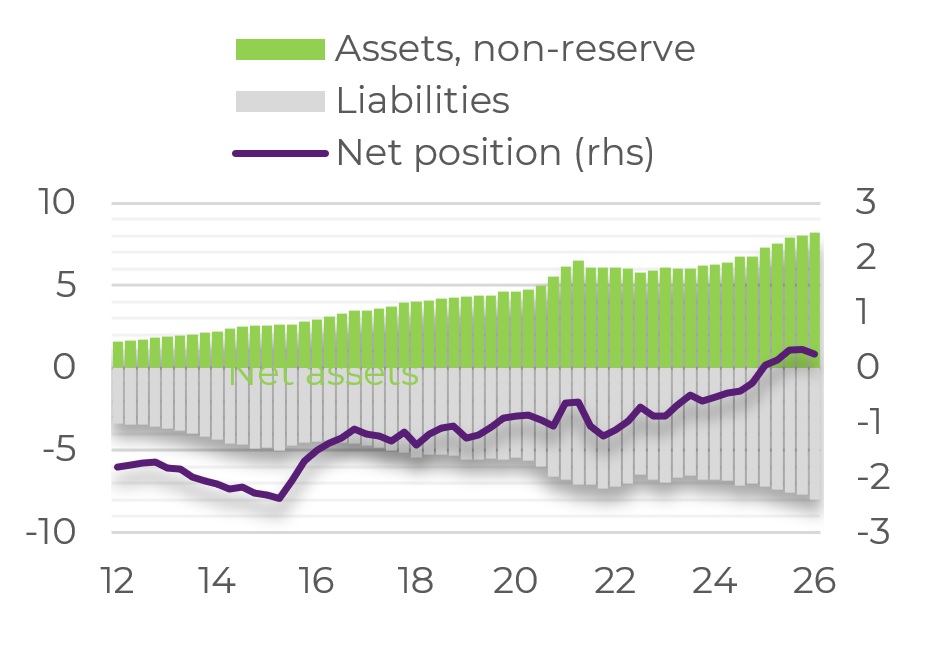
The second leg of the renminbi internationalisation follows from China’s external position. The persistent current account surplus is mirrored, by construction, in a financial account deficit: China is a net exporter of capital. Successive years of surplus have turned the country into a substantial net creditor, with an international investment position dominated by outward claims – official reserves historically, and increasingly the foreign assets of Chinese banks and corporates. By the end of 2024 China’s net international investment position exceeded 3 trillion US dollars, and the overseas assets of Chinese resident entities surpassed 8 trillion, giving Beijing an enormous stock of external claims it can seek to redenominate.
Figure 5 | International investment (trillion US dollars)
Sources: Natixis, SAFE. Data as of Q1 2026.
That is the raw material for currency internationalisation along this route. If the world does not accumulate renminbi claims on China, then China will accumulate claims on the world – and it can choose to denominate them in its own currency. In other words, China aims at internationalising its currency by the “renminbisation” of its own foreign assets. Given how relevant Chinese banks have become in China’s overseas assets, by lending to the Global South, the central role of banks in this endeavour should not surprise anybody.
The “renminbisation” of banks overseas assets
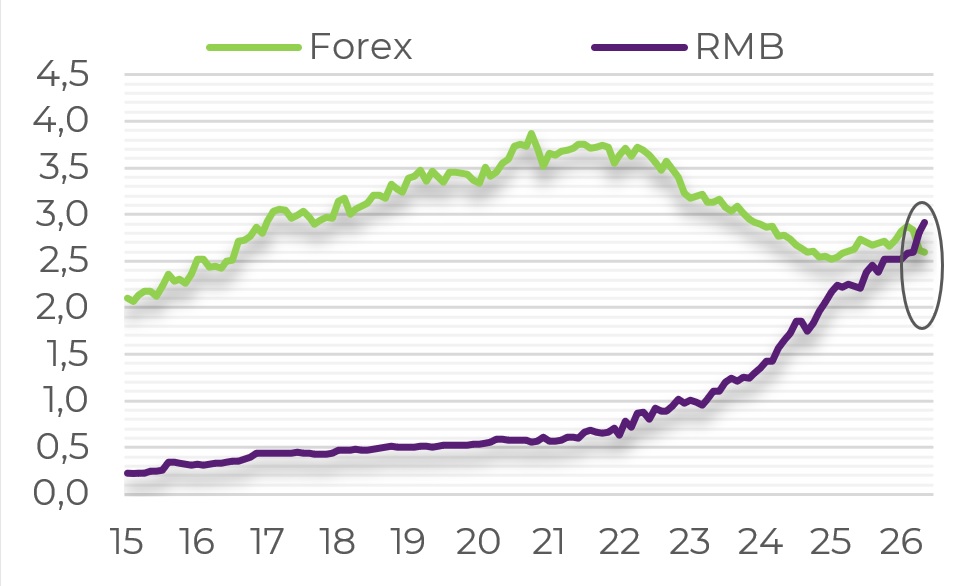
Chinese banks have massively expanded their balance sheet in the past twenty years, starting with the stabilising role they played during the 2008 global financial crisis.[8] An increasing – although still limited – part of their assets is overseas, mostly cross-border loans to finance infrastructure projects under the Belt and Road Initiative (BRI) and, more generally, outbound investment. Launched in 2013, the BRI provided the initial vehicle for this outbound lending, and, although the headline pace of BRI lending slowed after 2019, its currency composition has since shifted markedly towards the renminbi. Banks’ overseas lending denominated in renminbi has grown far faster than their dollar lending. Banks are responding to a dual mandate. The commercial one is that offshore renminbi loans are benchmarked to offshore rates and therefore yield more than comparable onshore assets, while carrying no currency risk for a renminbi-funded lender. The political one is that Beijing wants the currency used abroad, and the large state banks are keen to help with this policy objective.
Figure 6 | Overseas loans by currency (trillion renminbi)
Sources: Natixis, SWIFT. Data as of May 2026.
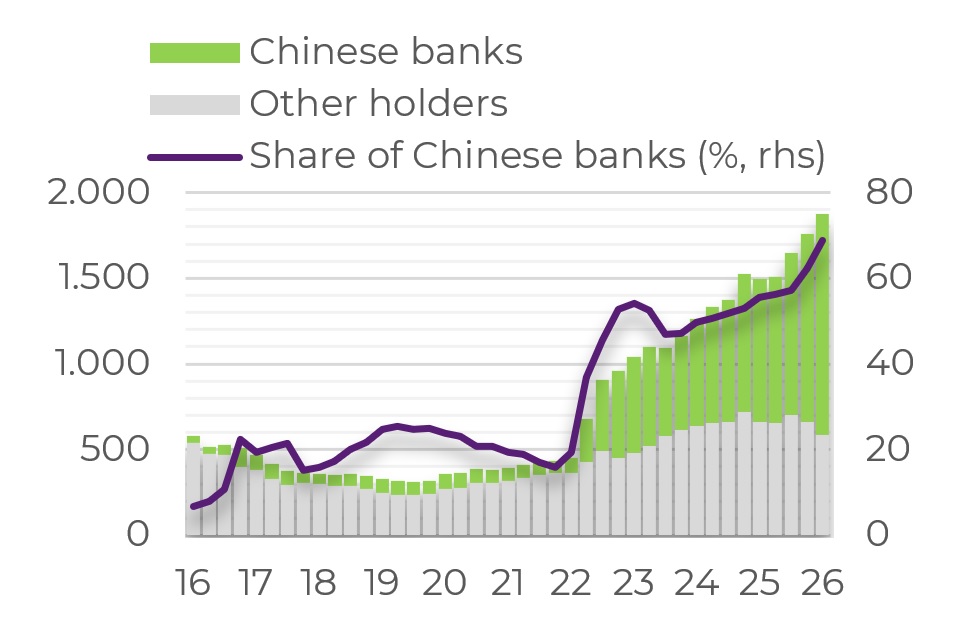
Beyond banks, the offshore bond market has followed the same logic. Dim sum bond issuance – renminbi-denominated bonds issued in Hong Kong – has run at record levels since 2022 and the outstanding stock has multiplied, driven by the same arbitrage: cheap onshore funding, higher offshore yields, no foreign exchange mismatch. Gross dim sum bond issuance reached record levels – on the order of 1 trillion renminbi a year – in 2024-2025 and offshore renminbi bonds have risen to a low-double-digit share of total renminbi bond issuance, up from a negligible fraction before 2022. Hong Kong’s role as the pool for offshore renminbi (CNH) assets, such as renminbi bonds and loans, has been reinforced accordingly. Interestingly, an increasing part of these CNH assets are bought by Chinese banks, which also contributes to the “renminbisation” of their foreign assets.
Figure 7 | Outstanding dim sum bond by holder (billion renminbi)
Sources: Natixis, SAFE, Bloomberg. Data as of Q1 2026.
So, the renminbi is reaching the world – but through credit extended by Chinese institutions rather than as an asset demanded by foreign ones.
The missing piece: Foreign investment in renminbi
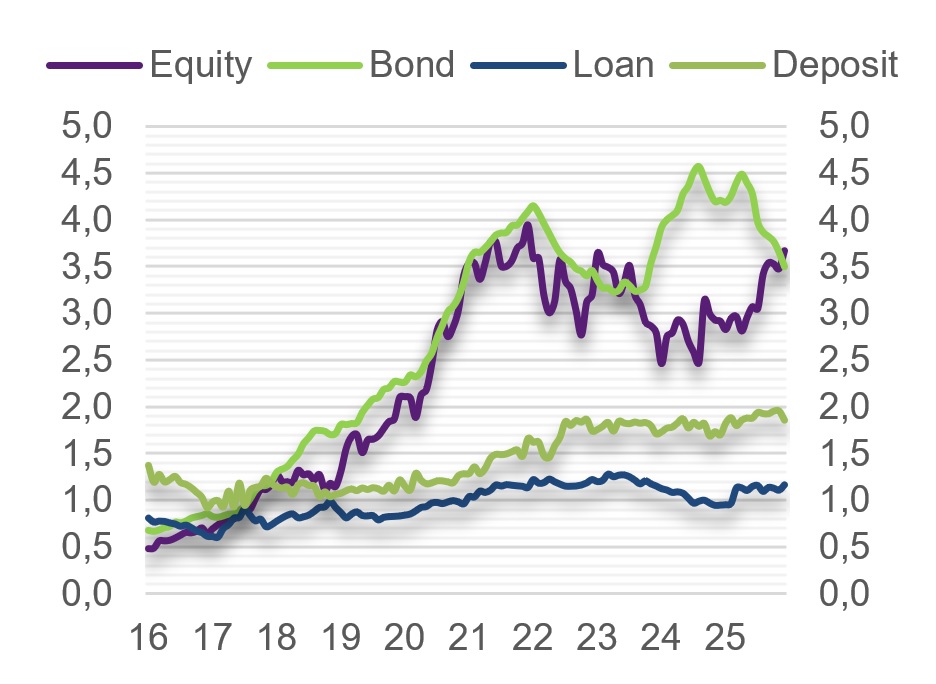
Foreign investors, both public and private, have been quite reluctant to hold renminbi assets, whether as fixed income or equity. Foreign holdings of onshore renminbi bonds stood at about 3.2 trillion renminbi at the end of June 2026, following eleven consecutive months of net selling through March – a fall of roughly 28 per cent, or 1.25 trillion renminbi, from the peak[9] due to downbeat yields. Offshore, the dim sum market has boomed, but issuance is overwhelmingly Chinese credit risk bought by Chinese balance sheets, with genuinely foreign issuers and foreign buyers being just a small minority.
Figure 8 | Foreign holding of onshore renminbi asset (trillion renminbi)
Sources: Natixis, PBoC, HKMA.
This is a monetary alternative system rather than currency internationalisation in the usual sense. It is a closed loop: Chinese entities issue, Chinese entities buy, Chinese infrastructure clears, and the currency circulates abroad without ever requiring a foreign investor to want it. The loop is resilient – it is largely immune to shifts in global risk appetite – but it is also self-limiting.
Policy has now begun to address these limitations. At the Lujiazui Forum on 17-18 June 2026, PBoC Governor Pan Gongsheng announced that the PBoC[10] established an RMB Repo Facility for Foreign and International Monetary Authorities, the so-called FIMA RMB Repo. The latter allows foreign central banks and monetary authorities, international financial organisations and sovereign wealth funds to obtain short-term renminbi liquidity directly from the central bank against Chinese collateral, namely Chinese government bonds and other high-grade collateral. The name of this new facility deliberately mirrors the Federal Reserve’s facility of the same type because they have the same rationale: US Treasuries are the premier reserve asset partly because they can be financed rather than only sold. In contrast, foreign investors holding Chinese bonds have until now had no way to turn them into cash without selling into the market. And even outright sale is not always straightforward: onshore secondary liquidity is much thinner than in the US Treasury market, so a foreign holder trying to exit a large position in stressed conditions could move prices against itself or run into repatriation frictions.
Several other measures point the same way. Hong Kong is launching Chinese government bond futures in early August, closing a long-standing gap when it comes to the holdings of Chinese fixed income assets, namely the lack of duration hedging without which global asset managers do not hold an asset at scale.
These measures are worth flagging as the first coherent attempt to make renminbi assets tradeable, financeable and hedgeable for non-residents – although not really for all as the facility is open to the official sector only (finance ministries, central banks, sovereign funds, international financial institutions). Private investors face the same repatriation and hedging frictions as before, and low onshore yields mean that hedged returns on Chinese bonds remain unattractive. But these new steps show that Beijing is now helping the renminbi become an investment currency. The very low yields on renminbi will probably continue to put off investors, even official ones, but the call for diversification away from the US dollar may be enough to create some demand.
Financial infrastructure is the other key theme
Chinese policy makers have long been worried about the powerful extraterritoriality of the US dollar and how it may impact China. This became clear when the West imposed sanctions on Russia following its annexation of Crimea in 2014 – an episode Chinese policymakers studied closely as to risks associated with the dollar system in extreme situations – and even more so after Russia’s full-scale invasion of Ukraine in February 2022.
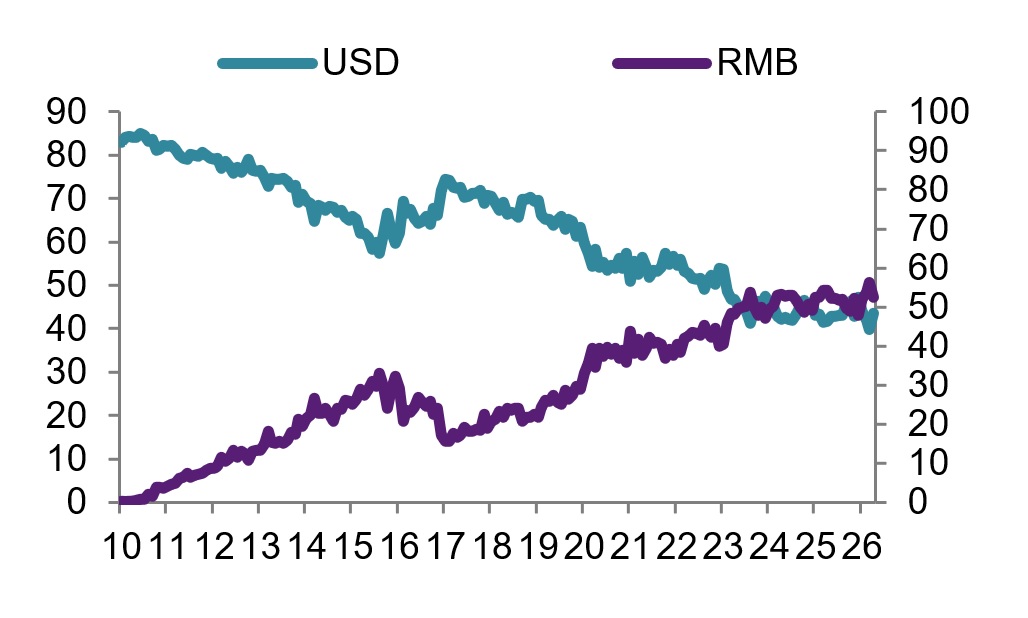
China’s most important attempt to build an alternative financial structure is the Cross-border Interbank Payment System (CIPS) that the PBoC established on 8 October 2015.[11] Since then renminbi cross border payment transactions have been growing steadily. The turning point came in March 2022, when several Russian banks were disconnected from SWIFT; interest in CIPS as an insurance policy against exclusion rose sharply thereafter, particularly among counterparties trading with Russia and Iran. The fact that CIPS has developed its own messaging system, instead of relying on SWIFT, has made it a valuable option for cross-border payments potentially subject to sanctions. In 2024 CIPS handled some 175 trillion renmimbi in transactions, up more than 40 per cent year on year, and by 2025 it linked more than 170 direct and over 1,500 indirect participants across some 120 countries and regions – still a fraction of SWIFT’s reach, but a functioning parallel rail.[12]
Figure 9 | China: Bank foreign payments and receipts on behalf of clients (%)
Sources: Natixis, SAFE, PBoC.
Securities settlement is the newer front with the development of an international central securities depository in renminbi from Hong Kong. OmniClear, or more precisely CMU OmniClear Limited, has operated since January 2025 as the Hong Kong Monetary Authority’s Central Moneymarkets Unit, and since March 2025, together with Hong Kong Exchanges and Clearing, as a CNH securities depository, which makes it a deliberate counterpart to Euroclear for CNH assets.
This piece of infrastructure is very important since a currency cannot be held at scale without a custody and settlement layer trusted by its holders; building one that does not route through Euroclear, the Brussels-based global clearing house and central depository for cross-border securities, is a strategic choice, not a technical one.
Foreign exchange is the logical next step, and it has now started. The PBoC has launched an offshore renminbi FX trading pilot in the Shanghai free trade zone, authorising ICBC, Agricultural Bank of China, Bank of China, China Construction Bank, Bank of Communications and CITIC to trade offshore renminbi through the China Foreign Exchange Trade System. The renminbi already ranks fifth in global FX spot volumes and exchange-traded renminbi derivatives have grown quickly. In the Bank for International Settlements’ 2025 triennial survey, the renminbi ranked fifth among the most-traded currencies, with a turnover share of roughly 9 per cent (out of 200 per cent), its highest on record, and Chinese-currency derivatives on exchanges in Hong Kong and Singapore have deepened since.[13] The question the offshore renminbi FX trading pilot raises is whether China eventually wants its own Continuous Linked Settlement (CLS) – a settlement venue for renminbi pairs outside the incumbent, dollar-anchored infrastructure. The sequencing followed by Beijing so far suggests it does.
Digital finance: Two rails, tightly held
The final element is digital. The electronic onshore renminbi (e-CNY) was formally launched at the Beijing Winter Olympics in February 2022, having been piloted in selected cities since 2020, and then substantially reformed with effect from 1 January 2026. The reform clearly aims at making it more attractive as it now bears interest at 0.05 per cent and sits as a commercial bank liability covered by deposit insurance rather than as a direct central bank liability backed by sovereign credit. The Shanghai e-CNY international operations centre is now fully operational, with a cross-border e-CNY transfer platform live alongside it and agreements with Hong Kong, and specific countries, namely Thailand and United Arab Emirates (UAE) through Memoranda of Understanding to facilitate its circulation. The digital-yuan international operations centre in Shanghai was itself unveiled at the June 2025 Lujiazui Forum and became operational over the following year, giving Beijing a cross-border rail for the e-CNY that sits entirely outside the dollar-based correspondent banking system.
This reform is best read as clearing the field. An interest-bearing digital renminbi squeezes out the space for renminbi-pegged stablecoins onshore, which is consistent with China’s general ban on crypto – one of the most restrictive regimes in Asia Pacific. At the same time, though, Chinese policy makers are concerned about the attractiveness of US dollar stablecoins, which are dragging capital out of China. Against such backdrop, Hong Kong has passed its Stablecoin Ordinance with a non-interest-bearing requirement that confines stablecoins to a payments role and prevents them from competing with the e-CNY for savings. That is a two-rail approach conducted with extraordinary caution: experimentation permitted offshore, under a licensing regime, with strict surveillance and the occasional verbal intervention from Beijing when the experiment drifts.
The unconventional rise of renminbi
The renminbi’s international rise is real but unconventional. It rests on trade settlement thanks to China’s trade dominance, and on funding, which leverages very low domestic interest rates and the balance sheets of Chinese banks. It rests equally on infrastructure: CIPS for payments, OmniClear as an alternative to Euroclear for securities, and possibly a Chinese CLS for currencies. Foreign investors remain the missing piece, and the measures unveiled in June 2026 – the FIMA repo facility, bond futures in Hong Kong, wider QDII quotas, a tighter rate corridor – are the first serious attempt to bring them in without touching convertibility.
Whether that attempt succeeds is genuinely an open question. A liquidity backstop offered at the discretion of the issuing central bank is only as credible as that discretion, and reserve managers diversifying away from one politically administered currency will not be indifferent to the politics of the new money they choose.
The experience of 2022, when sanctions froze roughly half of Russia’s central-bank reserves almost overnight, is precisely what makes some reserve managers willing to accept lower yields for a non-Western alternative; whether that willingness extends beyond a handful of geopolitically aligned holders remains the central open question. The surplus arithmetic still binds: a country that exports capital cannot easily supply the world with savings assets denominated in its own currency.
But the direction is not in doubt, and the environment is helping. The realignment of the global economy and the weaponisation of currencies and cross-border payment systems by the United States and its allies have done more for this project than any policy Beijing could have designed on its own.
Alicia Garcia Herrero is the Chief Economist for Asia Pacific and Middle East at Natixis and Senior Research Fellow at Bruegel.
Paper produced in the framework of the IAI-Intesa Sanpaolo Partnership. The views expressed in this report are solely those of the author.
[1] SWIFT Global Currency Tracker, retrieved from https://www.swift.com/products/global-currency-tracker/document-centre.
[2] IMF Currency Composition of Official Foreign Exchange Reserves, retrieved from https://data.imf.org/en/datasets/IMF.STA:COFER.
[3] The SDR is an international reserve asset whose value is based on a basket of five currencies – the US dollar, the euro, the Chinese renminbi, the Japanese yen and the British pound sterling. The SDR itself is not a currency but an asset that holders can exchange for currency when needed. The SDR serves as the unit of account of the IMF and other international organisations. See IMF website: Special Drawing Rights (SDR), https://www.imf.org/en/about/factsheets/sheets/2023/special-drawing-rights-sdr.
[4] IMF, IMF Adds Chinese Renminbi to Special Drawing Rights Basket, 30 September 2016, https://www.imf.org/en/news/articles/2016/09/29/am16-na093016imf-adds-chinese-renminbi-to-special-drawing-rights-basket.
[5] SWIFT, Global Currency Tracker July 2026, https://www.swift.com/sites/default/files/files/global-currency-tracker_july-2026.pdf.
[6] China’s State Administration of Foreign Exchange website: Cross-border Receipts and Payments by Non-banking Sectors, https://www.safe.gov.cn/en/2019/0919/1561.html.
[7] China’s Ministry of Finance website: MOF-China Government Bond Yield Curve, https://yield.chinabond.com.cn/cbweb-czb-web/czb/moreInfo?locale=en_US&nameType=1.
[8] García Herrero, Alicia, “China’s Banking Goliath: From Growth Engine to Economic Drag”, in Bruegel Newsletter, 6 March 2026, https://www.bruegel.org/node/11945.
[9] García Herrero, Alicia et al., “Chinese Banks Overseas Expansion Increasingly Denominated in Renminbi”, in Asia Macro Insights, 8 July 2026, http://research.natixis.com/Site/en/publication/BcGMi4xEH1LovBHpOng3dg%3D%3D.
[10] Pan Gongsheng’s keynote address announcing the FIMA RMB Repo facility and the offshore renminbi FX trading pilot. See Bank for International Settlements (BIS), Keynote Speech by Mr Pan Gongsheng, Governor of the People’s Bank of China, at the 2026 Lujiazui Forum, Shanghai, 17 June 2026, https://www.bis.org/speeches/20260624-evolution-financial-structure-and-modernization-financial-markets-china. See also Silver, Andrew and Ziyi Tang“China Makes New Push to Take Yuan Global, Vows Vigilance against Financial Risks”, in Reuters, 17 June 2026, https://www.reuters.com/world/asia-pacific/chinas-financial-regulator-vows-risk-prevention-support-strategic-industries-2026-06-17.
[11] The People’s Bank of China launched CIPS (Phase 1) on 8 October 2015 with 19 direct and 176 indirect participants; by 2024 the system processed some 175 trillion renminbi in annual transactions.
[12] CIPS website: Clearing & Settlement > Statistics, https://www.cips.com.cn/kjjqgsyyingw/cipsfw/index.shtml#statistics.
[13] BIS website: Triennial Survey > Tables & Dashboards > Turnover of OTC Foreign Exchange Instruments, by Currency, https://data.bis.org/topics/DER/tables-and-dashboards/BIS,DER_D11_3,1.0.