Titolo completo
Climate, Peace and Security: Shrinking the Gap between Africa and Europe
|
The intersection of climate change, peace and security is one of the current defining policy challenges. No longer viewed solely as an environmental issue, climate change is now globally recognised as a “threat multiplier”. It interacts with existing socio-economic vulnerabilities, political instability and historical grievances to destabilise societies, disrupt livelihoods and trigger violent conflict. However, how this “nexus” is conceptualised is far from uniform. The African Union (AU) and its member states approach the issue through a lens of human security, sustainable development and resilience,[1] while the European Union and its member states have increasingly viewed the nexus through a framework of securitisation, border management, geopolitical stability and defence readiness.
Coherent efforts between Africa and Europe to better understand and coordinate policy and action on climate, peace and security are critical.[2] Both Africa and Europe have developed policy positions and practices to address this nexus including on climate risk assessments and sustainable investments. However, there is some divergence as Africa’s approach centres development, while the EU’s stance is increasingly securitised. Bridging the gap between the AU and the EU requires integrated thinking that is solutions-oriented and action-driven, rather than focused solely on the problems.
Nothing new under the African sun: A long history of climate, peace and security
For Africa, the climate, peace and security nexus is not new. Historically, traditional African governance structures, regional mechanisms and civil society have managed the direct security implications of ecological shifts. In the Sahel, the Horn of Africa and the Lake Chad Basin, indigenous conflict-resolution mechanisms have historically mediated disputes over shifting grazing routes, drying water bodies and seasonal migrations.
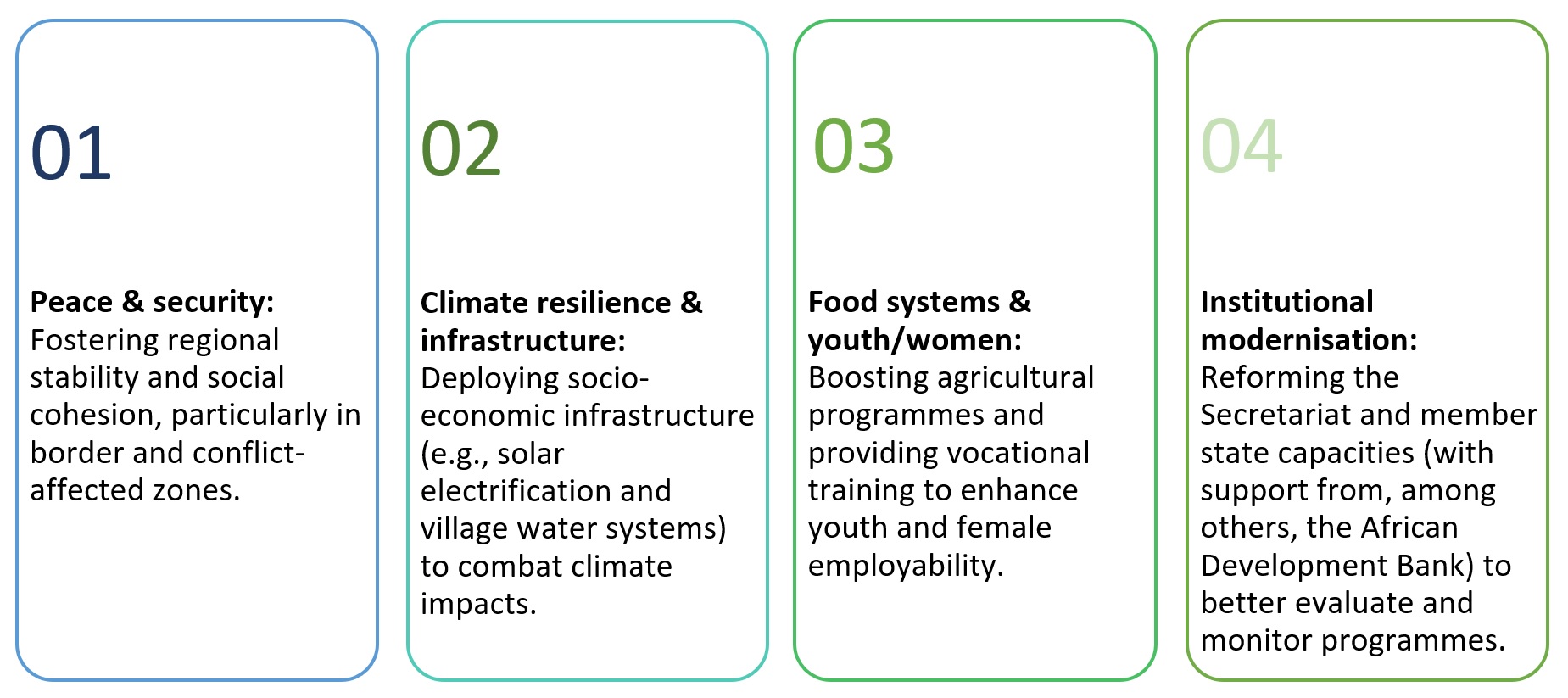
Outside of the traditional, at national, regional and continental levels, discussions on common security and the importance of shared resources, including those impacted by climate change, have been a feature since at least the 1950s. Long before the AU was established, for example, the oldest regional cooperation organisation on the continent, le Conseil de l’Entente (‘Council of Accord’), was created in 1959 by Côte d’Ivoire, Niger, Burkina Faso (then Upper Volta) and Benin (then Dahomey), and joined in 1966 by Togo, to advance joint development through integration and communal resource management.[3] Central among these was an understanding of the impact that climate disasters, in particular drought at the time, had on regional stability and, by extension, shared development. Today, the Conseil incorporates climate change mitigation and resilience into its sub-regional development and security strategies. The 2024-2028 Strategic Plan directly integrates sustainable development, peace, and climate resilience as top priorities.[4]
Figure 1 | Conseil de l’Entente 2024-2028 Strategic Plan
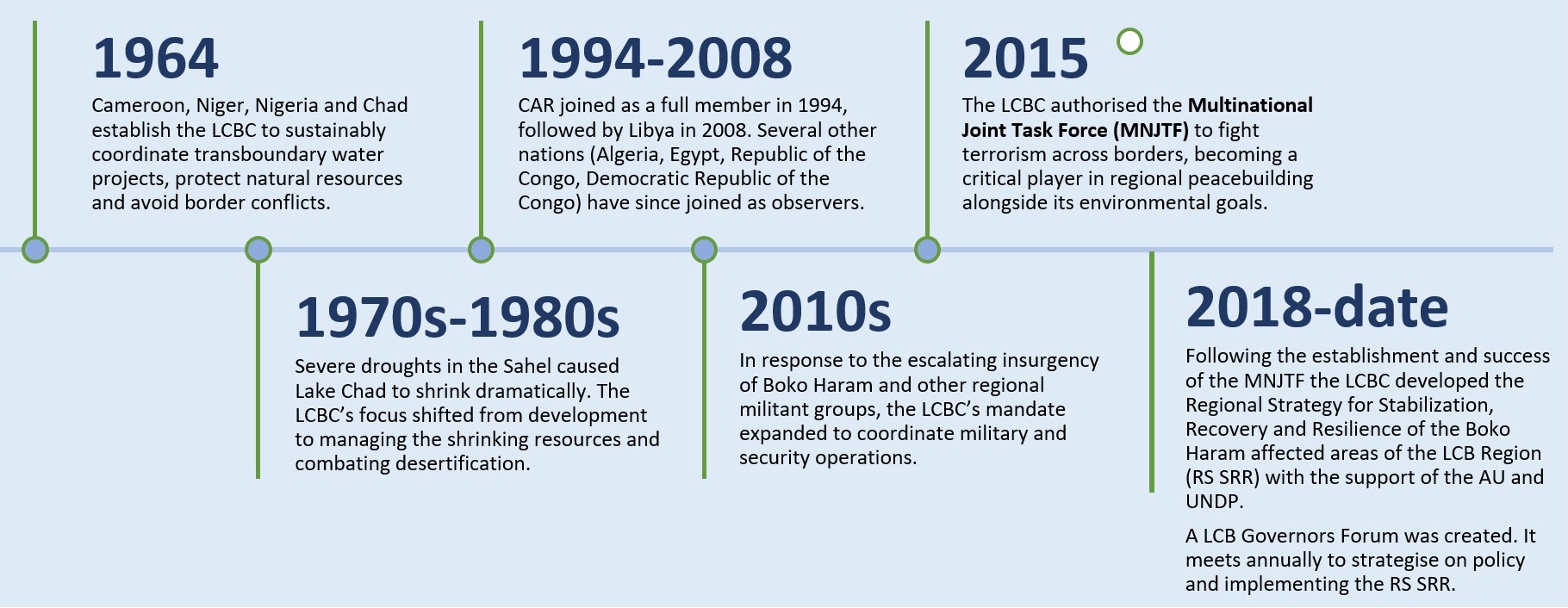
Similarly, the Lake Chad Basin Commission (LCBC), founded in 1964, was established when four riparian countries – Cameroon, Niger, Nigeria and Chad – signed a historic Convention to manage shared water resources and resolve cross-border disputes.[5] Headquartered in Chad’s capital N’Djamena, the Commission’s mandate centres on regional security. The Central African Republic (CAR) and Libya are also members of the Commission, having joined in 1994 and 2008, respectively. The LCBC addresses climate, peace and security by integrating climate adaptation with regional stabilisation efforts.[6] The unpredictability of Lake Chad’s basin since the 1960s is a textbook example.[7] Having shrunk for decades, leading to ecological collapse that directly accelerated poverty, which in turn fuelled recruitment by violent extremist groups like Boko Haram,[8] the basin’s partial resurgence has ignited a fresher cycle of instability.[9] Remedying this vicious cycle requires coordinated action that addresses the consequences, while advancing livelihoods, enabling resilience and sustaining stability for development.
Figure 2 | LCBC timeline
Other regions, such as the Horn, the Sahel and Southern Africa, are also impacted. In the Sudano-Sahelian zone, for example, southward desertification has altered traditional transhumance paths, forcing pastoralists into agrarian lands and sparking deadly conflicts over land tenure and water access. With over 60 per cent of the African population dependent on rain-fed subsistence agriculture,[10] erratic rainfall and prolonged droughts can destroy livelihoods.
Recognising that climate change and its impacts are not limited to specific geographies, the AU draws on the experiences of member states and regional mechanisms.[11] It views climate and security as key components of its peace and long-term development agenda.[12]
The AU has progressively institutionalised its human security approach to climate, peace and security. For example, the AU Peace and Security Council has held numerous high-level sessions dedicated to climate change, consistently framing it as a crisis that undermines the achievement of the development goals of Agenda 2063.[13] Furthermore, through the African Peace and Security Architecture (APSA), the AU and its member states increasingly integrate climate risk into conflict prevention and mediation toolkits, that are implemented by emphasising local ownership and community-led adaptation.
As the AU develops a Common African Position on Climate, Peace and Security (CAP-CPS),[14] drawing on the AU Peace and Security Council’s commissioned study on the nexus between climate change and conflicts, the Commission launched the Africa Climate Security Risk Assessment (ACRA) in August 2024.[15] A key finding of this assessment is that climate change affects food and water security, triggering resource competition and fuelling conflicts. Addressing this requires urgent, coordinated action. This is especially so in high-risk regions like the Sahel, the Lake Chad Basin and Somalia, where climate change compounds insecurity, leading to forced migration and instability.
Yet, recognising that climate change compounds insecurity and crises has not resulted in an AU approach that is heavily securitised. Instead, African perspectives on climate-conflict recognise environmental risks as systemic livelihood and human security crises. The appreciation of climate change’s direct impact on human survival, local livelihoods and community resilience means that policy and action remain focused on a broad framing of human security. The challenge is how to turn these sound policy positions to trackable implementation with results.[16]
The AU still faces structural and operational limitations in addressing the climate, peace and security nexus. Because climate is still compartmentalised outside of traditional peace and security discussions, the connection with insecurity may inadvertently be missed or poorly addressed. Further, much of the AU’s programming on climate, peace and security is externally funded – including by the EU and individual EU member states, such as Denmark, Germany and Sweden.[17] This external reliance is critical for the AU, but it can also diminish its ability to implement some of its own initiatives if funding is limited or unavailable. Significantly, conflict-affected states, which are the most fragile, face the greatest difficulty accessing climate financing as they lack the necessary systems and guarantees to ensure return on investment or repayment.
The EU approach: From rhetorical leadership to securitisation
When the EU began engaging on climate peace and security, its approach was from an environmental and sustainable development perspective, including through its involvement in developing and refining the 1994 United Nations Framework Convention on Climate Change (UNFCCC). Key EU-specific milestones in the 1990s included the establishment of the European Environment Agency (EEA) in 1990, which began systematically monitoring the environment and informing the public about ecological threats, forming the empirical basis for future security assessments. Having played an instrumental role in the negotiation of the Kyoto Protocol on carbon emissions reduction, the EU committed to driving regional economic and energy policy. During this early period, security was largely understood in military and state-centric terms, and environmental degradation and climate change were not seen as fitting into this security paradigm. This shifted from the early 2000s into the more security-focused approach today.[18]
The EU’s previous framing of climate change as a soft-power, diplomatic issue evolved into one that is part of institutionalised, defence-oriented ‘collective securitisation’.[19] This shift since the mid-2000s treats climate impacts as existential threats requiring emergency measures, particularly concerning resource competition, border management and military readiness.[20] In this way, climate change and its impacts are viewed both as an external threat (border disputes and displacement due to climate change) and as an internal risk requiring systemic changes to how the EU addresses its domestic impact.
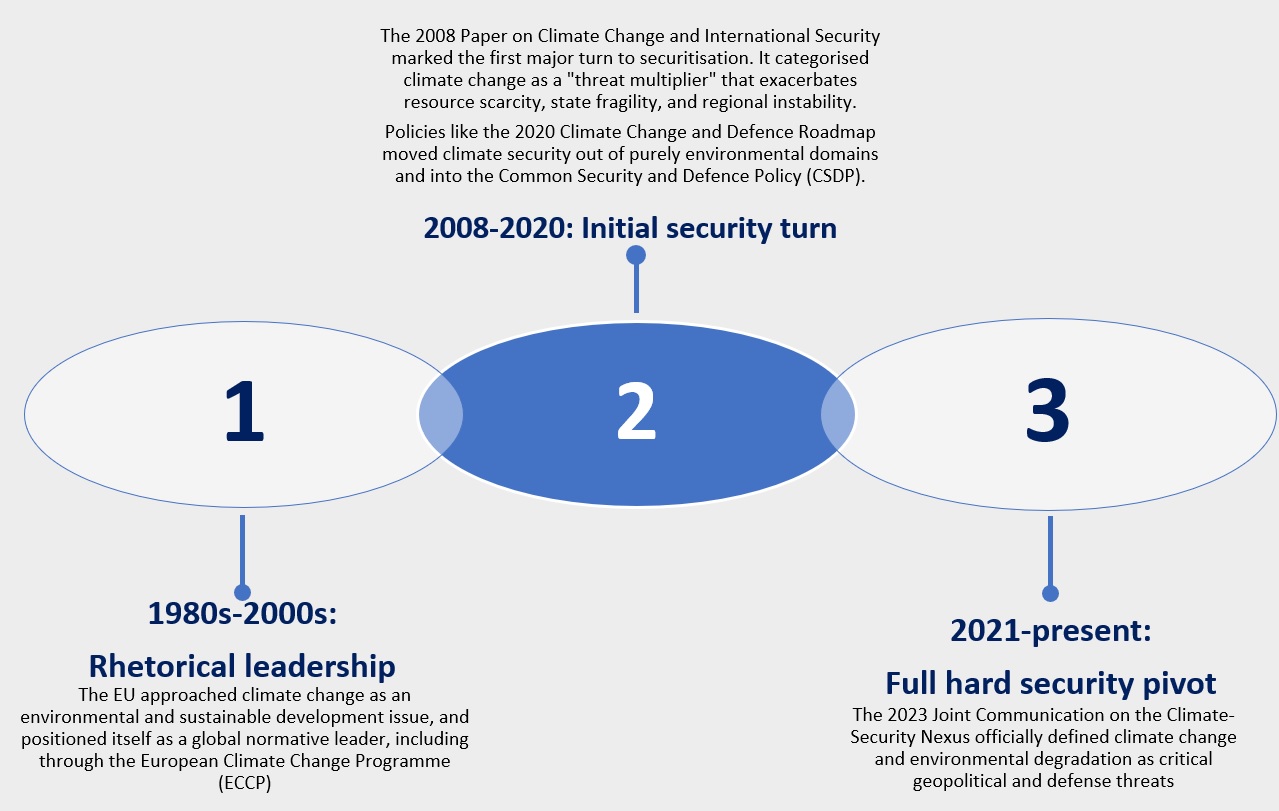
Early documents, such as the 2008 paperClimate Change and International Security by the High Representative and the European Commission, laid the groundwork by identifying climate change as a global threat multiplier.[21] The paper established that resource scarcity, environmental degradation and natural disasters would severely exacerbate existing national and regional tensions, thereby destabilising fragile states in Europe’s neighbourhood and directly threatening European interests. In the coming decade, the EU moved to more closely link energy with national security. The EU also connected efforts to mitigate the impact of climate change directly with energy dependency. Tensions in Eastern Europe, in particular, highlighted the vulnerabilities of relying on imported fossil fuels.[22] At this point, the EU began treating rapid decarbonisation and the green energy transition as both ecological obligations and critical components of geopolitical independence and energy security. As such, the 2016 EU Global Strategy for Foreign and Security Policy noted a direct link between climate change, state fragility and geopolitical conflict, making it a foundational element of EU external action.[23] More recently, instruments such as the 2020 Climate Change and Defence Roadmap, the 2021 Concept for an Integrated Approach on Climate Change and Security, and the 2023 Joint Communication on the climate-security nexus[24] formally recognised that climate change threatened Common Security and Defence Policy (CSDP) missions and infrastructure.
These instruments view the climate-peace-security nexus through a defence lens, grounded in policy and practice across three spaces.[25] First is the adaptation of military and humanitarian operations to climate change by focusing on how armed forces could reduce their fossil fuel dependency, adapt to extreme climate conditions, and improve resilience without compromising operational effectiveness. Second is the development of research and innovation capabilities to enhance evidence-based analysis and foresight. Third comes the analysis of the impact of climate change on the EU’s external action policies and activities. In practice, this has meant factoring in climate considerations across all EU external actions, requiring member states to adapt civilian and military infrastructure, upgrade early warning systems and address climate-induced displacement and migratory movements.[26] Importantly, the emphasis has been on using reliable and accessible evidence-based analysis on the climate and security nexus to inform policy and practice, including as the basis to reinforce international partnerships, in line with the EU’s climate change and environment agenda.
Figure 3 | The EU’s transition from norm entrepreneurship to hard security
The current EU approach increasingly treats climate change as a core, non-traditional security threat that must be integrated into foreign policy, defence and energy strategies. Some steps taken to date have included establishing a data and analysis hub within the EU Satellite Centre, deploying environmental advisors in EU missions and operations,[27] and developing internal expertise on vulnerable geographical areas, such as the Arctic and the Sahel.
Figure 4 | Climate and security nexus
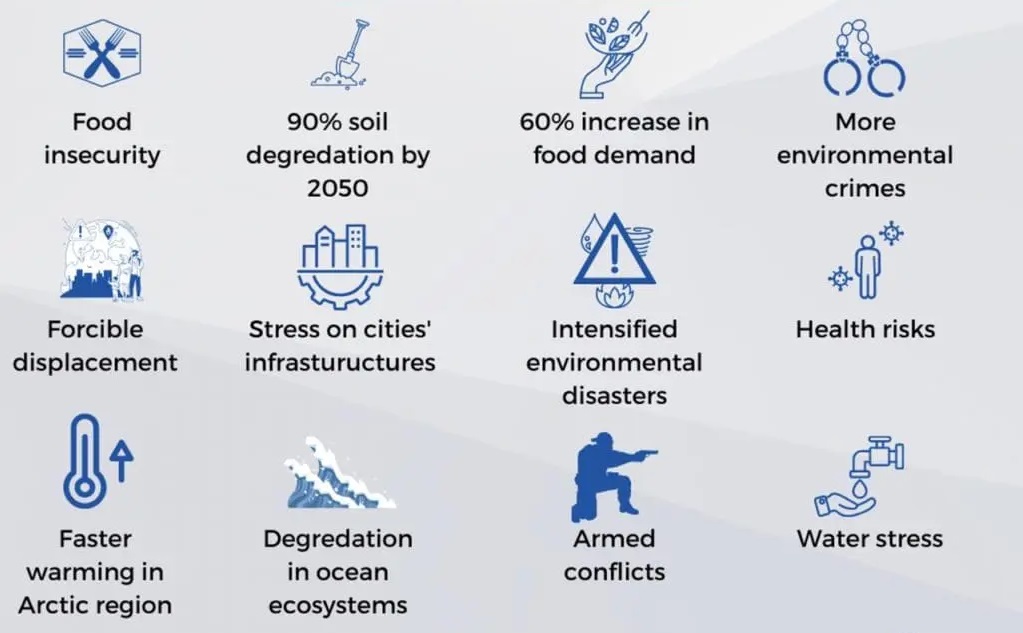
Source: Gülenç, Ilyas, “The New EU Security Paradigm: Climate and Security Nexus”, in Beyond the Horizon Commentaries, 31 July 2023, https://behorizon.org/?p=61088.
The transformations at the EU level reflect a broader geopolitical realism. It balances soft-power imperatives with the pragmatic need to protect European borders and interests amid worsening global climate-conflict dynamics. Yet, critics argue that framing climate change primarily through a defence lens has shifted resources toward border security, military preparedness and energy independence.[28] As a result, peace-focused activities and localised conflict resolution in fragile regions, such as the Sahel, the Lake Chad Basin and the Horn of Africa have seen funding declines relative to traditional security measures.[29] In the long term, over-securitisation can alienate the very populations the EU seeks to support, turning vulnerabilities into hard security standoffs.
Can the two worlds meet? Bridging the divide between the AU and EU
Increased securitisation narrows the focus and sidelines broader human security and livelihood issues that are critical for long-term stability and peace. The question, thus, is whether there is space for convergence – not only between the AU and the EU, but also between short- and long-term needs.
Figure 4 | EU-AU Joint partnership areas of cooperation
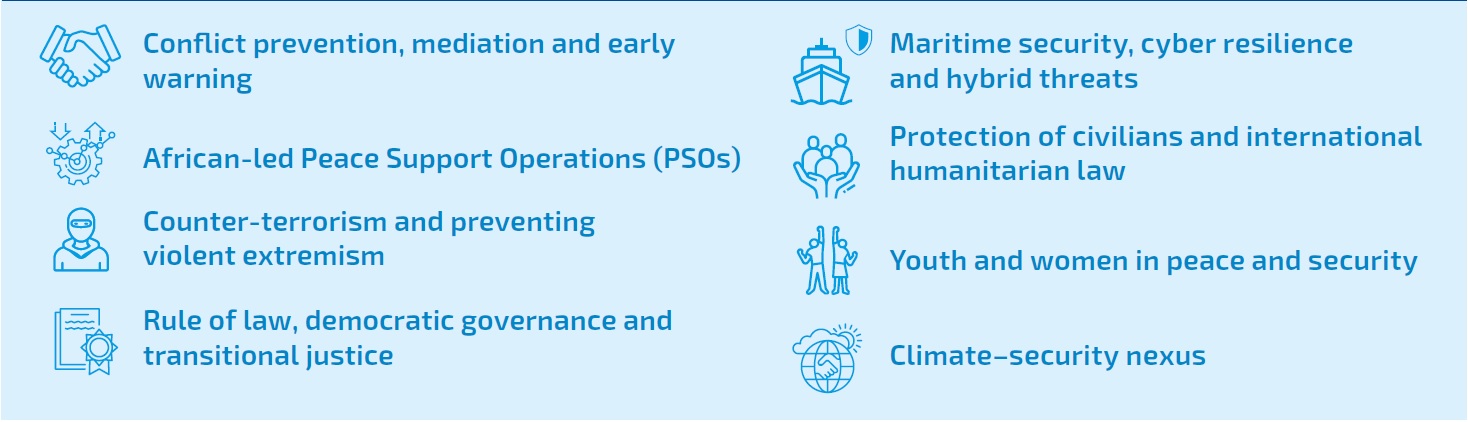
Source: EEAS, AU-EU Partnership: Peace, Security and Governance, November 2025, https://www.eeas.europa.eu/node/452699_en.
Already, since 2018, the AU and the EU have partnered on the Intra-ACP Climate Services and Related Applications (ClimSA) Programme and the Strengthening for Early Warning in Africa (SEWA) project. These two initiatives continue to reflect mutual efforts to enhance multilateral cooperation between Europe and Africa, socio-economic development, climate resilience, sustainable development and institutional transformation across Africa. Recent efforts have focused on strengthening Africa’s ability to manage climate risks.[30]
Crafting a partnership that is both constructive and mutually beneficial on climate, peace and security requires taking a step back and focusing on the bigger picture: collective security is foundational for sustainable peace and development, but there is no value in security only for security’s sake. The inherent risk in (over) securitising climate change, and in particular its nexus with peace and security, is that it detracts from the broader human security and development agenda. By focusing on symptoms of underlying problems, it deemphasises long-term investment in peace and stability in favour of short-term gains.
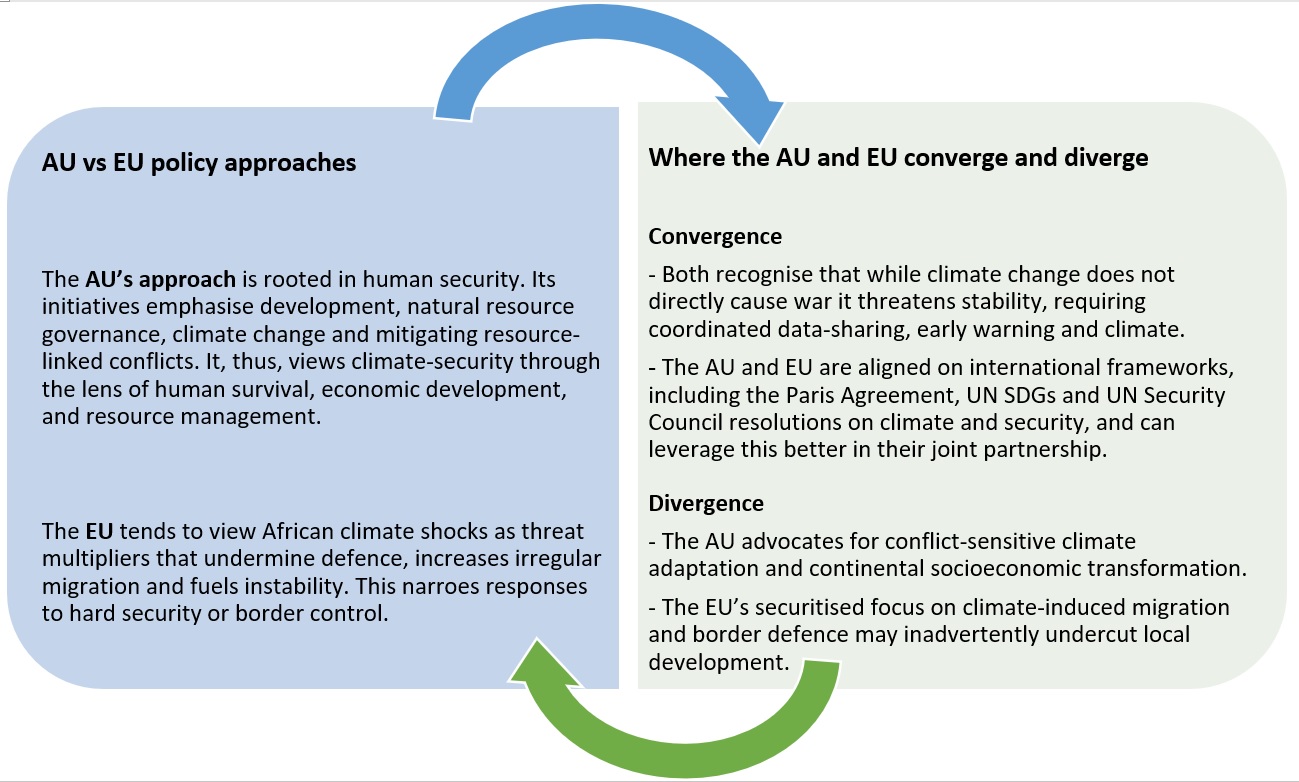
To create a more constructive AU-EU peace, security and governance partnership,[31] policy frameworks must therefore shift from reactive, hard security-oriented models to proactive, human-centric resilience. This means aligning on sustainable development strategies that include empowering marginalised communities. There are two main areas where there is strategic convergence that can be leveraged to enhance the partnership:
• Early warning systems: Both the AU and the EU agree on the importance of gathering data and developing predictive, evidence-based foresight models to anticipate climate shocks. Both continents already possess sophisticated data collection systems, but they do not sufficiently communicate or translate data into rapid, preventive diplomatic action. By partnering and sharing data, the two blocs can improve their understanding of climate risk and jointly develop more evidence-based approaches to the climate, peace and security nexus. Establishing a unified AU-EU Climate Security Data and Action Hub would merge European satellite capabilities with the AU’s continental early warning systems and localised conflict-monitoring centres.
• Institutional partnership: The AU and the EU both recognise the need to strengthen their partnership and regional architectures. At the global level, the AU and EU represent a large voting and diplomatic bloc (a combined 83 countries). Collaborating to institutionalise the climate, peace and security agenda would enhance their existing efforts to integrate climate risk assessments into all UN and AU peacekeeping mandates globally.
At the continental level, the EU is a strategic partner for the AU and contributes financially and through technical support to AU-led peace support operations and climate adaptation frameworks. To take this further requires a shift in funding priorities away from military operations toward civilian-led natural resource governance. This includes funding local initiatives that empower women and youth who are on the front lines of both climate impacts and community leadership. Ideally, European support would be funnelled directly to local authorities through the AU’s regional mechanisms and economic communities and strengthening the domestic social contract rather than bypassing it via foreign security forces.
To build a mutually beneficial partnership, the AU and EU must reconcile their differences and enhance their cooperation on the two areas of strategic convergence highlighted here. This would be key in jointly advancing sustainable, localised and long-term stability. Doing so would also mark the maturation of the partnership into a balanced strategic alliance rooted in mutual respect, shared responsibility and a commitment to human security.
The climate, peace and security nexus cannot be resolved through the barrel of the gun or the intensification of border security. While the EU’s securitisation approach stems from a need to maintain regional stability, a narrow focus on defence ultimately addresses only the symptoms, not the root causes, of climate-induced conflict and displacement. By embracing the AU’s human security paradigm, the AU-EU partnership can transform into a proactive, resilient strategic alliance.
Ottilia Anna Maunganidze is Head of Special Projects at the Institute for Security Studies (ISS), Pretoria.
This brief was prepared within the framework of the project Nexus25–Shaping Multilateralism. Views expressed are the author’s alone.
[1] Amani Africa, “Climate Change: Challenges to Peace and Security in Africa”, in Insights on the PSC, 5 March 2025, https://amaniafrica-et.org/?p=20553.
[2] ISS PSC Report, “Cultivating Common Ground on Climate, Peace and Security”, in PSC Insights, 12 February 2025, https://issafrica.org/pscreport/psc-insights/cultivating-common-ground-on-climate-peace-and-security. See also Barnett, Jon and W. Neil Adger, “Climate Change, Human Security and Violent Conflict”, in Political Geography, Vol. 26, No. 6 (August 2007), p. 639-655, DOI 10.1016/j.polgeo.2007.03.003.
[3] Gnanguênon, Amandine, “Conseil de l’Entente”, in Mapping African Regional Cooperation, 29 October 2020, https://ecfr.eu/?p=57209.
[4] “Togo: Conseil de l’Entente, plan stratégique 2024-2028 et recommandations pour un repositionment”, in Koaci, 19 December 2023, https://www.koaci.com/article/2023/12/19/togo/societe/togo-conseil-de-lentente-plan-strategique-2024-2028-et-recommandations-pour-un-repositionnement_174505.html; Renaud Dossavi, Ayi, “West Africa: Conseil de l’Entente Adopts CFA44 billion Budget for Its 2024-2028 Strategic Plan”, in Togo First, 19 December 2023, https://www.togofirst.com/en/economic-governance/1912-13134-west-africa-conseil-de-l-entente-adopts-cfa44-billion-budget-for-its-2024-2028-strategic-plan; African Development Bank, Côte d’Ivoire: African Development Bank Group and Council of the Entente Join Forces to Boost Regional Growth in West Africa, 24 March 2025, https://www.afdb.org/en/node/82072.
[5] On the Convention (commonly, the “Fort Lamy Convention”), see LCBC website: The Convention and Statute of the Lake Chad Basin Commission, https://cblt.org/?p=4084.
[6] de Coning, Cedric et al., “Managing Climate, Peace and Security Risks in the Lake Chad Region”, in XCEPT Briefing Papers, 20 January 2026, https://www.xcept-research.org/?p=7304.
[7] UN Environment Programme, “The Tale of a Disappearing Lake”, in UNEP Stories, 28 February 2018, https://www.unep.org/node/21096.
[8] Heinrigs, Philipp and Marie Trémolières (eds), Global Security Risks and West Africa Development Challenges, Paris, OECD Publishing, 2012, https://doi.org/10.1787/9789264171848-en.
[9] Lamarche, Alexandra, “Climate-fueled Violence and Displacement in the Lake Chad Basin: Focus on Chad and Cameroon”, in Refugees International Reports, September 2022, https://www.refugeesinternational.org/?p=3496.
[10] Omokpariola, Daniel O. et al., “Climate Change, Crop Yield, and Food Security in Sub-Saharan Africa”, in Discover Sustainability, Vol. 6 (2025), Article 678, https://doi.org/10.1007/s43621-025-01580-4.
[11] Pichon, Eric, The African Union’s First Climate Strategy. And EU-Africa Climate Cooperation, in EPRS Briefings, November 2022, https://www.europarl.europa.eu/thinktank/en/document/EPRS_BRI(2022)738201.
[12] See African Union PAPS website: Climate Change Peace & Security, https://www.aupaps.org/en/page/78. In May 2018, the AU Peace and Security Council (AU-PSC) initiated a study on the nexus between climate change and conflicts in Africa. The AU heads of state Assembly, in 2022 and 2024, reiterated the imperative for developing a comprehensive Common African Position on Climate, Peace and Security (CAP-CPS).
[13] ISS PSC Report, “Cultivating Common Ground on Climate, Peace and Security”, cit.
[14] GIZ, Advancing the Common African Position on Climate Change, Peace and Security, 26 February 2026, https://www.giz.de/en/regions/africa/african-union/news/advancing-common-african-position-climate-change-peace-and.
[15] Rüttinger, Lukas et al., Weathering Risk. Africa Climate Security Risk Assessment, Berlin, adelphi, August 2024, https://climate-diplomacy.org/node/6347.
[16] African Union, Statement on the African Union’s Efforts to Address Climate Change, Peace, and Security by Dr Alhaji Sarjoh Bah…, 15 November 2024, https://www.peaceau.org/en/article/statement-on-the-african-union-s-efforts-to-address-climate-change-peace-and-security-by-dr-alhaji-sarjoh-bah-director-conflict-management-directorate-political-affairs-peace-and-security-department-african-union-commission.
[17] African Union, Strengthening the AU–EU Partnership through the ClimSA and SEWA Programmes, 16 March 2026, https://au.int/en/node/46159; African Union, African Union and Denmark Strengthen Partnership to Advance Sustainable Peace, 24 April 2026, https://au.int/en/node/46324; African Union, African Union and Germany Deepen Strategic Partnership to Advance Agenda 2063 Priorities, 19 November 2025, https://au.int/en/node/45682; German Federal Foreign Office, Climate, Peace, Security: Three Pillars of German Foreign Policy, April 2024, https://www.publikationen-bundesregierung.de/pp-en/search-for-publications/climate-peace-security-2275734; Sweden Government website: Sweden’s Climate Aid, https://www.government.se/government-policy/swedens-climate-aid.
[18] For analysis on development of the securitisation, see Dupont, Claire, “The EU’s Collective Securitisation of Climate Change”, in Journal of West European Politics, Vol. 42, No. 2 (2019), p. 369-390, DOI 10.1080/01402382.2018.1510199; Chen, Siyu, “The Evolution of the European Union’s Securitization of Climate Change and the Effectiveness of Its Policies”, in Journal of Education, Humanities, and Social Research, Vol. 2, No. 3 (2025), p. 10-19, https://www.gbspress.com/index.php/JEHSR/article/view/274/279; European External Action Service (EEAS), Enhancing Climate Security and Defence, 21 May 2026, https://www.eeas.europa.eu/node/449373_en.
[19] Morsut, Claudia and Mark Rhinard, “The Collective Securitisation of Climate Change: Implications for Climate Adaptation Policy in the United Nations and European Union”, in Review of International Studies, 16 September 2025, https://doi.org/10.1017/S0260210525100867.
[20] Bolopion, Emma, “The European Union and Climate Security. Between Ambitions and Realities”, in Verfassungsblog, 1 November 2024, https://verfassungsblog.de/?p=86671.
[21] Council of the EU and European Commission, Climate Change and International Security, March 2008, https://data.europa.eu/doi/10.2860/50106.
[22] Dickel, Ralf et al., “Reducing European Dependence on Russian Gas: Distinguishing Natural Gas Security from Geopolitics”, in OIES Papers, No. NG 92 (October 2014), https://doi.org/10.26889/9781784670146.
[23] EEAS, Shared Vision, Common Action: A Stronger Europe. A Global Strategy for the European Union’s Foreign and Security Policy, June 2016, https://www.eeas.europa.eu/node/17304_en.
[24] EEAS, Climate Change and Defence Roadmap, 6 November 2020, https://data.consilium.europa.eu/doc/document/ST-12741-2020-INIT/en/pdf; EEAS, Concept for an Integrated Approach on Climate Change and Security, 16 September 2021, https://data.consilium.europa.eu/doc/document/ST-12537-2021-INIT/en/pdf; European Commission and EEAS, A New Outlook on the Climate and Security Nexus: Addressing the Impact of Climate Change and Environmental Degradation on Peace, Security and Defence (JOIN/2023/19), 28 June 2023, https://eur-lex.europa.eu/legal-content/en/TXT/?uri=celex:52023JC0019.
[25] The EU’s action in this area is documented through assessment reports (see European Environment Agency, European Climate Risk Assessment, 2024, https://doi.org/10.2800/8671471) and progress reports (see European Commission, Progress Report on the Implementation of the Joint Communication A New Outlook on the Climate and Security Nexus (SWD/2025/49), 17 February 2025, https://data.consilium.europa.eu/doc/document/ST-6321-2025-INIT/en/pdf).
[26] EEAS, Concept for an Integrated Approach on Climate Change and Security, cit.
[27] Environmental advisers have been deployed in civilian CSDP missions in Somalia, Mali and the Central African Republic (CAR).
[28] Mishra, Amlan, “The Securitization and Eurocentric Narratives in the European Union’s Climate Policy and Diplomacy”, in Journal of Contemporary European Politics, Vol. 3, No. 3 (September 2025), Article e70019, https://doi.org/10.1002/cep4.70019.
[29] Cilliers, Jakkie, “Peacekeeping Funding Cuts Mean Africa Must Rethink Security”, in ISS Today, 5 June 2026, https://issafrica.org/iss-today/peacekeeping-funding-cuts-mean-africa-must-rethink-security.
[30] African Union, Strengthening the AU–EU Partnership through the ClimSA and SEWA Programmes, cit.
[31] EEAS, AU-EU Partnership: Peace, Security and Governance, cit.