Titolo completo
Self-Preservation, Not Salvation: Deterrence, Diplomacy and the Gulf’s Iran Problem
|
As the United States marked its 250th anniversary of independence, the Islamic Republic of Iran chose the same week to bury its slain Supreme Leader, Ali Khamenei. Among the visiting delegations, Gulf Arab attendance included Qatar, Oman and – more surprisingly – Saudi Arabia. The rupture in Riyadh-Tehran relations since 2016, patched in 2023 through a China-facilitated normalisation, has held despite the US-Iran war, with the Saudis retaining considerable engagement with Iran even as the latter struck its neighbours, Saudi Arabia included. The rest of the Gulf is fractured: Oman remains locked in a tug-of-war with Iran over the Strait’s free-passage status even as it mediates; Kuwait and Bahrain, having borne the brunt of recent attacks, have strongly condemned Iran’s persistent transgressions; and the United Arab Emirates (UAE), with its hard rhetoric, has vowed to cut its Hormuz dependency to zero although time and regional stability will be important variables. This is the hallmark of a Gulf yet to align against a regional antagonist.
The US-Iran Memorandum of Understanding (MOU), signed in mid-June, requires consensus among the “Persian Gulf littoral states” to define the Strait of Hormuz’s future status. Managing this waterway is arguably the Gulf’s first test – not only for its own and the world’s supply chains, but also for breaking the violent peace that has since taken hold. Strikes, threats and brinkmanship have persisted since the 8 April ceasefire, and even since the MOU. Qatari and Pakistani mediators keep Washington and Tehran at the table with declarations of “positive progress”; separately, a twelve-nation dialogue convened in Bahrain by CENTCOM, the US command responsible for the greater Middle East area, affirmed a “shared commitment” to protecting Hormuz. But the MOU’s architecture remains ambiguous, and subsequent strikes on Kuwait and Bahrain bear that out.
The moment to recognise that collective security can no longer be outsourced solely to Washington has never been clearer. What follows is a case for a dual-track approach: sustained diplomatic engagement with Iran, alongside renewed Gulf Arab security cooperation as a hedge should diplomacy fall short. The balance between the two depends heavily on Iran’s own conduct ahead.
The limit of US guarantees
The preliminary US-Iran accord fed Gulf unease over the lack of consultation, a concern that could deepen should the eventual agreement disadvantage these allies. Already, the Saudi Foreign Minister and the Gulf Cooperation Council Secretary-General have denied any knowledge of the 300 billion dollar reconstruction fund for Iran, which according to Clause 6 of the MOU the United States “undertakes with [its] regional partners”. While the MOU provides for the “permanent termination of military operations on all fronts”, it has not stopped Iran from reengaging against Gulf states, recipients of more than 7,000 projectiles over the war. This came on top of initial statements by Qatar, Kuwait, Bahrain and the UAE, each stressing “good neighbourliness”, while Saudi Arabia called for a lasting agreement that accounts for “the security interests of regional countries”.
It was within this apprehensive climate that US Secretary of State Marco Rubio swung through the UAE, Kuwait and Bahrain in late June, a belated attempt to reassure the Gulf states that their security remained an American priority, and to settle the back-and-forth among various US officials over compensation – whether owed to Iran or claimed from it. Gulf states remain exposed to Iranian attacks on their infrastructure: Tehran can use the hosting of US bases as a pretext for retaliation, while its weaponisation of the Strait of Hormuz holds Gulf oil and gas exports, and the global economy, hostage. Bypass routes are partial or still in progress: Saudi Arabia and the UAE have pipeline alternatives, though incapable of offsetting a fully disrupted strait; Kuwait, Qatar and Bahrain do not.
The historical record on US reliability should discipline Gulf expectations. In September 2019, Iran-backed Houthi drone strikes knocked out nearly half of Saudi Arabia’s crude oil output in a single day; Trump declared the United States “locked and loaded” but opted for sanctions, not retaliation. In November 2023, when the Houthis began striking Israel and international shipping in the Red Sea in retaliation against Israel’s Gaza onslaught, the Biden Administration was slow and hesitant in its response before targeted strikes went ahead. In 2026, despite intensive Gulf lobbying against a wider war, Trump – following his return to office – was drawn into direct conflict with Iran under Israeli influence, rupturing the détente and containment policy the Gulf had built with its adversary over several years.
The pattern across three Administrations is unmistakable: Gulf states must diversify defence procurement and partnerships and build security arrangements independent of, though not conflicting with, the United States – as shown, amongst others, by recent Gulf-Ukraine deals and systems now expedited to the Gulf from South Korea and Italy.
Wrangling Hormuz out of Iranian control?
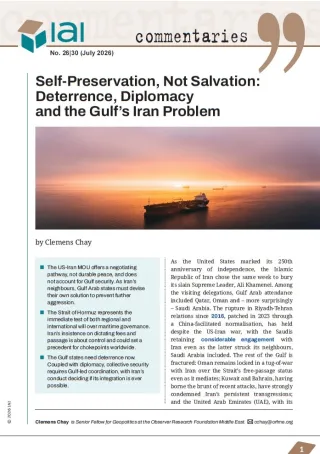
Uncertainty over Hormuz has had no real remedy since the war began. The United States has attempted to secure the waterway militarily, but its campaign fell short. France and the UK have launched the Multinational Military Mission (MMM), now securing Oman’s agreement to help protect its own territorial waters with mine-clearance vessels, escort ships and reconnaissance assets. This departs from an earlier framing in May, which held that the 38-nation coalition would only operate once hostilities cease entirely – a precondition still unmet, given the latest strikes on Bahrain and Kuwait.
The more consequential fight over Hormuz is not so much on money as on governance. Iran’s insistence on collecting fees – and approving insurance on vessels – alongside Oman is, at its core, an assertion of control. Iran’s Deputy Foreign Minister’s made it explicit: “Hormuz is defined under Iran’s command, not CENTCOM.” On this point, Washington and the Gulf are unusually aligned: Qatar has stressed it remains “in full coordination with countries across the region, including our brothers in the Sultanate of Oman” to keep the Strait open. Iran’s own conduct undercuts any claim to neutral stewardship: its Ambassador to China has said Beijing and other “friendly” nations would receive special treatment on any future Hormuz fees – proof Tehran intends to dictate terms rather than administer a shared waterway. Oman’s oscillation between professing compliance with international law and now conceding “voluntary maritime service mechanisms” risks handing Tehran further advantage.
The Gulf must push back precisely here: restoring freedom of navigation is the operational and symbolic test. If Iran succeeds at Hormuz, every other chokepoint state takes note.
Rethinking collective security
Thus far, bilateral bargaining has bought time, not durable security. Qatar’s mediating role has bought it influence – Doha resumed maritime trade with Iranian ports – but that goodwill remains fragile, as a Qatari-flagged LNG tanker, the Al Rekayyat, was struck near the Omani coast. The UAE reportedly delivered roughly 3 billion dollars to Iran to halt strikes on its territory, though Abu Dhabi has “categorically denied” the reports. Saudi Arabia refused Washington use of its bases and airspace for Project Freedom, the US-launched operation that was supposed to provide military cover to ships transiting the Strait of Hormuz.
These arrangements are transactional, not structural. Iran could equally channel such inflows toward economic recovery or rebuilding its missile and drone arsenal. Washington itself dangled General License X, granting 60-day sanctions relief on Iranian crude exports, only to revoke it after Iran hit tankers in the strait. The reversal shows economic relief employed as both reward and punishment for Iranian conduct, but such concessions – bilateral or otherwise – remain a stop-gap at best. How effective this mix of carrots and sticks prove in weaning Iran off retaliatory force will determine whether a pathway exists toward its integration into regional security – or whether the Gulf must plan around an indefinite threat.
A dual-track strategy of bloc diplomacy and deterrence would make Iran reconsider its options. Absent any collective security architecture, Saudi Arabia has floated a non-aggression pact modelled on the 1970s Helsinki framework, whose three baskets – mutual recognition, economic cooperation, human rights – thawed Cold War tensions between Western and Soviet blocs. A Gulf-Iran version would differ in content, resting on mutual guarantees against attack, but sharing the same rationale: détente to defuse escalatory risk. Gulf states can converge on a lowest-common-denominator arrangement convincing Iran that its prosperity depends on the region’s. This remains a medium-term prospect contingent on confidence-building measures.
In the near term, establishing deterrence is imperative – whether through a ‘GCC-plus’ or ‘GCC-minus’ format, a tighter circle of capable states bolstered by extra-regional partners along the MMM model. Maritime security is the natural first coordination point: a joint Gulf patrol, in the mould of the Malacca Strait Patrol, would signal seriousness without the weight of a mutual defence treaty. Demining the Strait, meanwhile, could draw on the expertise of the Dutch and Belgian navies – veterans of disarming World War-era ordnance – and further afield, Japan.
With drones now central to low-cost warfare, coordinated air and missile defence would raise the cost of future Iranian strikes. As Kuwait’s Colonel Sabah Al-Sabah put it, “no country defends its airspace alone; it is a coalition problem whether you like it or not”. He proposed agreeing a “release authority” matrix in advance – who may shoot, at what, and on whose order – since a single cruise missile can transit multiple countries before reaching its target.
Only if calm takes root in the next months should an inclusive security architecture be considered. For now, Iran’s increasingly assertive leadership, and doubts over its command structure, argue against it: the domestic censoring of Parliament Speaker Ghalibaf’s interview – reportedly for straying too far into nuclear inspections and the memorandum’s economic provisions – points to close scrutiny by hard-line factions inside the Islamic Revolutionary Guards Corps, which now exerts a greater degree of control over the state than before. If this is indeed the case, it strengthens the case for Gulf-centred deterrence as the more pressing priority, and diplomacy as its corollary.
Clemens Chay is Senior Fellow for Geopolitics at the Observer Research Foundation (ORF) Middle East.