Titolo completo
Not Europe’s War? The Gulf Crisis and the EU’s Maritime Dilemma
|
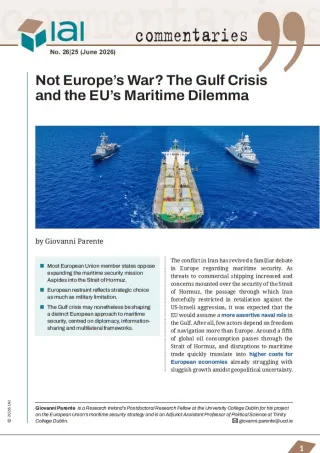
The conflict in Iran has revived a familiar debate in Europe regarding maritime security. As threats to commercial shipping increased and concerns mounted over the security of the Strait of Hormuz, the passage through which Iran forcefully restricted in retaliation against the US-Israeli aggression, it was expected that the EU would assume a more assertive naval role in the Gulf. After all, few actors depend on freedom of navigation more than Europe. Around a fifth of global oil consumption passes through the Strait of Hormuz, and disruptions to maritime trade quickly translate into higher costs for European economies already struggling with sluggish growth amidst geopolitical uncertainty.
Yet, by March 2026 it became evident that European governments had reached a remarkably different conclusion. Despite growing instability in the region, there was “no appetite” for expanding Operation Aspides, the EU’s fourth maritime security operation launched in February 2024 to protect commercial shipping in the Red Sea from drone, rocket and missile attacks from the Iran-supported Houthi rebels in Yemen, who had threatened passage in the Bab el-Mandeb strait in retaliation against Israel’s brutal offensive in Gaza. Calls for a broader naval role received virtually no support among member states. The prevailing message from European capitals was simple: this is “not Europe’s war”.
Critics have long argued that the EU is willing to benefit from global security while relying on others to provide it. Viewed from this standpoint, Europe’s reluctance to assume greater responsibility in the Gulf would merely confirm a familiar pattern. Nevertheless, a similar interpretation risks overlooking a more significant development. The debate surrounding the Gulf crisis suggests that the Union may be gradually moving towards a different model of maritime engagement, one centred less on military intervention and more on diplomacy, information-sharing and multilateral security frameworks. Rather than signalling irrelevance, the European restraint may reveal the contours of an alternative approach to maritime security.
A consensus against escalation
The first striking feature of the Union’s response was the degree of political convergence. A broad consensus emerged against any expansion of the Aspides’ mandate towards the Strait of Hormuz for different reasons. Germany questioned both the feasibility and the effectiveness of extending the operation. Italy rejected the idea of participating in missions related to the conflict and instead emphasised the importance of international legitimacy and multilateral frameworks. Spain positioned itself as one of the strongest advocates of diplomacy and de-escalation. On a different note, Poland argued that Europe’s primary security challenges remain much closer to home, with Russia’s war of aggression against Ukraine continuing to dominate strategic thinking across the eastern flank, including in the Baltic Sea area. Despite these different motivations, the conclusion was the same. When EU High Representative Kaja Kallas remarked that “this is not Europe’s war”, she was effectively expressing a consensus view.
The reasons for such a consensus go beyond political caution. European governments recognise that expanding Operation Aspides would fundamentally alter the mission’s very nature. When the mission was established in February 2024, it was presented as a “defensive” initiative designed to protect commercial vessels from attacks in the Red Sea. With its legitimacy resting on this executive mandate, an extension towards the Strait of Hormuz would inevitably raise different questions. Protecting merchant vessels in a confined area is one thing; operating amid an active interstate conflict is another. The distinction matters because maritime security missions can gradually evolve beyond their original mandates. Escort operations can escalate into direct confrontations. Defensive postures can create pressure for pre-emptive action. The line between protection and intervention often blurs in practice. Iran, for which control of Hormuz creates massive leverage, would certainly see any attempts at securing maritime traffic against its consent as a hostile act, and the involved parties as co-belligerents alongside Israel and the United States. European governments appear acutely aware of the risks. This context explains why discussions in Brussels focused on reinforcing existing operations rather than expanding them. More ships, surveillance assets and logistical support were considered acceptable, but a fundamentally different mission was not. That said, the debate has not disappeared entirely. Over the last few days, discussions have emerged in Brussels about a possible future role for Aspides beyond its current mandate. The mission could eventually assume a “primary role” in mine-clearing operations in the Strait of Hormuz as part of a Franco-British-led initiative to safeguard maritime traffic once conditions allow.
There is also a broader strategic reality that cannot be ignored. As Poland rightly pointed out, the EU’s security priorities remain largely concentrated on the continent itself, namely in supporting Ukraine against the Russian invaders and countering Moscow’s hybrid offensive against EU countries. Opening a new front of strategic engagement in the Gulf would not simply strain limited military resources. It would risk diverting political attention from what remains the Union’s most pressing security challenge. Even governments with strong interests in maritime trade appear reluctant to accept such trade-offs. Yet if Europe is unwilling to assume a larger military role, what exactly should it do? The debate has often been framed as a choice between action and inaction. In this regard, the real question is not whether Europe should act, but rather how.
Naval partnerships and diplomacy
Over the past couple of decades, discussions of maritime security have been influenced by military approaches centred on naval deployments and power projection. Such tools remain important and, in many cases, indispensable. Nevertheless, they are not the only instruments available, nor are they necessarily the most effective in every context.
The Gulf crisis offers an opportunity for Europe to develop a more distinctive contribution. The first pillar of such an approach should be maritime information-sharing. Tracking vessels, monitoring threats, sharing intelligence and coordinating responses are becoming increasingly important complements to naval deployments and, in some contexts, may contribute more to maritime security than the marginal addition of further naval assets. In this realm, Europe has considerable expertise in these fields and has already developed significant capabilities through both civilian and military maritime initiatives. Strengthening information-sharing networks among regional partners could improve situational awareness, reduce risks to commercial shipping and help prevent escalation. Unlike military intervention, such measures are politically sustainable and broadly compatible with the preferences expressed by most member states.
This emphasis on information-sharing is not a substitute for naval action but reflects the changing nature of maritime security. Many contemporary maritime threats, including attacks on commercial shipping, sanctions evasion, smuggling networks and other forms of hybrid activity, are first detected through surveillance systems, intelligence exchanges and vessel-tracking mechanisms rather than naval patrols. In this regard, the experiences of both the EU (Atalanta) and NATO (Ocean Shield) counter-piracy operations off the Horn of Africa demonstrated that vessel reporting systems, shared threat assessments, and coordination between navies and commercial shipping operators were often as important as deploying additional warships. In such contexts, maritime security depends not only on the ability to deploy force but increasingly on the capacity to generate shared situational awareness among governments, navies and commercial operators. Effective information-sharing allows limited naval assets to be deployed more selectively, reduces uncertainty about potential threats and facilitates coordinated responses before crises escalate. Rather than replacing naval capabilities, these mechanisms act as force multipliers, enhancing their effectiveness while requiring a lighter political and military footprint. This is an area in which the EU has accumulated considerable experience, where it may be particularly well placed to make a meaningful contribution in the Gulf. For instance, this expertise is reflected in initiatives like the “Common Information Sharing Environment” (CISE), the “Maritime Surveillance” (MARSUR) network, and the information-sharing mechanisms developed through operations such as Atalanta and Aspides, all of which aim to improve coordination among civilian and military actors across maritime domains.
A second pillar should focus on reinforcing existing defensive missions without altering their mandates. The debate over Aspides has often been framed as an all-or-nothing choice between expansion and retreat. In reality, there is considerable scope to strengthen the operation while preserving its defensive character. Additional naval assets, improved surveillance capabilities and greater coordination with commercial shipping operators could all enhance maritime security without drawing the EU into regional conflicts.
Ultimately, Europe should devote greater attention to multilateral maritime governance. One of the recurring themes in the debate has been the search for broader international legitimacy. This reflects a long-standing preference for rules-based approaches to international security rather than ad hoc coalitions. In this context, proposals for a United Nations-backed maritime security framework deserve serious consideration. Such an initiative would undoubtedly face political obstacles, but it would certainly be more consistent with European preferences than efforts to transform existing missions into instruments of coercive power projection. In doing so, this initiative would align with the EU’s longstanding ambition to act as a stabilising rather than a confrontational actor in international affairs.
Towards a distinct European maritime strategy
Many observers will interpret the European response as another sign of geopolitical weakness. Yet the Gulf crisis points to a different conclusion. A majority, if not the totality, of member states collectively rejected the assumption that strategic relevance requires military escalation. The challenge is not to prove that Europe can fight another war at sea. Instead, it is to demonstrate that maritime security can be protected through diplomacy, information-sharing and multilateral action. If the Union succeeds, the legacy of the Gulf crisis will not be European passivity but the emergence of a distinct European model of maritime power.
Giovanni Parente is a Research Ireland’s Postdoctoral Research Fellow at the University College Dublin for his project on the European Union’s maritime security strategy and is an Adjunct Assistant Professor of Political Science at Trinity College Dublin.