Titolo completo
Conflict and Displacement in Africa: Advancing Durable and Sustainable Solutions through the Mattei Plan?
|
In December 2025, the world’s leading refugee protection agency, the United Nations High Commissioner for Refugees (UNHCR), marked its 75th anniversary, commemorating more than seven decades of commitment to protecting people forced to flee conflict, persecution and crises. The milestone coincided with the appointment of former Iraqi president Barham Salih as the agency’s new High Commissioner, succeeding Filippo Grandi, who led UNHCR for a decade.
High Commissioner Salih assumes leadership of the agency at a critical juncture, marked by rising global insecurity, conflicts and environmental pressures that continue to drive sharp increases in displacement. Shifting national priorities, global economic uncertainty and escalating military expenditures have led to significant budget cuts for programmes supporting displaced and vulnerable populations. Weakening and politicisation of international law is contributing to the gradual erosion of protection regimes, resulting in fragmented policies and increasingly ambiguous attitudes toward refugees and displaced persons. It is vulnerable populations who bear the brunt of these developments.
Because development and security are deeply intertwined, sustainably addressing displacement requires confronting its complex structural drivers. By engaging more directly with these underlying causes, European initiatives such as Italy’s Mattei Plan can play a more constructive role in advancing durable, long-term solutions to Africa’s displacement crisis.
International human rights protection
International law stipulates that refugee protection is a human rights issue and not an act of charity at the discretion of member states. Since the 1950s, international refugee protection has undergone profound transformations, starting with the establishment of the UNHCR in 1949. In 1950 the General Assembly adopted the statute of the UNHCR and with it the 1951 Convention which remains a guiding policy tool for refugee protection the world over.
From the 1960s onwards, UNHCR’s protection mandate expanded to include many African countries waging struggles against colonial domination. The individualised and persecution-based approach that hitherto had defined UNHCR’s approach when dealing with conflicts in continental Europe had proved unsustainable for the dynamics unfolding in many African countries at the time. Mass number of refugees and generalised violence that precipitated displacement needed new adaptable approaches. In 1967, the UNHRC protocol expanded the definition of refugee, which today is defined as a person who is persecuted, denied security of person and is unable to exercise his/her fundamental human rights such as those of freedom of expression, association and belief, to pursue his/her political convictions or to freedom from discrimination on account of race or ethnicity. It also defines a refugee as a person or a group of people who are unable to continue to live in security where she/he/they live due to the dangers of war, generalised violence or civil disturbance, whether targeted or indiscriminate. This contextual background is critical for situating Africa’s displacement crisis within a broader sociohistorical setting.
Africa’s displacement crisis
A combination of violent conflicts and protracted wars, political persecutions, socioeconomic hardships and human rights violations and environmental pressures in many parts of the world continues to provide impetus to migrate. According to the UN Refugee Agency’s latest estimates, there are currently 30.5 million refugees under UNHCR’s mandate and about 8.4 million asylum seekers in the world, the majority of whom reside in low- and middle-income countries. In 2025, UNCHR estimated the total number of displaced persons, including refugees, asylum seekers and internally displaced persons (IDPs) at 117 million.
Sudan and the Democratic Republic of the Congo (DRC) accounted for almost half of all conflict-driven internal displacements in 2024. While people have fled conflict and wars for centuries, what has changed fundamentally in recent years are environments in which people flee for safety. For instance, negative perceptions and stigma attached to the refugee and asylum seeker status have resulted in restrictive and control-oriented migration policies, sometimes at the expense of core human rights protections.
Africa hosts more than a third of the world’s conflicts and around 35 per cent of all displaced persons as a result – about 44 million people. The majority of them were displaced because of conflict, with South Sudan, Eritrea, Sudan, Somalia and eastern DRC accounting for the largest share.
Across the continent, interconnected conflicts are driving unprecedented displacement and compounding humanitarian crises. Sudan’s civil war for example has uprooted 13.4 million people and forced nearly 4 million refugees into neighbouring countries, straining already fragile health systems, as seen in Cholera outbreaks in Chad. In the Horn, unresolved insecurity in Ethiopia, renewed Ethiopia-Eritrea tensions over maritime access, and Israel’s recognition of Somaliland have heightened risks of regional conflict escalation in a context marked by governance deficits, human rights violations and environmental stress. Similar dynamics exist in the Great Lakes region, where continued fighting between government forces, militias and Rwanda-backed M23 rebels in eastern DRC has displaced over 7 million people. In the Sahel, jihadist violence, prolonged insecurity and economic fragility are driving large displacement flows into neighbouring countries, deepening a regional humanitarian crisis.
Mitigating displacement sustainably requires tackling its root causes, and this is where European initiatives such as the Mattei Plan, in partnership with UNHCR and African countries, can play a more constructive role in advancing durable and long-term solutions to Africa’s displacement crisis.
Strengthening protection for refugees and IDPs in Africa: What role for Italy?
The gradual erosion of international human rights protection has left those needing protection both vulnerable and exposed. With millions of people on the move, durable solutions to Africa’s displacement crisis have become increasingly elusive. Budgetary cuts to UNHCR have constrained the agency’s capacity to respond to growing humanitarian needs and to support host governments. As a result, an increasing number of states are resorting to restrictive measures, including border closures and refoulements, further exposing vulnerable populations to serious harm and, in some cases, even death.
Approaches that focus primarily on managing the symptoms of displacement, such as financing refugee camps, securitising migration and borders, or adopting restrictive asylum and migration policies often do little to address its complex drivers. Mitigating displacement sustainably requires tackling its root causes, and this is where Italy, in partnership with UNHCR and African countries, can play a constructive role in advancing durable and long-term solutions to Africa’s displacement crisis. The Mattei Plan largely sidesteps hard security issues in favour of a business-model approach in its engagement with African counterparts, which is arguably a significant design flaw. In contexts where insecurity is a primary driver of conflict and displacement, for instance, in Ethiopia, development outcomes are inseparable from security conditions. Investments and growth cannot be sustained in fragile environments marked by violence, instability and population displacements. To meaningfully engage with the complex governance and sociopolitical dynamics underpinning displacement in Africa, the Mattei Plan must adopt an ambitious yet holistic approach to the security-development nexus.
Similarly, for sustained impact, the Mattei Plan must move beyond migration containment to alignment with greater protection, capacity building and sustainable development objectives. Strengthening state capacity and protection systems to implement the Kampala Convention could be one of the many ways Italy could lend support to African countries. To date, only 34 out of 54 states have ratified the Convention, while ten have signed but not ratified it, and 11 have neither signed nor ratified it. This uneven uptake reflects persistent gaps in political will and institutional commitment to addressing Africa’s displacement crisis.
The African Commission on Human and Peoples’ Rights’ Resolution 565 (2023) underscores the imperative of including refugees, asylum seekers, IDPs and stateless persons within national socio-economic systems, public services and economic opportunities. This reflects a growing continental consensus that durable solutions to displacement cannot be achieved through humanitarian assistance alone, but require development-led, rights-based approaches that promote inclusion, self-reliance and resilience.
Italian technology firms can help to build civil registration registers through updated national asylum systems and build digital identity systems that reduce statelessness and bridge protection gaps. Similarly, by prioritising investments in energy access, agriculture, health, education, food systems and infrastructure, the Mattei Plan offers a strategic opportunity to address structural drivers of displacement. Targeted investments in the six pillars of the Mattei Plan can help to expand access to public goods and services, stimulate local economies and reduce reliance on environmentally harmful coping strategies. Support for climate-smart agriculture and resilient food systems can strengthen rural livelihoods, improve nutrition and reduce vulnerability to price shocks and climatic extremes. In drought-prone regions, investments in integrated water management systems can mitigate drought and flood-related risks that increasingly drive both internal and cross-border displacement.
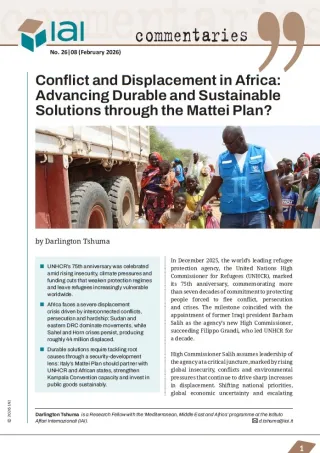
Africa’s displacement crisis continues to deepen as conflict-driven movements collide with shrinking international support and overstretched domestic budgets. During an official mission to East Africa, High Commissioner Salih witnessed first-hand the scale and complexity of the challenge, which cannot be met through fragmented or transactional approaches. While the Mattei Plan offers an important opportunity to reshape partnerships with Africa, its current design falls short of the realities on the ground, highlighting the urgent need for a rethink that aligns ambition with long-term developmental objectives, especially in fragile contexts.
Darlington Tshuma is a Research Fellow with the ‘Mediterranean, Middle East and Africa’ programme at the Istituto Affari Internazionali (IAI).