Titolo completo
Europe after America: A Survival Guide for Moving on
|
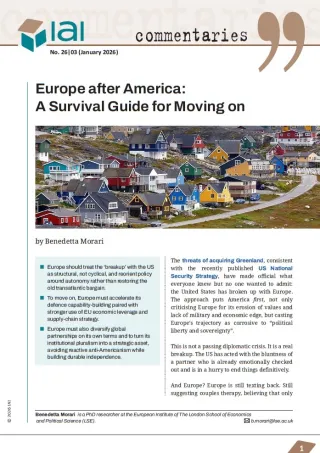
The threats of acquiring Greenland, consistent with the recently published US National Security Strategy, have made official what everyone knew but no one wanted to admit: the United States has broken up with Europe. The approach puts America first, not only criticising Europe for its erosion of values and lack of military and economic edge, but casting Europe’s trajectory as corrosive to “political liberty and sovereignty”.
This is not a passing diplomatic crisis. It is a real breakup. The US has acted with the bluntness of a partner who is already emotionally checked out and is in a hurry to end things definitively.
And Europe? Europe is still texting back. Still suggesting couples therapy, believing that only if it makes itself more attractive – by increasing military spending, paying for the reconstruction of Ukraine, or even selling Greenland – surely the US will realise how much potential they still have together.
This response should not be surprising. It is classic behaviour from someone who has just been left but is not ready to accept it. Yes, geopolitics is more complex than relationship dynamics (is it?). But setting aside conventional foreign policy frameworks and recognising this as a relationship-ending episode can offer a new, perhaps slightly optimistic, lens for understanding where Europe is headed. Because, like in all relationship endings, pain is simply part of the process of moving on.
Step one: Admit that the relationship is over
Right now, European capitals are operating in denial mode. The signals of US disengagement are everywhere: public humiliation of European leaders at the Munich Security Conference, open contempt for European defence capabilities and supranational institutions, threats towards the sovereignty of Greenland.
Yet, European responses continue to assume the old transatlantic framework is salvageable. Official declarations mimic the same response: appeasement, blame-taking and begging the US not to leave. The tepid reactions of European governments and institutions to US military action in Venezuela show this pattern of forsaking their own normative foundations and foreign policy coherence to preserve the relationship, especially when it comes to Ukraine.
This denial serves a psychological function: acknowledging the breakup means confronting seventy-five years of strategic dependence. It means admitting that the security architecture Europe built its entire post-war order around no longer exists, and that Europe may face the choice between outright confrontation with the US or political and even territorial concessions.
But denial is already cracking. Underneath it, anger is starting to surface – in recriminations about American “betrayal” of democratic values, resentment over burden-sharing accusations and outrage over Venezuela. This anger is healthy: it breaks the emotional attachment that denial tries to preserve. But it also risks being dangerous if Europe remains trapped in it, becoming a vengeful ex, defining itself only in reactive anti-Americanism instead of understanding who it truly wants to become.
Step two: Recognise that the relationship was toxic
If Europe is going to move on successfully, it needs to do more than just accept that the relationship ended. It needs to recognise that the relationship, for all its benefits, was also deeply toxic.
The transatlantic partnership infantilised Europe, preventing it from developing its own strategic autonomy. European foreign policy was always triangulated through American interests, while the relationship created pathological dependencies in energy, technology and defence that make Europe structurally vulnerable to this moment.
This was not just strategic dependency; it was a form of learned helplessness. European publics and leaders became accustomed to avoiding major security decisions by deferring them to Washington. It enabled decades of underinvestment in collective and independent defence capabilities because American guarantees made genuine European strategic autonomy feel unnecessary.
Recognising these patterns is not about blaming the United States or excusing European weakness. It forces honesty and reckoning about European complacency. Only by sitting with the pain, only by acknowledging how much was sacrificed to maintain the transatlantic relationship, can Europe figure out what it actually wants to build instead, what it stands for.
But here is what makes moving on even harder: the toxicity did not end with the breakup. The US has moved on, yet it still expects Europe to remain subservient – classic abusive relationship dynamics. Consider the contradictions: the US openly threatens to seize Greenland from a NATO ally, whilst demanding that the very same alliance’s members spend 5 per cent of GDP on defence – not to build European autonomous capacities, but to purchase American weapons that maintain dependence.
This means moving on requires not just building independence, but building it despite active American resistance. Every step toward autonomy will be met with economic pressure, diplomatic threats and preferential treatment to domestic populist parties. Europe is not healing from a clean breakup – it is escaping a relationship where the ex thinks they still own you.
Step three: Learn to stand alone
Accepting this reality is painful, but loneliness is also clarifying. If Europe faces this state instead of avoiding it, it can fundamentally reorient the question from “How do we get back together with Washington?” to “What can Europe build independently?”
This shift has concrete policy implications across multiple domains.
First, moving on requires building genuine European defence capabilities – not to impress Washington or salvage NATO, but because Europe needs the capacity to act independently – in Ukraine, Greenland and beyond – when necessary. This requires more than symbolic national spending increases. It demands defence industrial consolidation across EU member states, joint procurement that achieves real economies of scale and willingness to accept higher costs at home in exchange for strategic autonomy. It means developing European command structures that can function across coalitions and constellations of member states, without US logistics. It means creating a European security pillar within or outside of NATO that can operate autonomously when American priorities diverge.
Second, Europe must be more confident about its enormous economic power – it has the world’s largest, geopolitically relevant financial systems, and regulatory standards that shape global markets and make corporate giants tremble. So far, it has been too cautious or naïve about using this power as an instrument of foreign policy. Moving on means developing strategic investment policies for critical supply chains, industrial capabilities, and technologies, reciprocal trade measures that protect European interests, and leveraging market access to build meaningful partnerships and diversify its networks.
Ever heard that to move on from a breakup, you should start seeing other people? Europe should stop defining its relationships in Asia, Africa and Latin America through the US. China is a competitor, but that does not mean that Europe’s China policy should simply mirror Washington’s. Europe must start developing partnerships that are not substitutes for American relationships but are independent pillars of European global engagement. And in the meantime, take the relief from the lingering pressure to appease the US as an opportunity to rethink the coherence of its diplomatic behaviour towards the Global South.
Finally, Europe must turn its uniqueness into strength. The EU has spent years apologising for its complexity, for not having only one telephone number to give out, for its inability to speak with one voice. But in a world of overbearing unilateralism, Europe’s characteristics – its intrinsic diversity and the resulting consensus-building capacity can become strategic assets, not weaknesses. Instead of trying to resemble the US’s intrinsic unity as a federal state, it should embrace its own distinctive governance and learn to be strategic on how to channel and leverage its internal disagreements.
Moving on, in the end, means developing an independent sense of what Europe is and wants to become, defined by European priorities rather than in reference to Washington. This step will require determination, because the US will resist it. European strategic autonomy, economic and diplomatic diversification will require accepting short-term costs and diplomatic friction as the price of long-term autonomy.
This is not a rejection of the transatlantic partnership – it is necessary regardless of what administration comes next. The transatlantic rupture is not sudden collateral damage of the “Donroe Doctrine”, but a progressive drift since Obama’s “pivot to Asia”. And as a result, Europe needs independent capabilities and capacity to make strategic choices, whether the US is a reliable partner or not.
Step four: Thrive, don’t just survive
Moving on means Europe does not need Washington to come back. And here is the uncomfortable truth: there will be future US administrations that will want to get back together, promising to restore alliance cohesion and recommitting to multilateralism. The Biden administration made exactly these promises after Trump’s first term, yet the structural US reorientation away from Europe continued beneath the rhetorical reconciliation. But if Europe does this work – builds independent capabilities, diversifies partnerships, learns to leverage its comparative advantages – it will no longer be hostage to these oscillations, negotiating future relationships from a position of confidence, not desperation. The transatlantic relationship can still exist, but its dynamics must be reconfigured: choosing the partnership rather than accepting any terms to avoid being alone.
Breakups force growth when you would rather stay comfortable. They force confrontation with weaknesses and the need to reinvent oneself when maintaining the status quo would be easier. The transatlantic breakup is real. The question is not whether Europe can survive it – the question is whether Europe will give in to defeatism or use this pain to become its best self. The greatest response to an abusive relationship is not resentment – it is thriving without them.
The ending of a relationship always hurts. But it can also be the beginning of something better – if you are willing to do the work of actually moving on.
Benedetta Morari is a PhD researcher at the European Institute of The London School of Economics and Political Science (LSE).