Titolo completo
Europe’s ‘Two-Chinas’ Strategy and the Prospect for Beijing-Taipei Peaceful Coexistence
|
In recent years, Europe has significantly upgraded its economic and political relations with Taiwan. Officially, the Union and its member states continue to recognise and have formal ties only with the People’s Republic of China (PRC), abiding by the so-called ‘One-China’ policy – Beijing’s position that there is only one Chinese government that Brussels has acknowledged since 1975, when both the PRC and the Republic of China (Taiwan) were under authoritarian rule.
Five decades later, the PRC continues to be ruled by the Communist Party, and while the reforms initiated in the late 1970s have brought about significant socio-economic changes and modernised the country, the political transformation hoped for by the West has not materialised. Under Xi Jinping, in power since 2012, China has become even more nationalistic and authoritarian, with a tightly controlled economy and society, and an assertive foreign policy towards neighbours.
Taiwan has become, instead, a free and open society, with an advanced market economy. No wonder that the island has been embraced by Western countries as a successful example of transition from authoritarian rule (Taiwan endured 38 years of martial law from 1949 to 1987) to full-fledged democracy.
EU institutions and many European governments are now treating the island as a ‘de facto’ independent state with which they are entitled to entertain economic, political and security relations – (almost) on a par with Beijing. A vivid example took place in September 2025, when both foreign ministers visited Europe: Taiwanese Minister of Foreign Affairs Lin Chia-lung was in Czechia, Italy and Austria from 11 to 20 September, while Chinese Foreign Minister Wang Yi visited Austria, Slovenia and Poland from 12 to 16 September.
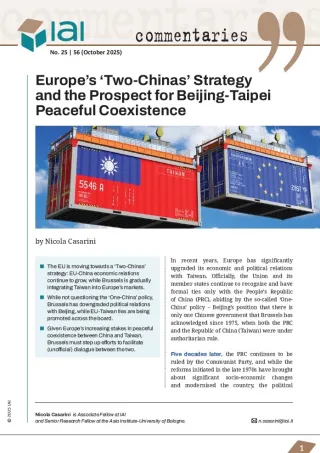
Overall, the European Union is gradually moving towards a ‘Two-Chinas’ strategy, a pragmatic approach that takes into consideration Brussels’s rebalancing of ties in favour of Taiwan and the concurrent worsening of PRC-European political relations, although without formally questioning Brussels’s adherence to the One-China policy.
Rebalancing ties
EU-PRC relations are perhaps at their lowest levels in decades. The latest China-EU Summit, held in Beijing on 24 July 2025, was shortened to just one day (instead of the usual two), while the annual High-Level Economic and Trade Dialogue (TED), which traditionally had taken place before the summit, was scrapped altogether, due to mutual misperceptions and trade tensions. A few weeks before the summit, European Commission President Ursula von der Leyen declared that “China is de-facto enabling Russia’s war economy”. Von der Leyen’s statement is a clear indication that the PRC-Russia ‘no limits’ partnership – announced just before the invasion of Ukraine in February 2022 and reaffirmed in 2025 on the third anniversary of Russia’s aggression – has significantly contributed to worsening EU-PRC political relations.
Sino-European economic ties, however, continue to thrive. Today, the EU and the PRC together account for almost 30 per cent of the global trade in goods and services and for over a third of the global GDP. In 2024, EU-PRC total trade exceeded 845 billion euros: more than 2 billion a day in goods and services. The PRC is currently the EU’s second-largest trading partner in goods alone, after the United States, while the EU is the PRC’s top trading partner.
Conversely, total goods trade between Brussels and Taipei reached 71.9 billion euros in 2024 – less than one-tenth of EU-PRC trade. The EU is Taiwan’s fourth-largest trading partner (after the PRC, the US and Japan), while the 27-member bloc is the most important investor in Taiwan, though the accumulated stock pales compared to the investments made by European companies in mainland China.
While Taiwan’s economy is a fraction of that the PRC’s – which is possibly the world’s largest nowadays – the island is highly strategic for some of Europe’s industrial sectors since over 60 per cent of the world’s semiconductors, and almost 90 per cent of the most sophisticated chips, are manufactured in Taiwan – another reason for the EU’s increased ties with the island.
Europe’s long march towards Taiwan
The push for closer Europe-Taiwan relations across the board has traditionally been led by the European Parliament, which is also the EU institution that has criticised Beijing’s regime the most in recent decades. Members of the European Parliament (MEPs) are now pressuring the European Commission to finalise an EU-Taiwan Bilateral Investment Agreement (BIA), after having shelved the EU-China Comprehensive Agreement on Investment (CAI) announced in 2020 but never greenlighted by the Parliament due to Beijing’s imposition of sanctions on some MEPs’ (recently lifted).
At the latest EU-Taiwan Trade and Investment Dialogue (TID) held in Brussels in December 2024, the two sides made substantial progress towards the BIA which, once finalised, stands a good chance to be quickly ratified by the EU Parliament – but is then likely to be blocked by EU governments fearing China’s backlash. The sentiment prevalent in Brussels, especially among MEPs, is that the time for Taiwan to come second after the PRC is over.
Brussels and Taipei are also working on a Resilient Supply Chain Agreement (RSCA) as well as a Capital Markets Link (CML) which would expand investment opportunities, boost market liquidity and improve capital access for companies from both sides. There are plans to connect the Taiwan Stock Exchange with leading European exchanges, including Frankfurt, Paris, Amsterdam and Milan, giving European investors direct access to Taiwanese equities. This would not only strengthen Taiwan-EU economic ties but also offer a structured pathway for facilitating two-way investments which have grown significantly in recent times.
European companies are attracted by Taiwan as a high-tech hub, while the Taiwanese corporate sector is driven to Europe by a desire to diversify the companies’ global footprint, enhance supply chain resilience, and capitalise on European market opportunities and strategic initiatives like the EU Chips Act, which aims to boost Europe’s semiconductor manufacturing capabilities, and the Green Deal.
In 2023, Taiwan Semiconductor Manufacturing (TSMC) – Taiwan’s largest company – teamed up with Stuttgart-based Robert Bosch, Neubiberg-based Infineon Technologies and Netherlands-based NXP Semiconductors to set up the European Semiconductor Manufacturing (ESMC) as a joint venture, receiving financial support from Germany and incentives from the European Commission. ESMC will provide advanced semiconductor manufacturing services to industries such as the automotive and industrial sectors.
Hsinchu-based GlobalWafers has received a development grant of up to 103 million euros from the European Commission and the Italian government for its 12-inch chip plant project in northwestern Italy – an investment largely incentivised by the EU Chips Act. ProLogium, a Taiwanese solid-state battery manufacturer, has made a 5 billion euro investment in France to build a battery factory to take advantage of the EU’s Green Deal.
According to the Taiwanese government, in 2023 alone, Taipei initiated 22 new investment projects in the EU, totalling almost 5 billion US dollars. Europe’s open-door policy to Taiwanese investments stands in stark contrast to the reception given to PRC investors who are increasingly scrutinised when entering the EU and face mounting difficulties in some strategically sensitive sectors.
EU-Taiwan deepening of ties in the areas of investments, supply chains, critical technologies, semiconductors and finance means that Europe’s stakes in peaceful Beijing-Taipei relations have never been so high.
Preparing for the future
Brussels should seriously consider what to do if Taiwan is attacked. The continuation of the current status quo would be the best option for Taiwan, the US, the EU and indeed the whole world, though it may not be tenable as the PRC – and large swathes of its population – have embraced the narrative that Taiwan must return to the ‘motherland’, with the Chinese military preparing for that.
Former Chairman of the Joint Chiefs of Staff Mark Milley mentioned 2027 as a date when China could be militarily ready to invade Taiwan. At the latest Shangri-la Dialogue in Singapore, US Secretary of Defense Pete Hegseth made similar remarks, while President Xi instructed the Chinese military leadership to be ready by that year and recently warned against Taiwanese independence.
To be sure, the EU is not a security provider in East Asia and its military contribution to a US-led coalition against the PRC, in case the mainland attacks the island, would be minimal. Europe could certainly use its economic weight to exercise pressure on Beijing, though unanimity within the bloc would be difficult as the 27 member states have different approaches towards Beijing. The real added value of the EU lies in its soft power capabilities.
The EU should make the most of its ‘Two-Chinas’ strategy to convince Beijing and Taipei to engage in dialogue. Towards the PRC, Brussels should signal that the EU values cooperation with China on East Asian affairs (and globally) linking the improvement of EU-PRC political relations to the acceptance by Beijing’s leadership to discuss, at least unofficially and behind closed doors, the future of Cross-Strait relations. Towards Taiwan, Brussels should highlight its unwavering support for Taiwanese democracy and leverage its good relationship to invite the ruling Democratic Progressive Party to reconsider its tough anti-PRC approach that also seems to be met with increasing weariness by Taiwanese voters.
Considering the breadth and depth of EU-Taiwan ties and the strategic and economic importance of the EU-PRC relationship, it is time for Brussels to be bold and step up its engagement in Cross-Strait dynamics, considering that any attempt at diplomacy today could reduce the risk of war tomorrow.
Nicola Casarini is Associate Fellow at the Istituto Affari Internazionali (IAI) and Senior Research Fellow at the Asia Institute-University of Bologna.