Titolo completo
Merging Cohesion Policy and CAP: What Does It Take for National and Regional Partnership Plans to Deliver?
|
One of the key innovations in the Commission’s proposal for the 2028-2034 Multiannual Financial Framework (MFF)[1] is the consolidation of all existing EU funds under shared management into single ‘National and Regional Partnership Plans’ (NRPPs). Drawing on the experience of the Recovery and Resilience Facility (RRF), the NRPPs will combine investment and reforms and adopt a performance-based approach, i.e. EU payments will be conditional on the achievement of predefined objectives rather than reimbursing incurred costs.
The NRRP reform is substantial and offers both opportunities and risks. It may allow for greater strategic coherence and stronger focus on performance but also risks diluting the Union’s cohesion policy and weakening the role of regional authorities in the planning and implementation of EU funds. The shift to a performance-based model also poses challenges for national and regional administrations, which differ widely in capacity across member states.
At the moment of writing, the NRPP proposal is under negotiation. The Council has already published its partial negotiating position,[2] while the European Parliament is expected to do so in the autumn. While the Council fully embraces the Commission’s radical consolidation effort, the Parliament is more critical. Its interim report on the MFF proposal strongly criticises the shift towards single national plans and calls for separate, clearly ring-fenced funding for agriculture, cohesion and the European Social Fund Plus (ESF+).[3]
A structural shift: From 540 programmes to 27 national plans
The new NRPPs will merge the four funds financing the EU Cohesion Policy,[4] the two funds financing the Common Agricultural Policy (CAP),[5] the fund financing the EU’s common fishery policy[6] and three instruments financing actions in migration and border management affairs.[7] Today, some of these funds are jointly programmed[8] and are subject to common management and control rules,[9] but each has different specific objectives and operates under different eligibility and thematic concentration rules, which shape how resources can be deployed. Consequently, they are implemented separately through roughly 540 different national and regional programmes. Under the NRRP model, there will only be 27 national plans governed by common rules on objectives, eligibility criteria, programming, management and control (see Figure 1). Five sector-specific regulations will remain but will be significantly streamlined.
Figure 1 | Overview of “The Fund”, in current prices
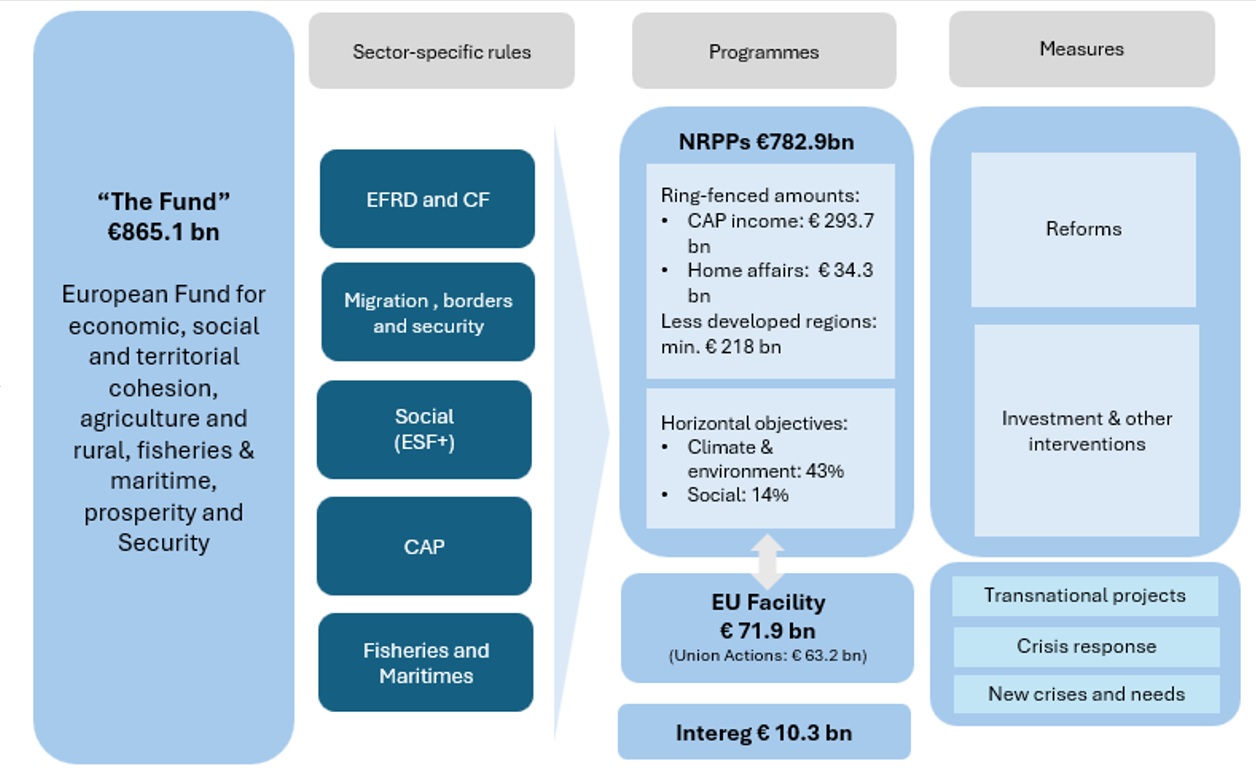
Note: Additional loan support of 150 billion euros to member states for the implementation of their Plans is also envisaged, financed by the Commission borrowing on the financial markets.
Source: Authors’ own elaboration, based on European Commission, Europe’s Budget. National and Regional Partnership Plans, 2025, https://doi.org/10.2761/9109969.
All national plans will be guided by the same five general objectives, operationalised through 28 specific objectives structured in five thematic pillars: “sustainable prosperity”, “security and defence”, “social cohesion”, “quality of life” and “democracy and rule of law”. Many of the objectives largely overlap with those already pursued under existing cohesion, CAP, and home affairs programmes, but member states will also be expected to use their NRPPs to strengthen the Union’s industrial base[10] and support the Union’s defence capability.[11]
A broader scope of intervention will be accompanied by lighter earmarking rules, giving member states greater discretion in allocating funds across sectors and territories. Of the 748 billion euros available under the national plans, 293.7 billion will be ring-fenced for CAP income support and 34.3 billion for ‘home affairs’ interventions. At least 10 per cent of the NRRP budget will have to be allocated to rural areas, and a minimum amount will have to be reserved for less-developed regions. Beyond these requirements, member states will have considerable flexibility in how they use the remaining resources, including the option to reinforce CAP or finance other areas. The only two horizontal constraints are that at least 14 per cent of the NRPP budget (excluding CAP earmarked amounts) must support social objectives and 43 per cent climate and environmental objectives.
The new framework also provides greater capacity to adapt to changing circumstances and needs. Each national plan will include a 25 per cent “flexibility reserve”: up to 10 per cent of the total allocation may be mobilised to address crises, while the remaining 15 per cent will be allocated following a mid-term review in 2031, based on performance and emerging needs. However, under a concession introduced by the Commission in January 2026 in response to concerns about the impact of the Mercosur agreement,[12] member states will be able to use up to two-thirds of this 15 per cent reserve from the outset to support farmers. If fully utilised, this will make an additional 45 billion euros available for CAP-related interventions.
Finally, the NRRPs will adopt an RRF-like performance-based approach. Unlike under the RRF, however, each milestone and target will be assigned a specific payout value, and EU payments will correspond to the aggregate value of the milestones and targets that have been fulfilled. A further important difference is that the assessment of their satisfactory fulfilment will be carried out by member states rather than by the Commission.
Open issues
Cohesion policy: Risk of marginalisation or strategic re-framing?
The NRPP reform has major implications for the EU Cohesion Policy. Since its inception, the cohesion policy has been pursued through bottom-up, integrated regional development strategies. This place-based approach is reflected in the design of the policy: (i) funds are distributed according to regional levels of prosperity; (ii) programmes are tailored to regional needs; (iii) regional authorities play a central role in programming and implementation; and (iv) there is strong emphasis on using integrated, bottom-up instruments such as smart specialisation strategies, territorial just transition plans, and sustainable urban development strategies.
The NRRP regulation breaks with this legacy. While promoting cohesion is one of the Plan’s general objectives, the specific objectives are mostly formulated in sectoral terms, with only a general commitment to deliver them “across all regions”. Member states must guarantee a minimum allocation of funds for less-developed regions, address the specific needs of disadvantaged areas and allocate 10 per cent of funds to rural areas. Yet, territorial chapters are optional, and no provisions require the use of territorially integrated instruments.
Overall, the implicit assumption is that cohesion will emerge indirectly from the allocation of resources to less developed regions and a broadly balanced territorial distribution of funds. This represents a shift from an explicit to an implicit cohesion logic and creates a risk of policy dilution. Member states may design their plans following a pure sectoral-based approach, paying little or no attention to the territorial dimension.
In addition, the NRPP reform reduces the CAP and cohesion envelope by approximately 14 per cent in real terms.[13] While a minimum amount is ring-fenced for CAP interventions, no equivalent safeguard is provided for cohesion. Given the wide discretion granted to member states in allocating the non-ring-fenced resources, there is a risk that they will use these funds to reinforce CAP-related interventions, thereby devoting fewer resources to cohesion-related objectives.
At the same time, the Plan’s integrated approach also offers the opportunity to address cohesion challenges differently. Greater discretion allows national administrations to design tailor-made and integrated strategies to tackle territorial challenges, which are ill-targeted by the current cohesion policy, such as the rural-urban divide or the stagnation or decline in middle-income regions. The combination of investments and reforms may also allow national governments to develop more coherent strategies to support territorial cohesion.
A more centralised governance: Blurring responsibilities?
Compared to the current framework, where many programmes are managed at regional level, the NRPP model will lead to greater concentration of decision-making at the national level. This may facilitate a more strategic and integrated approach to the management of EU funds, but it also raises concerns about the involvement of regional authorities, especially in countries where regions hold key competences.
In particular, if milestones and targets are defined exclusively at the national level, based on aggregate indicators, and if the submission of payment requests and distribution of funds received is centralised, regional authorities may not be adequately rewarded – or held accountable – according to their own performance. This could weaken incentives, blur responsibilities and undermine ownership. Ensuring a clear accountability chain within a centralised, performance-based governance model will therefore be crucial.
Performance-based approach: Beware of administrative complexity
The NRPP delivery model represents an improvement with respect to the RRF performance-based approach. It harmonises the definition of milestones and targets, links payments strictly to achieved milestones and allows greater flexibility in modifying and selecting milestones for payment requests. However, its simplification gains may be overestimated. The adjustment costs to shift from a cost-based to a performance-based model will be significant, particularly for weaker administrations. Moreover, the NRRP regulation introduces new administrative complexities, notably the requirement to assign payout values to all milestones and targets, including reforms. Uncertainty also remains about audit requirements and whether authorities will still need to retain detailed cost information.
The combination of performance-based payments with a strict N+1 decommitment rule[14] may also encourage member states to prioritise easily deliverable projects over more complex or innovative investments. Moreover, because in practice payments will rely mainly on output indicators (capturing what has been financed or delivered, such as kilometres of railway built, number of buildings renovated or number of trainees supported) rather than outcomes (final direct impact achieved, such as reduction of energy consumption of renovated buildings or employment rate of the people having followed a training programme), the new system may improve performance orientation only marginally while increasing administrative demands.
Grants, guarantees and financial instruments: Any major change?
The NRPP proposal does not substantially alter the rules governing financial instruments and budgetary guarantees. Similar to the current framework, national managing authorities will be able to use financial instruments with NRPP funds, support loan, guarantee and equity instruments, implemented either directly or through the European Investment Bank Group and national and regional promotional banks and institutions (NRPBIs). Member states can also continue to establish national compartments under InvestEU.
The main innovation is the removal of the current ceiling (5 per cent of cohesion policy) on transfers to the European Competitiveness Fund (ECF) InvestEU Instrument, giving governments greater flexibility to scale up guarantee-based support. While a few member states used this option in the current period,[15] it may become more attractive in a context of reduced envelopes. In addition, NRPBIs’ capacity to structure bankable projects, combine grants with financial instruments and operate across sectors could become increasingly valuable under a more integrated and performance-oriented framework.
The current InvestEU programme includes a “social window” that supports investments in microfinance, social enterprises, health, education and affordable housing, among others. Under the Commission’s MFF proposal, these operations will be supported through the new EU Facility linked to the NRPPs.[16] This shift could improve alignment with national social-policy priorities, but also risks weakening ties between social investment and the implementation infrastructure developed under InvestEU and ECF. Crucially, unlike the current programme, the proposal does not provide a dedicated budgetary allocation for InvestEU interventions in the social field. Without a guaranteed envelope, the expertise, partnerships and project pipeline built up by InvestEU implementing partners in this area could be lost or gradually eroded.
Conclusions and policy recommendations
The merger of current EU funds under shared management into national plans offers the opportunity to develop more integrated and strategic interventions. However, consolidation combined with reduced (real-term) funds also creates risks of budgetary competition between sectors that currently benefit from EU funding, particularly agriculture and cohesion, and new eligible areas (such as industrial policy or defence).
In the absence of a clear vision of how the plans should contribute to reducing territorial disparities, member states may adopt a pure sector-based approach in the planning and implementation of NRRP funds, disregarding the territorial dimension.
The reform also raises important governance and implementation challenges. A more centralised approach can be useful, but member states must respect the division of legal competence when allocating NRRP tasks and ensure an appropriate chain of accountability. Transitioning towards a performance-based system may entail substantial adjustment costs, including redesigning procedures, establishing new monitoring systems and extensive administrative re-skilling. This can be particularly challenging for weaker administrations.
Targeted adjustments to the NRPP proposal could help mitigate some of these risks.[17] Ultimately, however, the effectiveness of the NRPP model will depend as much on its legal basis as on its practical implementation. The Commission should therefore pay close attention to the design and the implementation strategy of the plans – ensuring that competing policy objectives are reconciled while maintaining a clear and credible commitment to cohesion. It should also provide appropriate guidance for member states to transition towards a performance-based system, setting clear methodologies to define milestones, targets and payout values and reinforcing technical assistance for weaker administrations.
NPBIs may prove valuable partners in helping governments strike the right balance between centralisation and responsiveness to territorial needs. As noted above, greater centralisation can help overcome fragmentation and improve strategic prioritisation, but it may also lead to less place-based and territorially tailored interventions, particularly in less-developed regions where local knowledge and bottom-up approaches are critical. NPBIs are well positioned to operate across sectors and regions, translating EU and national policy objectives into sound investments delivered where they are most needed.
Finally, the shift to a performance-based approach, combined with the stricter N+1 decommitment rule, will make credible milestone-setting, reform implementation and timely delivery more challenging. This will increase the value of InvestEU implementing partners and intermediaries that can structure measurable projects, manage implementation risks and provide advisory services to public administrations – roles for which NPBIs are particularly well suited.
Overall, the reform offers opportunities but also poses specific challenges that should not be overlooked. Targeted adjustments to the draft NRPP proposal would therefore be welcome. Irrespective of such changes, the Commission will have a key role to play in ensuring the quality of the plans and supporting member states in their implementation. NPBIs can also make a valuable contribution to NRPP delivery in two respects: by bridging central decision-making and territorial needs, and by providing financial instruments and advisory services, both of which are likely to gain prominence in the next MFF.
Eulalia Rubio is Associate Senior Research Fellow in the Economic Policy Unit at the Centre for European Policy Studies (CEPS), Brussels, and Senior Research Fellow at the Jacques Delors Institute in Paris. Cinzia Alcidi is Senior Research Fellow and Head of the Economic Policy and Jobs & Skills Units at CEPS.
Brief produced in the framework of the project “The Multiannual Financial Framework 2028-2034: Priorities for the European Union and Italy”.
[1] European Commission, Proposal for a Regulation Establishing the European Fund for Economic, Social and Territorial Cohesion, Agriculture and Rural, Fisheries and Maritime, Prosperity and Security for the Period 2028-2034 (COM/2025/565/2), 16 July 2025, https://eur-lex.europa.eu/legal-content/en/TXT/?uri=celex:52025PC0565R(01).
[2] Council of the EU, MFF 2028-2034: Council Backs Simpler and More Efficient Financing for Key EU Priorities, 16 June 2026, https://www.consilium.europa.eu/en/press/press-releases/2026/06/16/mff-2028-2034-council-backs-simpler-and-more-efficient-financing-for-key-eu-priorities.
[3] European Parliament, EU Long-term Budget: Responding to Citizens’ Expectations and Major Challenges, 28 April 2026, https://www.europarl.europa.eu/news/en/press-room/20260423IPR41835.
[4] The European Regional Development Fund (ERDF), the Cohesion Fund (CF), the European Social Fund Plus (ESF+) and the Just Transition Fund (JTF).
[5] The European Agricultural Guarantee Fund (EAGF) and the European Agricultural Fund for Rural Development (EAFRD).
[6] The European Maritime, Fisheries and Aquaculture Fund (EMFAF).
[7] The Asylum, Migration and Integration Fund (AMIF), the Border Management and Visa Instrument (BMVI) and the Internal Security Fund (ISF).
[8] The four EU cohesion-related funds, together with the EMFAF, have to be programmed together in the context of ‘National Partnership Agreements’, and the two agricultural funds have to be programmed in national CAP strategic plans.
[9] The four EU cohesion-related funds, the EMFAF and the three ‘Home affairs’ funds are subject to the so-called ‘common provisions regulation’ which sets some common rules on programming, management and control.
[10] Article 3.1(a).ii of the draft NRRP regulation. See European Commission, Proposal for a Regulation Establishing the European Fund for Economic, Social and Territorial Cohesion…, cit.
[11] Article 3.1(b) of the draft NRPP regulation.
[12] Matthews, Alan, “Potential Increase in CAP Funding in Next MFF”, in CAP Reform blog, 7 January 2026, https://capreform.eu/?p=14233.
[13] The NRPP “general allocation” (749.8 billion euros)- which represents 90 per cent of the NRPP budget- roughly equals current combined cohesion policy and CAP budgets in current prices but it implies ≈14 per cent contraction in real prices.
[14] Current EU Cohesion Policy programmes are subject to the so-called N+3/N+2 rule: managing authorities must use amounts committed within three years of the year of commitment (two years for the 2027 allocations); otherwise, the unused amounts are decommitted. Under the NRPPs, member states face a much stricter N+1 decommitment rule. In practice, the period available to commit funds will be even shorter than – around ten months – since the Commission will decommit any amount in a Plan that has not been used for pre-financing or for which no payment request has been submitted by 31 October of the following year.
[15] As of December 2023, only six member states had signed a contribution agreement with the Commission to set up member state compartments. See European Commission, InvestEU Interim Evaluation (SWD/2024/228), 30 September 2024, https://commission.europa.eu/node/33002_en.
[16] See Annex XV in European Commission, Proposal for a Regulation Establishing the European Fund for Economic, Social and Territorial Cohesion…, cit.
[17] Rubio, Eulalia and Alcidi, Cinzia, “Navigating the European Commission’s MFF Proposal for 2028-2034. Mapping Risks and Opportunities for Cohesion Policy and Regional Development”, in European Parliament Studies, March 2026, https://www.europarl.europa.eu/thinktank/en/document/CASP_STU(2026)776029.