Titolo completo
The European Competitiveness Fund and the New InvestEU: How to Make Them Transformational?
|
In a context marked by intensifying geopolitical tensions, accelerating technological change and growing economic fragmentation, sustained investment in strategic areas is both an economic imperative and a condition for EU security and strategic autonomy (see Draghi and Letta reports).[1]
The proposed European Competitiveness Fund (ECF) is intended to become the EU’s central budgetary instrument to support these strategic investments.[2] With a total endowment of 234.3 billion euros (current prices), it will merge several existing EU instruments[3] managed at the EU level, which currently provide support to different sectors – digital, security and defence, health, small and medium-sized enterprises’ (SMEs) competitiveness, social investments and skills, climate and environment.
By consolidating these programmes, the ECF will provide potential beneficiaries with a common rulebook, in principle facilitating access to EU funding. Even more importantly, the new Fund is intended to give EU spending a stronger strategic focus. Its overarching objective is to support businesses and innovators operating in pre-selected industrial sectors of strategic importance to the Union, as well as infrastructure and skills projects that are necessary for the development of these sectors. To this end, support will be organised around four thematic windows. More than half of the resources (53.4 per cent) are earmarked for ‘Resilience and security, defence industry and space’, almost one quarter (22 per cent) for ‘Digital leadership’, and the remaining resources will go to ‘Clean transition and industrial decarbonisation’ (11.2 per cent) and ‘Health, biotechnology, agriculture and bioeconomy’ (8.9 per cent). Sectoral-oriented support will be complemented by cross-cutting actions (e.g. project advisory support, business coaching tailored to SMEs) aimed at helping private and public entities navigate the ECF.
A ECF’s major feature is the broad range of available financial instruments. In addition to conventional investment grants awarded through regular calls for proposals, the Commission will be able to launch dedicated support mechanisms tailored to address specific industrial challenges, such as value chain integration, support to EU tech frontrunners, or ramping up production of critical products. To this end, the proposal places great emphasis on the use of financial instruments and budgetary guarantees. InvestEU, currently a standalone programme under the Multiannual Financial Framework (MFF), will be integrated into the ECF as a horizontal delivery instrument. This should enable the Commission to combine grants and public procurement more effectively with loans, equity and guarantees. Such a broader toolbox should, in principle, allow support to be better matched to the financing needs of different sectors and to the various stages of project development.
The ECF is expected to operate in close coordination with other centrally managed programmes, notably Horizon Europe and the EU Innovation Fund. This is intended to ensure that these programmes pursue common strategic priorities but also to coordinate the type of funding support provided, covering the entire innovation cycle from basic research and scale-up to industrial deployment and manufacturing.
At the time of writing, the ECF proposal remains under negotiation. The Council has already reached a partial negotiating position on the proposal,[4] while the European Parliament is expected to do so in the autumn. Several issues remain contested between the two institutions, notably on the Fund’s governance, the degree of budgetary flexibility and the coordination with Horizon Europe. Considerable uncertainty also remains regarding the Fund’s final financial envelope. As with other EU spending programmes, there is a real risk that the ECF budget will be further reduced during the final MFF negotiations.
Uncertainty over the Fund’s final size makes it all the more important to ensure that its resources are used strategically. The ECF will only be transformative if its funding is concentrated on a limited number of clearly defined priorities and deployed in ways that maximise its impact. This requires robust governance arrangements, as well as effective mechanisms to strengthen the Fund’s capacity to leverage additional public and private investment.
Two key enabling conditions: Governance and scale
Governance: Finding the right balance between strategic direction, accountability and flexibility
The ECF has a broad scope. Each policy window lists many potential eligibility areas. While broad eligibility and flexible allocation of funds allow adaptation to a changing political context and rapid technological changes, they risk diluting impact unless paired with appropriate mechanisms for priority setting.
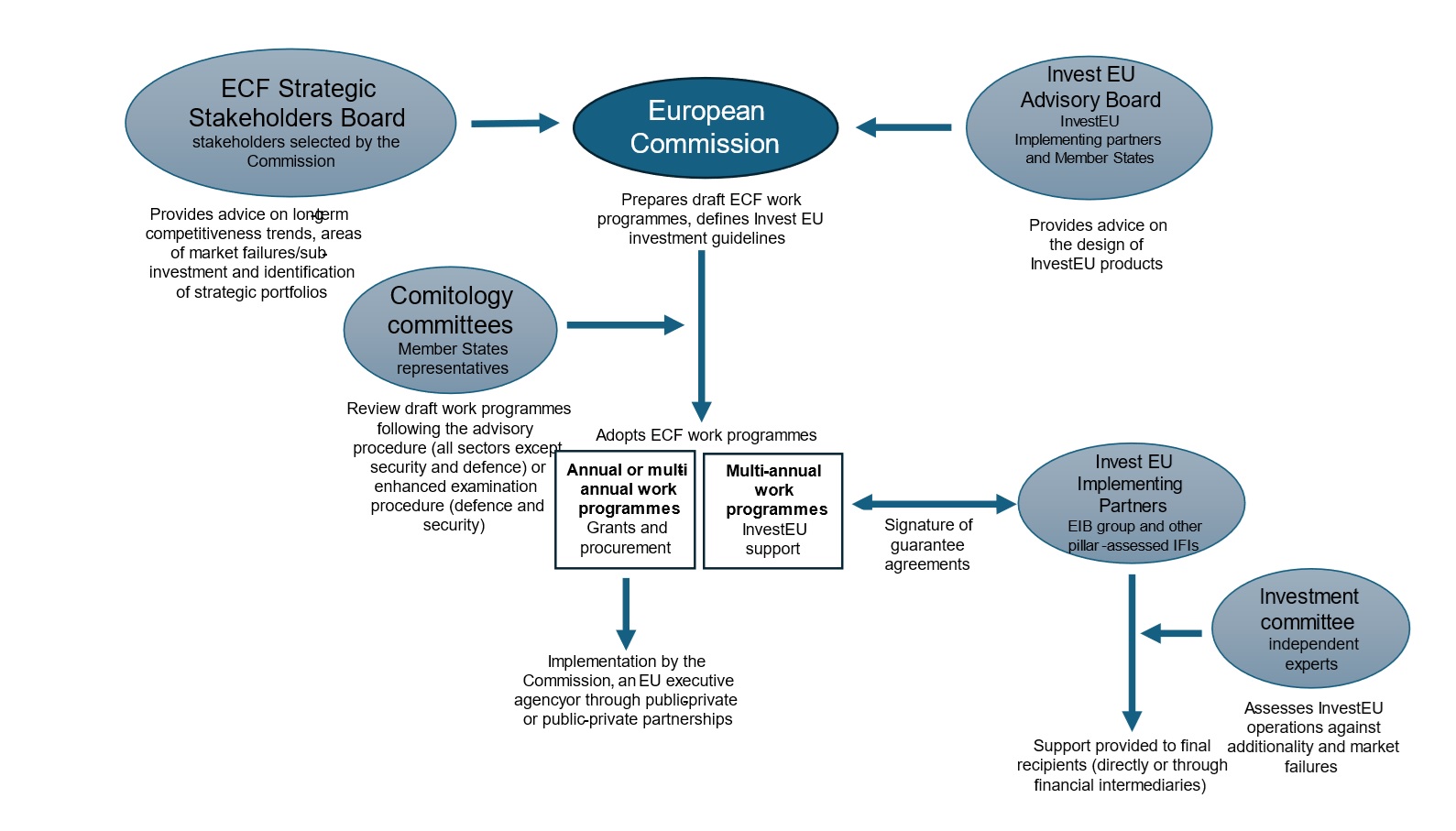
The proposed ECF governance gives a pre-eminent steering role to the Commission (Figure 1). The Commission alone will identify the sectoral priorities drawing on input from a ‘strategic stakeholders board’ whose composition is largely at the Commission’s discretion. Once the priorities are identified, the Commission will also decide the type of projects eligible for funding, award criteria and the funding modality through annual or multi-annual work programmes. Contrary to EU programmes like Horizon Europe and Digital Europe, where work programmes are adopted through the so-called ‘examination’ procedure – allowing member states to reject the Commission proposal by qualified majority – the ECF work programmes will generally follow the lighter ‘advisory’ procedure, under which the Commission may adopt the programme irrespective of member states’ opinions. Only the defence, security and space window will be subject to the more restrictive examination procedure.
Figure 1 | ECF governance
Source: Authors’ own elaboration.
Although InvestEU implementing partners – the European Investment Bank (EIB) Group as well as pillar-assessed national promotional banks and institutions (NPBIs) and international financial institutions (IFIs) – are expected to play a central role in the ECF implementation, they have little influence over programme steering. The current InvestEU Steering Board, which brings together Commission representatives and implementing partners to provide strategic guidance, will be removed. The Commission alone will define the InvestEU investment guidelines, while InvestEU implementing partners will only have a limited advisory role through the ‘InvestEU advisory board’.
A Commission’s central steering role can help shield funding decisions from short-term political pressures and fragmented industrial interests. However, it also entails risks. Decisions may become overly technocratic if they are insufficiently grounded in market realities. Stakeholder input could be captured by vested private interests if not balanced and transparent. Finally, limited member state involvement in setting the overall strategic direction may result in misalignment with national industrial policies.
Both the Council and the European Parliament propose constructive changes to address these gaps. The Parliament’s Committee on Industry, Research and Energy (ITRE) draft report proposes an ‘Economic and Technological Advisory Council’ composed of independent experts that will advise the Commission on long-term economic and technological trends, areas of market failure and sub-optimal investment needs.[5] This Advisory Council would publish annual reports enhancing transparency and accountability. The ‘stakeholders board’ would remain but with a narrower role, assisting the Commission in designing calls. The Council proposal mandates the Commission to prepare an ECF multiannual strategic document setting the overall strategic direction and priorities, to be discussed with member states’ representatives before drafting the work programmes. Both suggestions would lead to a more structured, well-informed and transparent process to set priorities.
By contrast, the Council’s intention to require the examination procedure to adopt all ECF work programmes is problematic. Reserving member states the right to decide the specific project eligibility rules and award criteria in calls is only justified in sensitive areas such as defence. Letting these decisions fall into the hands of the Commission will support coherent pan-European strategic objectives and reduce fragmentation and national capture. The core governance challenge is therefore to combine Commission steering capacity with accountability and stakeholder grounding, not to come back to ‘business-as-usual’, member state-centric comitology.
Another key governance challenge for the ECF is striking the right balance between flexibility and predictability. The ECF proposal seeks to maximise flexibility by combining annual and multiannual work programmes. Annual work programmes may be suitable in some areas to address changing circumstances or respond to new technological trends. However, investors need predictable funding horizons. This is particularly the case for infrastructure projects which require long-term planning and implementation. The same applies to InvestEU implementing partners, who need long-term predictability on the amount of the EU budgetary guarantee at their disposal to design and deploy financial instruments effectively as well as credibly attract private funding. Flexibility can be delivered through other mechanisms without undermining predictability, for example by regularly updating investment guidelines for the EU guarantee or launching targeted calls for specific thematic operations.
Scale: Ensuring sufficient financing capacity for ECF InvestEU
At around 33 billion euros per year – approximately 0.1 per cent of EU GDP – the ECF is significant in absolute terms but modest relative to the scale of the investment challenge. Its impact will critically depend on its ability to leverage additional public and private capital, making InvestEU implementing partners central actors of the ECF implementation.
The Commission’s draft ECF regulation states that the use of financial instruments that crowd in private investors should be the preferred form of intervention wherever possible (recital 14). Yet, the initial allocation for the ECF InvestEU Instrument is small: at 11 billion euros, it is lower than the current InvestEU budget (11.6 billion).[6] In addition, only 7 out of these 11 billion will be used to provision the InvestEU guarantee.[7] As the guarantee will be provisioned at 50 per cent to increase its risk-absorption capacity (instead of the current 40 per cent), this will result in a total 14 billion euros EU guarantee. Adding to this the 3 billion for direct financing of financial instruments, the total InvestEU’s financing capacity will amount to 17 billion, falling significantly short of the current InvestEU’s capacity of 29.1 billion.[8]
The draft regulation allows the 11 billion euros base allocation to be increased through additional contributions from ECF work programmes (with a maximum ceiling of 70 billion euros imposed for the InvestEU guarantee). While this increases flexibility, it risks increasing uncertainty among implementing partners as the total funding envelope is not set at the beginning and may create a discontinuity (“cliff-edge effect”) at the start of the programming period before supplementary work programme contributions materialise. Overall, it is difficult to reconcile such a small initial allocation with the stated ambition to use financial instruments and budgetary guarantees as the privileged form of EU support under the ECF.
Both the Council and the Parliament proposals reinforce the role of InvestEU in the ECF regulation. The Council proposes the inclusion of a legal provision explicitly stating that InvestEU should be the preferred form of action and a minimum percentage of contributions from the combined allocations of the four policy windows to be channelled to InvestEU. The Parliament ITRE report goes further, proposing to raise the ECF InvestEU Instrument initial allocation to 40 billion euros,[9] which, at a 50 per cent provision rate, would translate into an 80 billion guarantee.
Policy recommendations
The ECF’s capacity to be transformational will strongly depend on setting the right governance and leveraging a substantial volume of public and private investments.
With regard to governance, the ECF’s broad scope and use of flexibility in funding envelopes are justified by today’s uncertain and rapidly changing environment. However, they make effective priority setting essential. The Commission’s role in defining priorities centrally can be both a strength and a risk. While centralisation may shield decisions from short-term political pressures, priorities may be insufficiently grounded in market realities, misaligned with national industrial strategies, or skewed by unbalanced stakeholder input. To mitigate the risks, both industrial stakeholders and independent experts should provide the Commission with input on long-term economic and technological trends. The process and the input received should also be made more transparent, so that the Commission can be held accountable for the choices it makes. Actors with operational market expertise, such as InvestEU implementing partners, should also be involved in the priority-setting phase, as they are particularly well placed to identify market failures and investment gaps requiring EU intervention. As requested by the Council, member state representatives should also be involved in defining the ECF’s long-term strategic direction. However, except in sensitive areas such as defence, they should not have the power to adopt or block the adoption of work programmes.
It is important to find the right balance between predictability and flexibility: Investors and implementing partners require long‑term visibility to build pipelines and deploy financial instruments. While the draft ECF regulation suggests the use of multi-annual work programmes for the provision of support through InvestEU,[10] ECF InvestEU Instrument should be clearly exempted from annual programming, or exempted from work programmes (as under the current InvestEU). This approach preserves flexibility while providing the predictability needed for effective financial leverage.
With respect to the scale: while the overall proposed budget marks an increase compared to previous programmes supporting innovation and competitiveness, its relative scale remains modest. The Fund alone is unlikely to generate systemic effects. Its impact will therefore hinge critically on its ability to mobilise additional investment, notably through the ECF InvestEU Instrument. Relying on ulterior decisions to allocate part of the ECF funds to InvestEU does not offer enough certainty for InvestEU implementing partners and operators and may create a ‘cliff edge’ effect. To mitigate this, the initial allocation for the ECF InvestEU Instrument budget should be increased to 40 billion euros – roughly equivalent in real terms to the current 29.1 billion. This could be complemented with mechanisms to avoid funding discontinuities between MFF cycles, such as permitting carry-over of guarantees and maintaining continuity with existing InvestEU policy windows.
Overall, the ECF has the potential to become a powerful EU investment instrument to support the Union’s industrial ambitions. However, ambition alone will not make it transformational. Its success will depend on three conditions. First, improved governance by the establishment of more structured and transparent advisory and expert structures and by giving member states a say in the definition of the ECF’s strategic direction. Second, flexibility must be balanced with long-term predictability by making selective use of annual work programmes and ensuring long-term commitments with InvestEU partners. Third, the instruments’ firepower capacity shall be enhanced by increasing the initial allocation for the ECF InvestEU Instrument budget. If these conditions are met, the ECF and its InvestEU could become the cornerstone of a genuine European industrial policy.
Eulalia Rubio is Associate Senior Research Fellow in the Economic Policy Unit at the Centre for European Policy Studies (CEPS), Brussels, and Senior Research Fellow at the Jacques Delors Institute in Paris. Cinzia Alcidi is Senior Research Fellow and Head of the Economic Policy and Jobs & Skills Units at CEPS.
Brief produced in the framework of the project “The Multiannual Financial Framework 2028-2034: Priorities for the European Union and Italy”.
[1] Draghi, Mario, The Future of European Competitiveness. Part A, A Competitiveness Strategy for Europe, September 2024, https://commission.europa.eu/node/32880_en; Letta, Enrico, Much More than a Market, April 2024, https://www.consilium.europa.eu/media/ny3j24sm/much-more-than-a-market-report-by-enrico-letta.pdf.
[2] European Commission, Proposal for a Regulation on Establishing the European Competitiveness Fund (COM/2025/555), 16 July 2025, https://eur-lex.europa.eu/legal-content/en/TXT/?uri=celex:52025PC0555.
[3] Namely: Innovation Fund, the Digital Europe Programme, the Connecting Europe Facility - CEF Digital, the European Defence Fund, the Act in Support of Ammunition Production (ASAP), the European Defence Industry Reinforcement through Common Procurement Act (EDIRPA), the European Defence Industry Programme (EDIP), EU4Health, the European Space Programme, IRIS, InvestEU, the Single Market Programme (SME strand) and the LIFE Programme (for environment and climate action). Horizon Europe is usually counted as the 14th, but unlike the others, it remains a standalone programme.
[4] Council of the EU, MFF 2028-2034: Council Agrees Its Position on New and Innovative Fund to Boost EU’s Competitiveness, 16 June 2026, https://www.consilium.europa.eu/en/press/press-releases/2026/06/16/mff-2028-2034-council-agrees-its-position-on-new-and-innovative-fund-to-boost-eu-s-competitiveness.
[5] European Parliament, Draft Report on the Proposal for a Regulation on Establishing the European Competitiveness Fund (‘ECF’), Including the Specific Programme for Defence Research and Innovation Activities, 20 April 2026, https://www.europarl.europa.eu/doceo/document/ITRE-PR-784506_EN.pdf.
[6] The InvestEU budget was originally 10.5 billion euros but it has been increased to 11.6 billion with the Omnibus II regulation adopted in December 2025. See European Parliament and Council of the EU, Regulation (EU) 2025/2005 of 16 December 2025…, http://data.europa.eu/eli/reg/2025/2005/oj.
[7] One billion euros will be used to finance advisory services and 3 billion will be used to support fully-funded EU financial instruments that do not generate any leverage effect and are disbursed upfront (contrary to budgetary guarantees, that are only disbursed if/when called and in any case at a later stage).
[8] Under Regulation (EU) 2021/523 establishing the InvestEU Programme, the EU budgetary guarantee was set at 26,1 billion euros. Following the amendments introduced by the Omnibus II revision, the overall budgetary guarantee was increased to 29,1 billion euros.
[9] European Parliament, Draft Report on the Proposal for a Regulation on Establishing the European Competitiveness Fund (‘ECF’), cit.
[10] The draft ECF regulation stipulates that multi-annual work programmes “could in particular be considered” for the provision of support through InvestEU (recital 50).