Titolo completo
Making Enforcement Negotiable? The Digital Markets Act under US Pressure
|
On 28 April 2026, the European Commission published its first statutory review of the Digital Markets Act (DMA), which subjects the EU’s largest digital “gatekeepers” – a small set of companies designated on the basis of market capitalisation, user reach and competitive centrality – to a set of ex ante obligations designed to make digital markets fairer and more contestable.[1] At this point, seven gatekeepers have been formally designated, namely Alphabet, Amazon, Apple, Booking, ByteDance, Meta and Microsoft, covering 23 core platform services, a scope that encompasses the majority of consumer-facing digital infrastructure in Europe.[2]
The review reached a broadly positive verdict: the DMA is “fit for purpose”, has delivered measurable positive effects and does not require legislative revision at this stage.[3] For instance, the report pointed out that choice screens, mandated by Article 6(3) DMA, produced measurable shifts in browser market shares. Likewise, messaging interoperability obligations, the DMA’s most structurally ambitious intervention, have begun to open communication ecosystems, though the Commission acknowledged that full interoperability remains incomplete. The review also highlighted other measures favourably, including data portability requirements and advertising transparency obligations.
However, critics have argued that the DMA’s enforcement has not matched its regulatory ambition. They claim that the pattern of enforcement activity shifted following Donald Trump’s return to the presidency on 20 January 2025, with the Commission now treating DMA enforcement as a tool for managing trade rather than enforcing the law.[4]Additional concern has been raised by the Commission’s plan to enter into a “dialogue” with the Trump Administration on European digital regulation, a concession that opens structural channels for political influence over ongoing enforcement proceedings.[5] The America First Trade Policy memorandum signed on Trump’s first day in office directed the US Trade Representative to treat foreign regulations targeting American technology companies as trade irritants.[6] A subsequent Presidential memorandum of 21 February 2025 named EU digital regulation explicitly as a threat to American commercial interests.[7] Persistent reporting has indicated that the Commission modulated enforcement activity to reduce the risk of triggering US tariff responses.
As context, consider that the DMA is a Regulation directly applicable in all member states from the moment of its entry into force. The enforcement obligations it imposes on the Commission are correspondingly direct. Article 26 DMA requires the Commission to open proceedings when it suspects non-compliance; Article 27 provides for fines of up to 10 per cent of a gatekeeper’s total worldwide annual turnover, rising to 20 per cent for repeated infringement. To be clear, these are legal obligations triggered by factual determinations about gatekeeper behaviour. The Commission retains procedural discretion – over sequencing, resource allocation and the ordering of cases – but does not possess substantive discretion to decline enforcement of confirmed violations for reasons external to the DMA’s own legal framework. The DMA’s obligations are formally non-discriminatory and apply to any company meeting the gatekeeper thresholds regardless of nationality. But six of the seven designated gatekeepers are American firms, and Washington’s demonstrated willingness to treat enforcement against them as trade-provocative has made the non-discrimination argument politically inert. The framing is now embedded in the discourse and will likely persist.
In order to evaluate the recent clash between the EU and the United States regarding tech regulation, as exemplified by the debate about the Digital Markets Act, this brief examines the empirical record. Using a catalogue of official DMA-related documents, it measures shifts in enforcement activity and institutional language before and after 20 January 2025. It then assesses the legal and institutional implications before making policy recommendations.
1. Data: Enforcement patterns before and after Trump
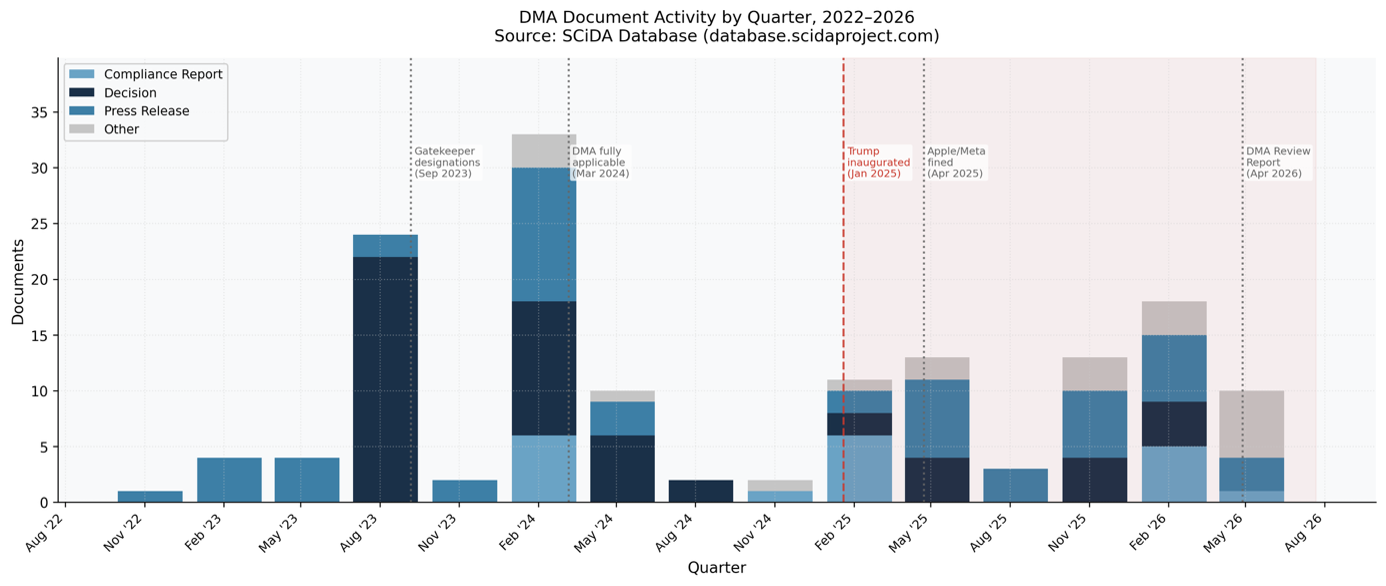
Based on web-scraped data collected under the SCiDA Project,[8]DMA-related document activity was sparse during the legislative phase and rose sharply as the DMA moved toward application (Figure 1). The peak came around the time of gatekeeper designations in September 2023 (24 documents in that quarter) and again when substantive DMA obligations first applied to designated gatekeepers in March 2024 (33 documents). Comparing the enforcement period, defined from March 2024 when DMA obligations became operative, the per-month document rate rose from 3.44 documents per month in the pre-Trump window (March 2024 to January 2025, 36 documents over 10.5 months) to 4.05 documents per month in the post-Trump window (January 2025 to May 2026, 67 documents over 16.5 months), an increase of approximately 18 per cent. In short, headline activity did not slow after Trump’s inauguration.
Figure 1 | Overall DMA-related activity
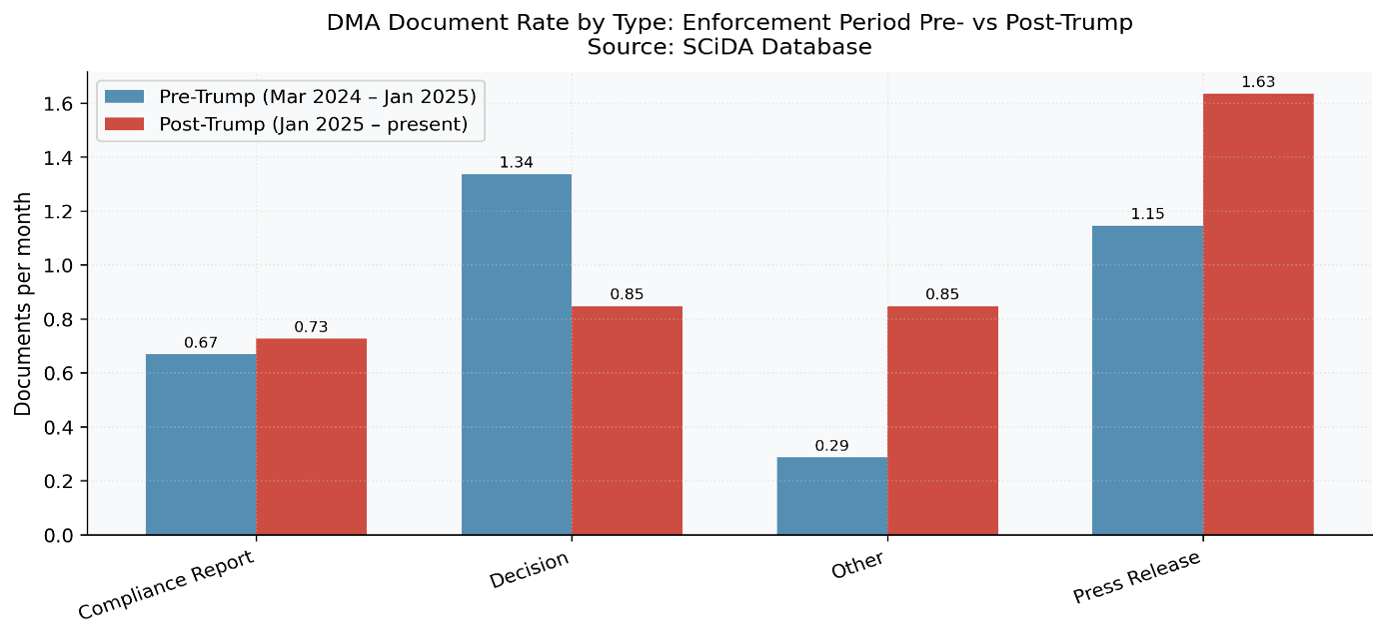
The composition of that activity, however, changed in ways that matter for enforcement (Figure 2). The rate of formal enforcement decisions, i.e. the category most directly associated with binding legal action, fell from 1.34 decisions per month in the pre-Trump enforcement window to 0.85 decisions per month post-Trump, a decline of approximately 37 per cent. By contrast, press releases increased from 1.15 per month to 1.63 per month (a 42 per cent increase) and “other” document types increased from 0.29 to 0.85 per month (a 193 per cent increase). Compliance report volume remained roughly stable (0.67 to 0.73 per month). This pattern is consistent with a shift toward high-visibility communications and procedural monitoring, with reduced formal enforcement decision-making. The Commission generated more documents, but the documents that impose legal obligations declined as a share of total output.
Figure 2 | DMA document type composition
In particular, the Commission opened seven non-compliance proceedings under the DMA across the full observation period.[9] Two resulted in formal fines: Apple, fined 500 million euros for App Store anti-steering violations, and Meta, fined 200 million euros for its “pay-or-consent” model regarding data combination for advertising purposes.[10] Both were announced on 23 April 2025, demonstrating that enforcement did not cease after Trump’s inauguration. A third major case concerning Google’s search self-preferencing and its Shopping and Maps vertical services reached a stage at which a substantial fine was prepared but not issued, with reporting indicating direct intervention at the level of the College of Commissioners in response to US diplomatic pressure.[11] Several investigations remain open as of writing (mid-May 2026) and the Commission’s own review report acknowledges that “gatekeepers have adopted approaches that may delay or limit effective implementation”.[12] Three years after substantive DMA obligations applied to designated firms, the concluded case count thus stands at only two.
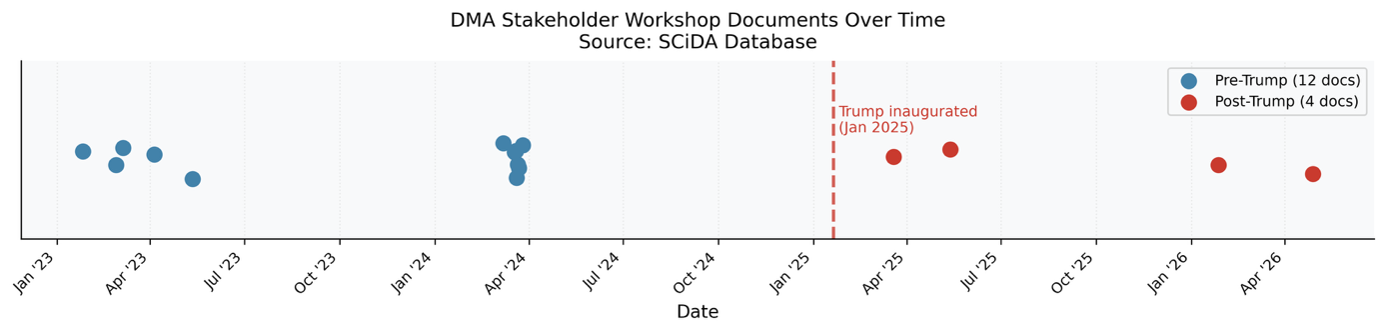
Stakeholder workshop records, which are the Commission’s primary mechanism for transparent, third-party engagement with compliance questions, appear twelve times in the SCiDA pre-Trump record and four times in the post-Trump record (Figure 3). This represents a 67 per cent decline. Unlike the aggregate activity trend, workshops do not admit of a lifecycle-based explanation: they are the fora through which civil society organisations, competitor firms and academic researchers can inform enforcement in real time. Their decline is consistent with a narrowing of participatory governance, even as the volume of official communications increased.
Notably, the DMA’s enforcement framework does not grant third parties any formal role in the Commission’s supervision or enforcement mechanisms, limiting their participation to that of passive informants with no right to a reasoned decision, no right of complaint and no right of access to proceedings documents.[13] Their participation is dependent on the Commission’s administrative discretion, which is precisely why the composition of that discretion, and its exercise across political regimes, matters. The Commission itself has acknowledged in its review that it must “further reflect on whether to revise the Implementing Regulation to take on board the suggestions made by stakeholders to further improve its proceedings and ensure wider access to information for third parties”.[14]
Figure 3 | The DMA workshop decline
Next, we turn to document-level vocabulary, which offers a second, independent window on institutional behaviour. Changes in enforcement priorities also tend to impact Commission language.[15] In particular, the language of official communications tracks what regulators are actually attending to, case by case. To test whether the corpus of DMA documents reflects a semantic shift, one can apply a so-called log-odds ratio comparison of word frequencies across the pre- and post-Trump document sets.[16] The method identifies terms that are statistically overrepresented in one period relative to the other, controlling for the difference in corpus size between the two windows. It does not measure intent; it measures what the Commission was writing about.
According to this linguistic analysis, terms significantly more frequent in post-Trump DMA documents include model, intelligence, apps, concerns, dialogue, effectiveness and evidence; i.e. a vocabulary consistent with AI-related scope extension debates and procedural enforcement language. Terms significantly more frequent in pre-Trump documents include subsidiaries, headquartered, parent, delineation, presumptions, rebuttal, qualification and niics (number-independent interpersonal communications services such as WhatsApp, a designated category of core platform service) – all terminology characteristic of gatekeeper designation proceedings, which require detailed analysis of corporate entities and service taxonomies. The pre-Trump lexicon describes the Commission building a regulatory architecture, whereas the post-Trump lexicon describes the Commission responding within that architecture, such as specific concerns about AI. Whether that transition reflects natural regulatory maturation or a contraction of agenda driven by political pressure cannot be resolved from vocabulary analysis alone; the pattern is consistent with both interpretations.
European Parliament written questions (PQs) addressed to the Commission function as a low-friction accountability mechanism, since they require a formal Commission response and are publicly registered. Since their titles often signal how Members of the EP (MEPs) are framing an issue at a given moment, we can trace the DMA’s framing in PQs over time to control whether parliamentary opinion on DMA enforcement has shifted. One methodological caveat applies: the Application Programming Interface (API) for the EP Open Data (v2) does not expose questions filed before July 2024, making any pre-Trump comparison impossible. Within that constraint, the ten DMA-related PQs recoverable from the post-Trump period reveal a clear directional shift (Figure 4).
Figure 4 | Parliamentary engagement with aspects of the DMA
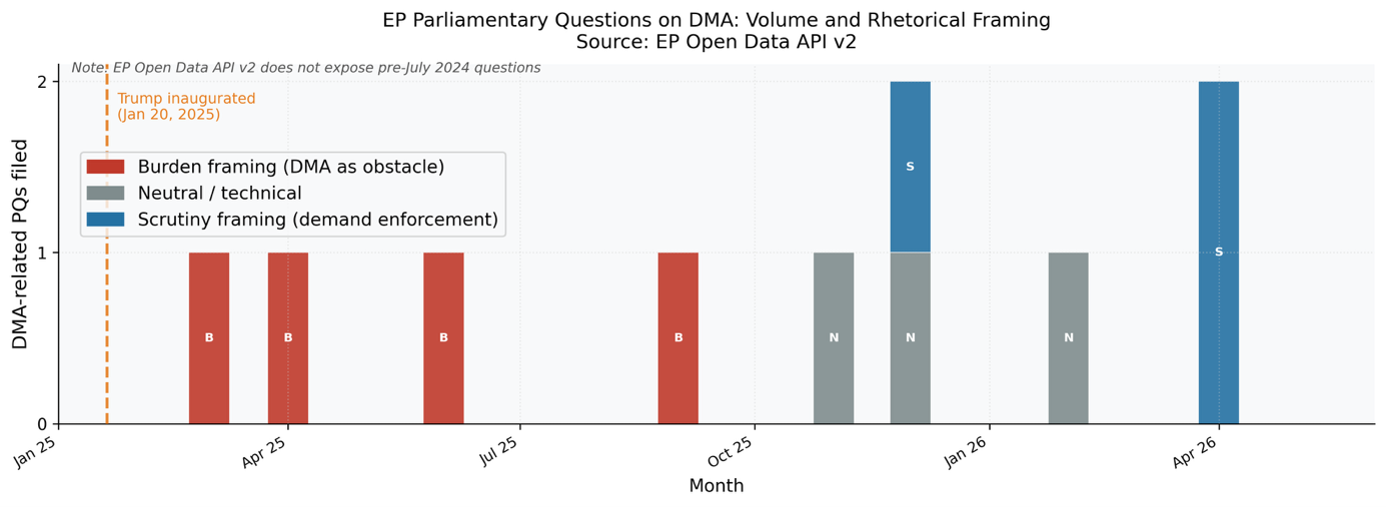
The first four questions, all filed between March and September 2025, share a consistent framing: the DMA as a source of harm or obstacle. MEPs asked the Commission how it would prevent harm to European businesses from DMA implementation (6 March 2025), how it would respond to the DMA’s effects on EU competitiveness (1 April 2025), what it would do about the DMA’s “unforeseen consequences” for small and medium-sized enterprises (SMEs) and customers (18 June 2025) and whether the DMA was delaying consumer-facing product features (30 September 2025). That last question, concerning a translation feature in wireless headphones, suggests that gatekeeper lobbying had successfully channelled concrete product-level complaints into parliamentary questions, framing the DMA as a brake on innovation rather than a competitive safeguard.
However, the pattern inverted over the following six months. The questions filed from November 2025 onward do not ask whether the DMA is too burdensome; they ask whether companies are complying with it. A December 2025 question concerned Booking Holdings’ obligations under the DMA (17 December 2025). In April 2026, two separate MEPs filed near-identical questions on the same day about Google’s new Android developer verification programme and its compatibility with DMA requirements (8 April 2026). The shift from “is the DMA hurting businesses?” to “is this named gatekeeper complying?” suggests that by late 2025 the dominant parliamentary concern had moved from regulatory overreach to enforcement adequacy, with MEPs directing pressure toward the Commission.
In conclusion, the patterns that can be inferred quantitatively from the SCiDA database are consistent with, but do not prove, the political modulation of DMA enforcement. Since the dataset is curated and covers only a short period of time, alternative explanations cannot be ruled out. These include the natural maturation of the DMA process and resource constraints at the Commission’s Directorate-General for Competition.
2. The legal and constitutional dimension
The DMA’s legal context, as outlined in the introduction, defines the outer limit of what the Commission may lawfully do in response to political pressure from Washington. Article 17 of the Treaty on European Union (TEU) requires the Commission to act as guardian of the Treaties, exercising its responsibilities “completely independent” and pursuing “the general interest of the Union”.[17] When considering how to apply this independence obligation to enforcement discretion, one can draw on existing principles of EU case law, though their application to the DMA context remains, in important respects, legally untested.
In general, the Court of Justice and the General Court have confirmed that the Commission enjoys discretion to prioritise enforcement cases, provided it applies objective criteria consistently and gives reasons for its choices.[18] This logic implies that decisions motivated by considerations wholly extraneous to the DMA’s own legal objectives, such as managing third-country trade relations, would not qualify as legitimate Community interest reasoning and could be challenged.[19] The recognised ground for such a challenge is “misuse of powers” under Article 263 of the Treaty on the Functioning of the EU (TFEU), which permits annulment where a measure is shown to have been adopted exclusively or predominantly for purposes other than those for which the power was conferred.[20] The evidentiary threshold is high. Meanwhile, courts have consistently held that the Commission cannot be compelled to open proceedings under Articles 101 and 102 TFEU, the two key competition rules.[21] Note, however, that Article 26 DMA provides that the Commission “shall take the necessary actions to monitor the effective implementation and compliance” with the obligations laid down in the DMA – mandatory-sounding language that may create a stronger legal foothold compared to the traditional competition rules.[22] Thus, if documented evidence emerged that the College of Commissioners exercised influence over DMA proceedings in response to US tariff threats, that evidence could likely be used as a legal basis for an action before the Court of Justice.
The geo-political and trade-law dimensions complicate the political picture – but without altering the legal analysis. The United States has not brought a formal challenge against the DMA under the World Trade Organization (WTO). Trump’s above-mentioned memoranda must be primarily seen as political instruments: they direct US agencies to identify countermeasures but create no international legal obligation on the EU. At the same time, the Commission led by Ursula von der Leyen entered its second term committed simultaneously to robust digital regulation and to the competitiveness agenda outlined in Mario Draghi’s influential September 2024 report, which placed regulatory burden reduction and investment promotion alongside digital sovereignty as co-equal policy objectives.[23]
These commitments become operationally incompatible when the primary subjects of digital regulation are the same US technology firms whose cooperation the Commission needs to attract investment for the AI Continent Action Plan, and whose home government is simultaneously the source of the tariff threat the Commission is trying to manage. The German government’s reported interest in moderating enforcement intensity is not irrational: German exports to the United States run to substantial levels annually, and the technology infrastructure on which German manufacturing depends, especially cloud computing and payment systems, is predominantly American.[24] France, whose strategic culture tends toward regulatory assertiveness and “technological sovereignty”, might have been expected to countervail Germany’s moderating pressure. But France faces the same US tariff threat across aerospace, agriculture and luxury goods, which limits its appetite for direct confrontation with Washington over digital enforcement.
The precedent risk extends well beyond the DMA. The AI Act,[25] which entered into force in August 2024 but applies its most consequential obligations only in the coming months and years, relies on an enforcement architecture with the same structural vulnerability: a body, here the European AI Office, embedded within the Commission’s organisational structure, subject to the same political influence that currently impacts DMA enforcement. If the DMA case establishes that EU regulation of American technology companies is subject to informal diplomatic adjustment, that expectation might transfer to AI Act enforcement. The reported modulation of enforcement intensity on the political level is difficult to document and is correspondingly difficult to challenge before the Court of Justice.
3. Conclusions and policy implications
Despite the gains for competition documented in the Commission’s review of the DMA, such as the browser choice system and greater transparency in advertising, the enforcement architecture poses increasing political and legal costs, thereby increasing regulatory uncertainty. Drawing on documents collected by the SCiDA project, this brief showed that the composition of DMA enforcement activity changed measurably after January 2025, in ways that warrant scrutiny despite an increase in aggregate document volume. The decline of 37 per cent in the formal decision rate, the decline of 67 per cent in workshop records, and the shift in vocabulary to procedural questions collectively describe an enforcement posture that has become more communicative and less binding.
To address this worrying trend, the EU could introduce institutional reforms that would transfer non-compliance proceedings to an independent European Digital Markets Authority (EDMA), which would be structurally separate from the College of Commissioners.[26] An EDMA modelled on the functional independence of the European Central Bank in monetary policy, including a fixed-term mandate and protected budget, would insulate enforcement against any trade-calculation logic. By contrast, if the DMA case establishes that EU law enforcement against politically connected foreign firms yields to diplomatic pressure, the AI Act’s credibility begins degraded from day one.
The Commission should also draw and enforce, a sharper operational distinction between legitimate regulatory adaptation and politically motivated enforcement deferral. Reducing procedural complexity, clarifying technical specifications and shortening compliance timelines for gatekeepers that have genuinely remedied violations are all legally compatible with DMA objectives. Slowing or suspending proceedings against confirmed violations in response to US tariff threats is not compatible with any objective the Commission is legally authorised to pursue. The two are systematically conflated in public debate to the consistent advantage of the firms under scrutiny.
Anselm Küsters is Scientific Director for the Nordic Countries and Head of the Division Digitalisation and AI at the Centre for European Policy (cep), Helsinki.
Paper produced in the framework of the IAI-Intesa Sanpaolo Partnership. The views expressed in this report are solely those of the author.
[1] European Commission, Report on the Review of Regulation (EU) 2022/1925 – Digital Markets Act (COM/2026/178), 28 April 2026, https://eur-lex.europa.eu/legal-content/en/TXT/?uri=celex:52026DC0178.
[2] European Parliament and Council of the EU, Regulation (EU) 2022/1925 of 14 September 2022 on Contestable and Fair Markets in the Digital Sector (Digital Markets Act), p. 1, https://eur-lex.europa.eu/eli/reg/2022/1925/oj/eng.
[3] European Commission, Commission Staff Working Document Accompanying COM(2026) 178 final (SWD/2026/123), 28 April 2026, p. 55, https://eur-lex.europa.eu/legal-content/en/TXT/?uri=celex:52026SC0123.
[4] Rudl, Tomas, “Bilanz zum Digital Markets Act: EU-Digitalgesetz ist kein Selbstläufer”, in netzpolitik.org, 29 April 2026, https://netzpolitik.org/?p=518170.
[5] Von Thun, Max, “Digitalregulierung: Von der Leyens DMA-Kurs gefährdet Europas Souveränität”, in Tagesspiegel Background: Digitalisierung & KI, 19 May 2026, https://background.tagesspiegel.de/digitalisierung-und-ki/briefing/von-der-leyens-dma-kurs-gefaehrdet-europas-souveraenitaet.
[6] White House, America First Trade Policy, 20 January 2025, https://www.whitehouse.gov/presidential-actions/2025/01/america-first-trade-policy.
[7] White House, Defending American Companies and Innovators from Overseas Extortion and Unfair Fines and Penalties, 21 February 2025, https://www.whitehouse.gov/presidential-actions/2025/02/defending-american-companies-and-innovators-from-overseas-extortion-and-unfair-fines-and-penalties.
[8] The SCiDA Project at Heinrich-Heine-University Düsseldorf and Newcastle University catalogues official documents related to the DMA, Germany’s Act against Restraints of Competition (GWB) §19a, and the UK Digital Markets, Competition and Consumers Act (DMCCA). As of mid-May 2026, when this analysis was conducted, their publicly accessible website lists 150 DMA entries, spanning the initial Commission legislative proposal of December 2020 through the most recent compliance records. Note that the database is a curated collection, rather than an exhaustive one. Therefore, the patterns to be discussed below must be interpreted with this limitation in mind. See: SCiDA Project website: SCiDA Database, https://database.scidaproject.com.
[9] The Commission opened five non-compliance investigations simultaneously in March 2024 (against Alphabet, Apple and Meta), and additional investigations followed.
[10] European Commission, Commission Finds Apple and Meta in Breach of the Digital Markets Act, 23 April 2025, https://ec.europa.eu/commission/presscorner/detail/en/ip_25_1085.
[11] Von Thun, Max, “Digitalregulierung”, cit.
[12] European Commission, Report on the Review of Regulation (EU) 2022/1925, cit., p. 5.
[13] Cseres, Katalin J. and Laurens C. De Korte, “Participation of Third Parties in the Public Enforcement of the Digital Markets Act: Between Democracy and Technocracy”, in Journal of Antitrust Enforcement, Vol. 13, No. 3 (November 2025), p. 595-620, https://doi.org/10.1093/jaenfo/jnae051.
[14] European Commission, Commission Staff Working Document, cit., p. 62.
[15] Küsters, Anselm, The Making and Unmaking of Ordoliberal Language. A Digital Conceptual History of European Competition Law, Frankfurt am Main, Klostermann, 2023; Bartalevich, Dzmitry, “The Influence of the Chicago School on the Commission’s Guidelines, Notices and Block Exemption Regulations in EU Competition Policy”, in Journal of Common Market Studies, Vol. 54, No. 2 (March 2016), p. 267-283, DOI 10.1111/jcms.12292.
[16] Using a chi-squared significance filter (χ² p < 0.05) applied to unigrams extracted from document titles and additional web-scraped descriptions.
[17] Consolidated Version of the Treaty on European Union, Article 17, in Official Journal of the European Union, C 326, 26 October 2012, https://eur-lex.europa.eu/eli/treaty/teu_2016/oj/eng.
[18] Court of Justice of the EU (CJEU), Judgement of the Court of First Instance of 18 September 1992 in Case T-24/90: Automec Srl v Commission, paras 73-77, https://eur-lex.europa.eu/legal-content/en/TXT/?uri=celex:61990TJ0024.
[19] See also the Commission Notice on the Handling of Complaints by the Commission under Articles 81 and 82 of the EC Treaty (OJ C 101, 27 April 2004, p. 65-77), paras 41-45, https://eur-lex.europa.eu/legal-content/en/TXT/?uri=oj:JOC_2004_101_R_0065_01.
[20] CJEU, Judgment of the Court (Fifth Chamber) of 13 November 1990 in Case C-331/88: The Queen v Minister of Agriculture, Fisheries and Food and Secretary of State for Health, ex parte: Fedesa and others, paras 24-25, https://eur-lex.europa.eu/legal-content/en/TXT/?uri=celex:61988CJ0331.
[21] CJEU, Judgment of the Court (Second Chamber) of 14 February 1989 in Case 247/87: Star Fruit Company v Commission, para 11, https://eur-lex.europa.eu/legal-content/en/TXT/?uri=celex:61987CJ0247 (Commission has no obligation to initiate infringement proceedings); CJEU, Order of the Court of 23 May 1990 in Case C-72/90: Asia Motor France v Commission, para 13, https://eur-lex.europa.eu/legal-content/en/TXT/?uri=celex:61990CO0072 (discretionary nature of Commission enforcement cannot give rise to non-contractual liability).
[22] European Parliament and Council of the EU, Regulation (EU) 2022/1925, cit., Article 26(1).
[23] Draghi, Mario, The Future of European Competitiveness: Part B, In-depth Analysis and Recommendations, September 2024, https://commission.europa.eu/node/32880_en; Küsters, Anselm, “Whatever It Takes to Innovate: Draghi’s Plans for EU Competition Policy”, in Kluwer Competition Law Blog, 11 September 2024, https://legalblogs.wolterskluwer.com/competition-blog/node/4619.
[24] For the German perspective, see: Rudl, Tomas, “Bilanz zum Digital Markets Act”, cit.
[25] European Parliament and Council of the EU, Regulation (EU) 2024/1689 of 13 June 2024 Laying Down Harmonised Rules on Artificial Intelligence (Artificial Intelligence Act), https://eur-lex.europa.eu/eli/reg/2024/1689/oj/eng.
[26] Mariniello, Mario, “The Case for a European Union Digital Enforcement Authority”, in Bruegel Policy Briefs, No. 05/2026 (5 March 2026), https://www.bruegel.org/node/11937.