Titolo completo
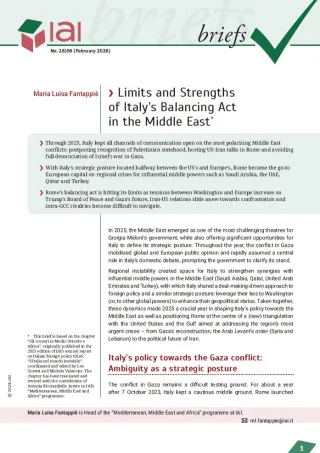
Limits and Strengths of Italy’s Balancing Act in the Middle East
|
In 2025, the Middle East emerged as one of the most challenging theatres for Giorgia Meloni’s government, while also offering significant opportunities for Italy to define its strategic posture. Throughout the year, the conflict in Gaza mobilised global and European public opinion and rapidly assumed a central role in Italy’s domestic debate, prompting the government to clarify its stand.
Regional instability created space for Italy to strengthen synergies with influential middle powers in the Middle East (Saudi Arabia, Qatar, United Arab Emirates and Turkey), with which Italy shared a deal-making-driven approach to foreign policy and a similar strategic posture: leverage their ties to Washington (or, to other global powers) to enhance their geopolitical status. Taken together, these dynamics made 2025 a crucial year in shaping Italy’s policy towards the Middle East as well as positioning Rome at the centre of a (new) triangulation with the United States and the Gulf aimed at addressing the region’s most urgent crises – from Gaza’s reconstruction, the Arab Levant’s order (Syria and Lebanon) to the political future of Iran.
Italy’s policy towards the Gaza conflict: Ambiguity as a strategic posture
The conflict in Gaza remains a difficult testing ground. For about a year after 7 October 2023, Italy kept a cautious middle ground. Rome launched humanitarian initiatives for civilians in Gaza and yet shunned away from firm condemnation of (and concrete measures against) Israel.[1] During the first year of the war, Italy suspended the signing of new contracts with Israel, drastically reducing the arms trade compared to the previous decade, but it remained one of the main suppliers of “dual-use” materials that can also be used for military purposes.[2] Italy has also repeatedly declared its support for a two‑state solution, while postponing recognising the State of Palestine. In multilateral settings, such as the United Nations General Assembly, Italy has abstained from resolutions calling for a ceasefire in the Gaza Strip and for Palestine to be recognised as eligible for UN membership.[3]
Contradictions also surfaced on humanitarian aid. While Italy supported humanitarian initiatives – such as the Vulcano vessel, the hundreds of tonnes of aid delivered by air and scholarships for young Palestinians,[4] it also temporarily suspended its funding to UNRWA, the United Nations Relief and Works Agency for Palestine Refugees in the Near East. Funding was later only partially reinstated but only outside of Gaza, such as in the West Bank and in Palestinian refugee camps in Lebanon, Jordan and Syria.[5] In short, for more than a year after 7 October, Italy has sought to strike a delicate balance between upholding international humanitarian law and preserving its historic ties with Israel.
Over the course of 2025, the Gaza conflict became increasingly central to Italy’s domestic debate, complicating the delicate balancing acts of the preceding months. During the summer, images of war, destruction and famine in Gaza circulated across both traditional and new media. A death toll reaching 70,000,[6] including over 20,000 children,[7] evoked horror and solidarity among Italians of different ages and political affiliations. Gaza thus became a magnet, bringing to the surface longstanding unresolved tensions within Italian politics and society. Between September and November, Italy experienced some of the most significant street protests in solidarity with Gaza in Europe. While driven by a genuine sense of solidarity, protest also channelled frustration towards the institutions and the political class, as well as unresolved tensions between left-wing activists (strongly pro-Gaza) and part of the right (openly supportive of Israel) currently in government. Solidarity with Gaza also took the form of a critique of the incumbent government, reviving anti-imperialist sentiments within the global left.
In response to these developments, the Meloni government invested more effort in defining a clear line of action regarding the conflict, seeking to transform the ambiguity of its position into a strategic strength. It positioned itself as a key player in Gaza’s reconstruction, capable of maintaining an open dialogue with all actors in the Arab world and beyond. Communication channels with Israel remained open, too. Rather than following Spain, and subsequently France and the United Kingdom, in recognising the State of Palestine, Italy stated its willingness to do so only after the release of hostages by Hamas and only once the organisation itself had been removed from any position of government.[8] Alongside Germany, Italy had also opposed, in May, the revision of the association agreement between Europe and Israel at the Foreign Affairs Council.[9]
At the same time, the personal and ideological affinities between Trump and Meloni elevated the Italian Prime Minister as a prominent actor in Europe in promoting the US President’s twenty-point plan for Gaza, introduced at the end of September. Italy sought to position itself as an influential interlocutor for Arab countries – Egypt, Jordan, Saudi Arabia – that aspire to play a role in Gaza’s future. In response to criticism of inaction and lack of a clear stance, Giorgia Meloni’s government highlighted the almost unique role Italy is increasingly playing in the context of negotiations over Gaza’s day after. The visit of the President of the Palestinian Authority, Mahmoud Abbas, to Rome and to the Atreju festival – the annual convention of the Prime Minister’s party – underscores the government’s attempt to carve out a sphere of influence on the Palestinian dossier.[10] However, tensions generated by the conflict remain unresolved, particularly within certain activist circles, as highlighted by a recent investigation in which some Gaza support groups were accused of collaborating with Hamas, and by the subsequent political debate that highlighted the risk of an indiscriminate criminalisation of pro-Palestinian activism.[11]
Italy as a key European player in the Middle East
For years, the concept of a “wider Mediterranean” has circulated within ministries, universities and research centres in Italy, often struggling to find concrete application. With Trump at the White House and a weak, divided – and above all poorly regarded in Washington – European leadership, the Meloni government, and Italy more broadly, have become, perhaps like never before, a key European “player” in advancing a policy towards the Mediterranean and the Middle East. The Mattei Plan, launched in 2023, was an initial step in this direction.
Over the course of 2025, the repeated Middle Eastern crises offered Rome multiple opportunities to present itself as an interlocutor for the United States and to deepen relations with the leaderships of Washington’s allied middle powers in the Gulf, thereby securing a role in shaping a new Middle East. This dynamic emerged in at least three instances. First, during the negotiations on Iran’s nuclear programme that preceded the so-called twelve-day war between Israel and the Islamic Republic in June.
Between April and May, Rome hosted the US special envoy Steve Witkoff and the Iranian delegation twice at the premises of the Omani Embassy, thereby providing a venue for the meetings. Although not part of the E3 (France, UK and Germany) that had signed the 2015 nuclear agreement (JCPOA), by hosting the new negotiations, Italy strengthened its mediation profile, keeping the door open for dialogue with Tehran. In this respect, Rome distinguished itself from the E3, which had refused dialogue before the war and then reimposed sanctions on the Islamic Republic in September. Not being a member of the E3, a factor traditionally seen as a weakness for Rome, thus became a strength in the new context, potentially placing Italy in a privileged position in Europe to play a role in the difficult negotiations between Washington and Tehran.[12]
A second instance of both crisis and opportunity was the aforementioned Trump twenty-point plan for Gaza. As noted, Italy once again became a key interlocutor for Saudi Arabia, the United Arab Emirates, Qatar and Turkey, collaborating on the various stages of the plan’s implementation. Over the course of the year, Rome deepened bilateral ties with each of these countries. In this context, particularly noteworthy is the Prime Minister’s visit to Saudi Arabia and her meeting with Crown Prince Bin Salman.[13] This was accompanied by visits to Bahrain and a strengthening of ties with the United Arab Emirates and Qatar in the defence and trade sectors. Finally, in December, Italy was invited as a guest of honour to the summit of the Gulf Cooperation Council, comprising Saudi Arabia, Qatar, the United Arab Emirates, Bahrain, Oman and Kuwait.[14] These countries are key interlocutors in shaping the stability of the Arab Levant, particularly regarding the delicate political transition in Syria following the fall of Bashar al-Assad’s regime, as well as in Lebanon after the decapitation of Hezbollah’s leadership.
Substantiating the Med-Gulf
In short, albeit for contingent reasons, the presence of a closely aligned Trump administration and the simultaneous weakness of European institutions and capitals offered Italy with an opportunity to define its strategic posture and substantiate the concept of a “wider Mediterranean”. In the political horizon, there is also the idea of linking this foreign policy push towards the Middle East to Italy’s new role in Africa, connected to the Mattei Plan.
What remains to be seen is whether the government’s aim will be to prioritise cultivating bilateral relations with the region’s middle powers or, instead, to reinvest its influence in the “Med-Gulf” region[15] – as it was termed at the Gulf Cooperation Council summit – within a broader European framework. The temptation to place national policy above European multilateralism is likely to be strong, especially in light of the diminished role of Brussels and the assertive posture of US military policy. However, such a ‘going alone’ approach would come at the cost of dismantling key fora and institutions (such as the EU or the UN itself) that have traditionally bolstered Rome’s overall limited capabilities, while it is highly dubious whether new US-imposed endeavours such as the Board of Peace may provide a legitimate alternative platform.
Maria Luisa Fantappiè is Head of the “Mediterranean, Middle East and Africa” programme at the Istituto Affari Internazionali (IAI).
This brief is based on the chapter “Gli scenari in Medio Oriente e Africa”, originally published in the 2025 edition of IAI’s annual report on Italian foreign policy titled: “L’Italia nel mondo instabile”, coordinated and edited by Leo Goretti and Michele Valensise. The chapter has been translated and revised with the contribution of Antonia Ricciardiello, intern in IAI’s “Mediterranean, Middle East and Africa” programme.
[1] See Fantappiè, Maria Luisa, “L’Italia e la guerra in Medio Oriente”, in Ferdinando Nelli Feroci and Leo Goretti (eds), L’Italia nell’anno delle grandi elezioni. Rapporto sulla politica estera italiana, Edizione 2024, Rome, IAI, January 2025, p. 35-41, https://www.iai.it/en/node/19396.
[2] For example, detonating cords, ammonium nitrate and tritium. See Brunelli, Elisa, “L’Italia ha inviato a Israele materiali chiave per esplosivi e armi nucleari”, in Altreconomia, No. 283 (July/August 2025), https://altreconomia.it/litalia-ha-inviato-a-israele-materiali-chiave-per-esplosivi-e-armi-nucleari.
[3] On Italy’s abstentions, see “Assemblea Generale adotta risoluzione per cessate il fuoco a Gaza; l’Italia si astiene”, in OnuItalia, 27 October 2023, https://onuitalia.com/?p=86579; “‘Palestina qualificata come membro dell’ONU’: l’Italia si astiene in Assemblea Generale”, in OnuItalia, 10 May 2024, https://onuitalia.com/?p=88924.
[4] See Italian Ministry of Foreign Affairs, Food for Gaza. Italy’s Humanitarian Commitment, 12 December 2025, https://www.esteri.it/en/?p=148012; Italian Ministry of Defence, “Solidarity Path Operation 2” Concluded: Over 100 Tons of Humanitarian Aid Delivered to the Civilian Population of the Gaza Strip, 19 August 2025, https://www.difesa.it/eng/primo-piano/italys-humanitarian-airlift-to-gaza-continues/77145.html.
[5] “Tamara Alrifai e l’UNRWA: le sfide e il ruolo nel futuro di Gaza”, in AffarInternazionali, 22 December 2025, https://www.affarinternazionali.it/?p=115558.
[6] Cook, James, “More than 70,000 killed in Gaza since Israel Offensive Began, Hamas-Run Health Ministry Says”, in BBC News, 30 November 2025, https://www.bbc.com/news/articles/c8e97kl240lo.
[7] See Save the Children, Gaza: 20,000 Children Killed in 23 Months of War - More than One Child Killed Every Hour, 6 September 2025, https://www.savethechildren.net/news/gaza-20000-children-killed-23-months-war-more-one-child-killed-every-hour.
[8] Italian Government, President Meloni’s Address to the 80th United Nations General Assembly, 24 September 2025, https://www.governo.it/en/node/29851.
[9] “Ue: sì alla revisione dell’accordo di associazione con Israele. Ma Italia e Germania votano contro”, in Repubblica, 20 May 2025, https://www.repubblica.it/esteri/2025/05/20/news/ue_israele_accordo_di_associazione_germania_hanno_votato_contro-424454344.
[10] “Meloni con Abu Mazen ad Atreju: ‘La sua presenza conferma la centralità dell’Italia’”, in RaiNews, 12 December 2025, https://www.rainews.it/maratona/2025/12/trump-lavoriamo-duramente-per-gaza-59-stati-ci-sostengono-896cd4a3-5ade-4650-bb42-fe0a54d7e146.html.
[11] Italian National Police, Terrorismo: colpita rete italiana di Hamas, 9 arresti e sequestri per 8 milioni di euro, 27 December 2025, https://www.poliziadistato.it/articolo/terrorismo--colpita-rete-italiana-di-hamas--9-arresti-e-sequestri-per-8-milioni-di-euro.
[12] Fantappiè, Maria Luisa, “I colloqui USA-Iran e il ruolo dell’Italia”, in AffarInternazionali, 19 April 2025, https://www.affarinternazionali.it/?p=112661.
[13] “Saudi Crown Prince Receives Italian PM in AlUla”, in Arab News, 26 January 2025, https://www.arabnews.com/node/2587883.
[14] “Italy Eyes Deeper Gulf Partnership as Meloni Attends GCC Summit in Bahrain”, in Al Arabiya, 3 December 2025, https://ara.tv/9dtri.
[15] Italian Government, President Meloni’s Speech at the Gulf Cooperation Council Summit, 3 December 2025, https://www.governo.it/en/node/30494.