Titolo completo
From Settler Terrorism to State-Enabled Violence: Rethinking Counterterrorism in the West Bank
|
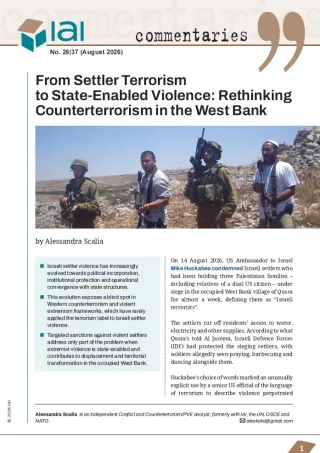
On 14 August 2026, US Ambassador to Israel Mike Huckabee condemned Israeli settlers who had been holding three Palestinian families – including relatives of a dual US citizen – under siege in the occupied West Bank village of Qusra for almost a week, defining them as “Israeli terrorists”.
The settlers cut off residents’ access to water, electricity and other supplies. According to what Qusra’s major told Al Jazeera, Israeli Defence Forces (IDF) had protected the sieging settlers, with soldiers allegedly seen praying, barbecuing and dancing alongside them.
Huckabee’s choice of words marked an unusually explicit use by a senior US official of the language of terrorism to describe violence perpetrated by settlers against Palestinians. It is even more striking given Ambassador Huckabee’s ideological closeness to right-wing Zionism.
Yet settler terrorism is hardly a new phenomenon, and its evolution into a state-enabled campaign to terrorise and dispossess civilians challenges the lingering validity of Western frameworks for counterterrorism (CT) and preventing and countering violent extremism (P/CVE).
From settler violence to settler terrorism
Violence by Israeli settlers has affected the occupied West Bank for decades, reaching unprecedented levels in the aftermath of Hamas’ 7 October 2023 attack.
Already in the 1980s, settlers regularly targeted Palestinian civilians and officials, including mayors of major towns. Members of the Jewish Underground, a radical fundamentalist group, plotted to destroy the Dome of the Rock in East Jerusalem. In the deadliest single instance of settler terrorism, in 1994 Brooklyn-born settler Baruch Goldstein massacred 29 worshippers inside Hebron’s Ibrahimi Mosque.
As scholars Daniel Byman and Natan Sachs argued in 2012, the evolution of the phenomenon also produced a significant fringe associated with the Hilltop Youth, a loose network of young radical settlers associated with “price-tag” attacks (purportedly retaliatory acts of vandalism and violence) against Palestinians and their property, partly aimed at deterring the dismantling of settlements and outposts.
A new generation emerged partly from Israel’s 2005 unilateral withdrawal from Gaza, which shook the settler movement so profoundly to be referred as “the expulsion”.
By 2011, the UN Office for the Coordination of Humanitarian Affairs (OCHA) recorded 411 settler incidents resulting in Palestinian casualties or property damage – an increase of more than 165 per cent in the weekly average compared with 2009. Crucially, this increase occurred while Palestinian terrorist violence was declining substantially.
On 31 July 2015, settlers set fire to Palestinian homes in Duma, killing an eighteen-month-old child and his parents in one of the most notorious acts of settler terrorism.
Writing that same year, Yousef Munayyer stressed the structural dimension of this violence. Such attacks take place within a system in which settlers, operating mostly in Areas B and C know that, should they face prosecution (which rarely occurs), they will be dealt with through the Israeli criminal justice system, while Palestinians living in the same territory remain subject to an apartheid legal regime. Areas B and C refer to the sections of the West Bank which, according to the Oslo Accord, were supposed to be temporarily administered by Israel and the Palestinian Authority (PA) together (Area B, where the PA would oversee civilian administration) and Israel alone (Area C).
Israeli human rights organisation B’Tselem argues that settler violence contributes to territorial control by facilitating the takeover of the West Bank, while state authorities tolerate, support or participate directly in such acts.
The trend intensified from 2017 onwards. By August 2023 the UN was warning of a dramatic increase in settler violence, recording nearly 600 settler attacks during the first six months of the year, approximately 40 per cent above the monthly average recorded in 2022.
According to OCHA, thousands of attacks have since been recorded. Around 700,000 Israeli settlers now live in approximately 250 settlements and outposts in occupied East Jerusalem and Area C.
This evolution cannot be separated from changes within the Israeli political system itself. Senior government officials include figures deeply connected to settlers and to their leaders such as Daniella Weiss, a veteran of the settler movement.
Far-right National Security Minister Itamar Ben-Gvir oversees Israel’s police and Border Police, while Finance Minister Bezalel Smotrich exercises extensive authority over settlement policy and civilian administration in the West Bank. Ben-Gvir, himself a settler, was previously convicted of incitement to racism and supporting the extremist group Kach – which the United States designated as a Foreign Terrorist Organization from 1997 to 2022. While Kach itself remained marginal, its trajectory provides a precedent: Washington has already considered terrorism frameworks applicable to settler violence.
There is, therefore, an increasingly blurred relationship between settler and state violence. A question becomes difficult to avoid: are conventional notions of “settler terrorism” still sufficient today to explain what is currently happening?
When settler violence converges with state power
In its 2026 June report, the UN Independent International Commission of Inquiry concluded that “the State of Israel is primarily responsible for actions of Israeli settlers”, based both on direct attribution and on Israel’s failure to exercise due diligence in preventing, investigating and prosecuting settler violence. These findings concern Israel’s obligations as an occupying power to protect civilians on occupied land.
Similarly, academic approaches to Israeli settler violence have gradually started focusing on settlers’ relationship with Israeli institutions and territorial expansion.
The 2014 Nir Gazit’s concept of “state-sponsored vigilantism” represents an important shift in the scholars’ debate. Gazit argues that informal cooperation between settlers and the IDF transforms civilian violence into a mechanism through which political and territorial control is reproduced.
This distinction matters. A state’s failure to prevent extremist violence and terrorism is one phenomenon. State tolerance, protection or operational convergence with the perpetrators to ultimately facilitate occupation is another.
Eiran and Krause’s 2016 analysis of “price-tag” attacks further complicates the picture. Rather than acting simply as state proxies, radical settlers may also use violence against Palestinians strategically to pressure Israeli authorities, raising the political and security costs of dismantling settlements and outposts and thereby seeking to deter further evacuations.
However, this interpretation seemed to rather depict the situation at the rise of the settler movement. In the aftermath of the 2005 Gaza disengagement, radical settlers increasingly perceived the Israeli state itself as a threat to their project. Two decades later, this relationship appears to have shifted substantially: what was partly a confrontation between settlers and the state has increasingly evolved into political incorporation, institutional protection and operational convergence.
Qusra crystallises this conceptual problem.
The original perpetrators of the siege were civilians. Yet the subsequent presence of Israeli soldiers did not restore a clear monopoly of legitimate state authority. The IDF declared the area a closed military zone, restricted access and deployed troops, while settlers continued to operate around Palestinian homes.
A counterterrorism blind spot
This ambiguity exposes a broader problem for terrorism and P/CVE studies.
There is no universally accepted definition of terrorism – and the term is often used for political motives. Nevertheless, most Western CT frameworks converge around some core elements: politically or ideologically motivated violence; attacks against civilians; an intention to intimidate or coerce a wider population; and the pursuit of political, ideological or territorial objectives.
Many acts described as “settler violence” clearly satisfy these criteria: burning homes while families sleep inside them; destroying livelihoods; or intimidating communities into abandoning their land.
This raises a taxonomical (and rhetorical) question: if comparable acts committed by Islamist groups would readily enter the vocabulary of terrorism, why have attacks committed by Jewish settlers so consistently been placed in a separate conceptual category?
Part of the answer lie in the architecture of Western counterterrorism itself. Since 9/11, CT and P/CVE have developed overwhelmingly around jihadist threats (and more timidly around far-right terrorism). Yet settler violence sits within this architecture, even if its perpetrators belong to a population protected by Israel, an ally of the West.
Labelling an attack “settler violence” or “terrorism” has policy consequences, affecting which sanctions, financial restrictions and forms of diplomatic pressure governments consider legitimate.
Australia, Canada, France, Norway and the United Kingdom – following earlier sanctions by New Zealand – have imposed targeted sanctions on violent settlers and, more recently, networks facilitating settler violence. In June 2026, the five governments explicitly linked such violence to Palestinian displacement and the expansion of settlements, while acknowledging that in some cases it occurs “under the protection of Israel’s security forces”.
Targeting individual perpetrators addresses only part of the problem if the enabling environment includes institutional protection, discriminatory law enforcement, settlement expansion and political support. Nor can this evolution be separated from Israel’s military campaign in Gaza, which the UN Independent International Commission of Inquiry, among others, concluded in September 2025 amounts to genocide. The systematic destruction of Gaza since October 2023 cannot clearly be understood in isolation from a much longer history of dispossession, displacement and territorial fragmentation. In parallel, the unprecedented acceleration of settler violence and Palestinian displacement in the occupied West Bank points increasingly to a process of territorial expansion, forced displacement and the progressive annihilation of the Palestinian life across the occupied Palestinian territory.
The occupied West Bank thus poses a distinct analytical challenge: what happens when the political environment itself rewards the territorial outcomes produced by extremist violence and terrorism?
Violence may function as an instrument of demographic and territorial/colonial transformation. This is what makes Huckabee’s description of the Qusra settlers as “Israeli terrorists” significant: it inserts the CT vocabulary into a debate from which it has been absent, while simultaneously exposing its limitations.
In August 2026, Israeli Defence Minister Israel Katz instructed the IDF to prepare the transfer of IDF responsibilities over settlers in the occupied West Bank to the police. Significantly, National Security Minister Ben-Gvir himself welcomed the move as a step towards “Israeli sovereignty” over the West Bank.
If settler violence is recognised as terrorism, global accountability cannot stop with the individual perpetrators. Where Israeli authorities arm, protect or systematically fail to prosecute violent settlers, or facilitate the illegal territorial acquisitions their violence produces, the same logic should extend to Israeli state officials and institutions enabling it. Targeted sanctions, financial restrictions and other forms of international pressure should therefore address not only violent settlers and their networks, but also those within the Israeli state apparatus who facilitate, protect or legitimise their actions against the Palestinians.
As of the end of August, the siege of Qusra continues, amid renewed settler attacks. Its significance extends well beyond the fate of three Palestinian families: it exposes the Western contradiction of recognising settler terrorism and sanctioning its perpetrators but largely shielding the state structures that enable it.
Alessandra Scalia is an independent Conflict and Counterterrorism/PVE analyst; formerly with IAI, the UN, OSCE and NATO.