Titolo completo
Rethinking the EU-UK Reset in a Shifting Global Context
|
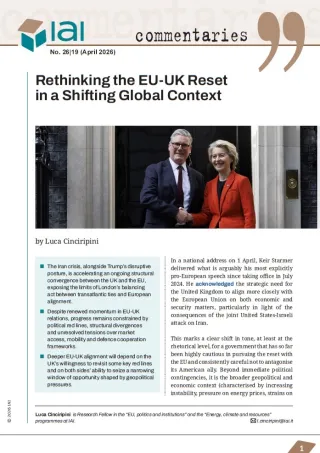
In a national address on 1 April, Keir Starmer delivered what is arguably his most explicitly pro-European speech since taking office in July 2024. He acknowledged the strategic need for the United Kingdom to align more closely with the European Union on both economic and security matters, particularly in light of the consequences of the joint United States-Israeli attack on Iran.
This marks a clear shift in tone, at least at the rhetorical level, for a government that has so far been highly cautious in pursuing the reset with the EU and consistently careful not to antagonise its American ally. Beyond immediate political contingencies, it is the broader geopolitical and economic context (characterised by increasing instability, pressure on energy prices, strains on alliances and a deteriorating European security environment) that is driving a structural convergence between London and Brussels.
In this context, the actions and posture of Donald Trump should be understood not as the primary cause of this rapprochement, but rather as a factor that accelerates and politicises dynamics already underway. With only a few months remaining before the next EU-UK summit, there are signs of potential progress in the reset process, albeit alongside significant political and structural constraints.
The unintended consequences of the Iran war
When the first US and Israeli strikes hit Iranian territory on 28 February, the regional repercussions were broadly foreseeable. Less immediately apparent, however, were the indirect consequences for EU-UK relations, which are still seeking a stable equilibrium ten years after the Brexit referendum.
The UK government’s initial response, in particular Starmer’s reluctance to allow the use of British military bases, was shaped by a combination of legal considerations and domestic political constraints, including Trump’s low popularity in the UK and the lasting public memory of the Iraq War.
The UK initially resisted US requests to use its bases for offensive operations and to join US and Israeli forces in the strikes. However, as the regional situation escalated (including Iranian drone attacks against a RAF base in Cyprus) and growing pressure from Washington, the government gradually adjusted its stance, ultimately authorising the use of British bases for limited “defensive” operations while continuing to rule out participation in broader offensive strikes. This stance generated tensions with Washington, as reflected in the harsh criticism directed at Starmer, who was accused by Trump of being overly concerned with international law and whose leadership was diminished in comparison to that of Winston Churchill.
In fact, the controversy highlighted the growing difficulty for London in reconciling its privileged relationship with the US with an increasingly unstable and polarised international environment. At the same time, these developments have made more visible a dynamic already in motion: the growing convergence between the UK’s economic, strategic and security interests and those of the EU, driven both by the shared response to the Russian invasion of Ukraine and by the need to hedge against a more transactional US approach under Donald Trump. In this sense, the Iran crisis has acted as a catalyst, accelerating an underlying structural trend rather than creating it.
Starmer’s recent statements suggest a potential shift both at the rhetorical level, through the explicit recognition of aligned UK and EU interests, and at the operational level, with openness to further developing existing agreements at the upcoming EU-UK summit. Despite initial difficulties, implementation of the 2025 Common Understanding has gained momentum, particularly with regard to the sanitary and phytosanitary agreement, the electricity market and the linking of the emission trading systems. In these areas, more detailed and substantive agreements appear within reach.
Negotiations on a food and agricultural agreement are currently ongoing and are expected to take effect by mid-2027; meanwhile, at the end of March the Council authorised the Commission to open talks with the UK on an electricity market deal. However, the scope for further expansion remains uncertain. Some dossiers, such as the youth mobility scheme, especially in relation to the reduction of academic tuition fees, remain politically sensitive. As a result, a significant broadening of existing agreements at the next summit cannot be taken for granted.
Constraints and structural limits
Further progress is most likely in areas where political and strategic convergence already exists, including energy, resilience and security. In particular, the UK remains a major industrial and military actor in the defence sector, despite the operational challenges highlighted in recent months. In this field, a new agreement could also help address the difficulties that emerged in late 2025, when the two sides failed to reach an agreement on the UK’s financial participation in the SAFE instrument due to disagreements over the scale of the UK’s financial contribution and the conditions for granting UK firms broader access to SAFE-funded projects beyond existing limits on third-country participation. At the same time, areas such as supply chain security, investment screening and the protection of critical infrastructure offer clear opportunities for deeper cooperation between the EU and like-minded partners, including the UK, as well as countries such as Norway and Canada.
However, significant political constraints remain on both sides. The EU continues to resist granting preferential treatment to the UK or allowing forms of selective participation in EU policies that could amount to cherry-picking. In parallel, despite Starmer’s more pro-European rhetoric, the Labour government continues to uphold the red lines set out in its electoral manifesto: no customs union, no free movement of people and no return to the single market.
These positions are difficult to reconcile. In particular, the refusal to rejoin the single market remains the main constraint on the UK’s ability to secure meaningful economic benefits, which are unlikely to be replicated through sectoral agreements alone. Moreover, EU member states are currently evaluating “Made in EU” policies that could, in the future, exclude certain British products and technologies from European supply chains.
Trump not a driver, but a catalyst for rapprochement
Within this broader framework, Trump’s role should be understood as enabling rather than determining, reinforcing conditions that should already push the UK and the EU closer together. The deterioration of the Special Relationship between the US and UK, a more confrontational approach towards allies, and the domestic economic impact of US foreign policy decisions, including on inflation and energy costs, are increasing pressure on London to strengthen ties with Brussels.
Trump’s influence also operates at the domestic political level. His unpopularity among the British public, as well as his association with right-wing Eurosceptic political forces such as Reform UK, creates incentives for the Labour government to differentiate itself, including through a more explicitly pro-European stance. A more assertive position on Europe could also help Labour regain support among pro-EU constituencies, particularly younger voters. In this regard, the rise of the Green Party, with its markedly progressive and pro-European positions, poses an additional challenge to Labour from the left, reinforcing the need for the government to consolidate its pro-UE credentials and undermining the assumption that it is the sole progressive alternative to Nigel Farage.
However, these dynamics are embedded in deeper structural trends. It is the broader international context marked by increasing Russian assertiveness, uncertainty over the future of NATO, and global economic tensions, that is making the case for closer European integration, including in the field of defence, increasingly compelling. In this evolving environment, the UK’s strategic priorities are naturally converging with those of major European capitals.
The process of EU-UK rapprochement remains complex and long-term. Rebuilding mutual trust will take time, not least considering the tensions accumulated over the past decade and the uncertainties surrounding UK domestic politics. In the short term, progress is likely to remain limited and focused on specific sectoral areas. A more substantial shift would require a softening of the UK’s red lines, particularly regarding the single market.
Nevertheless, external pressures are now more conducive than at any point in recent years to a closer alignment between London and Brussels. Rather than being driven by isolated political choices, the reset process increasingly appears as an adaptive response to a rapidly evolving international environment. The current global context offers a window of opportunity for advancing EU-UK relations. Borrowing a well-known line from British literary tradition, “there is a tide in the affairs of men, which, taken at the flood, leads on to fortune”. The upcoming EU-UK summit will provide important indications of the direction of travel, but its outcome will ultimately depend on whether both sides are willing, and able, to seize this moment.
Luca Cinciripini is a Research Fellow in the “EU, politics and institutions” and the “Energy, climate and resources” programmes at the Istituto Affari Internazionali (IAI).