Titolo completo
The Khamenei Succession: Hereditary Power and Democracy in Iran
|
Now in its second week, like the 2003 invasion of Iraq, the US-Israeli war with Iran is unlikely to bring democracy to the country or peace to the region. It rather risks creating further destruction and instability. If the Islamic Republic were to collapse suddenly under external military pressure, a power vacuum could emerge, potentially leading to the emergence of foreign fighters and militant groups who might carry out attacks in retaliation for the death of Ali Khamenei, as has occurred in other conflict zones. Iran stands at a crossroads, with an array of potential scenarios that may materialise, impacting the country’s and the region’s political landscapes.
From mourning to celebration?
Iranian society and culture are a complex mixture of historical memory, mythology and religious identity. They draw on the legacy of ancient Persia, including the eras of Cyrus the Great and Darius the Great; on the epic myths of the renowned Persian poet Ferdowsi, whose Shahnameh (an epic poem written between c. 977 and 1010 CE) celebrates Iranian heroes who fought against both internal and external tyranny; as well as on Shiite Islam, whose narratives of martyrdom, justice and resistance – particularly the story of Imam Husayn in Karbala – remain deeply embedded in the cultural and religious consciousness of a large part of the population.
This cultural mixture, combined with the presence of diverse ethnic groups (including Kurds, Baluch, Turks and Lors) and the many languages spoken across the country, such as Turkish, Kurdish and Arabic, has made Iranian society highly distinctive in the Middle East.
Furthermore, Iranian society has long included both groups that are sympathetic to imperialist ideas and others that strongly oppose them. These competing perspectives shape how different segments of society interpret current events; this helps explain the sharply contrasting reactions seen in recent days. While some have celebrated and even danced in response to the death of Ayatollah Khamenei, another segment of society has taken to the streets to mourn him, holding rallies and gatherings in his memory.
There is also a third group of Iranians who feel neither satisfaction nor sorrow over what has happened to the Supreme Leader. They reject both foreign intervention and the continuation of authoritarian rule under Ayatollah Khamenei. Many within this group feel a sense of humiliation that events have reached a point where the United States and Israel can intervene so directly in Iran’s affairs. They remain deeply aware of the country’s long history of foreign interference, and the 1953 overthrow of Prime Minister Mohammad Mosaddegh remains widely remembered as a defining example.
Widely shared in Iranian society is a sense of dissatisfaction, although interpreted in very different ways. Some believe that the Islamic Republic itself is the main reason Iran has not achieved the greatness it once had as an empire. Others argue that external pressure and foreign interference have prevented Iran from becoming what they see as a true Shiite society following the Twelver tradition. A third group believes that both the policies of the Islamic Republic and foreign intervention have contributed to the country’s current difficulties.
What unites Iranians, though, is ‘Iran’. As Ferdowsi wrote: “If there is no Iran, let me be not.” This reflects a deep sense of nationalism and patriotism that cuts across many segments of Iranian society. At the same time, different political groups often try to invoke this sentiment to advance their own agendas. Each of these groups sees the current situation as an opportunity to pursue its own political vision.
The rise of Mojtaba Khamenei
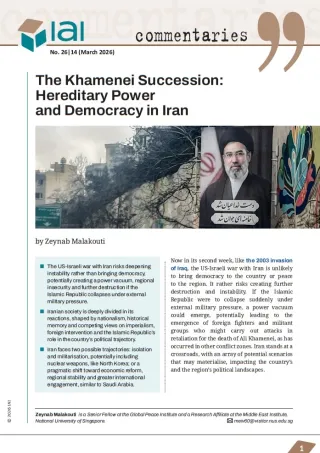
On 8 March 2026, following a week of widespread rumours – and not as a complete surprise for those following Iran’s internal politics – Mojtaba Khamenei, the son of Ali Khamenei, who ruled Iran for 36 years before his death, was selected as the new Supreme Leader by the Assembly of Experts for Leadership. This institution was established after the 1979 Islamic Revolution specifically to select the Supreme Leader at such critical moments.
The Assembly consists of 88 members who are elected by the public every eight years. Some observers argue that this process demonstrates that Iran is not a monarchy, since the Supreme Leader is formally chosen through an indirect electoral mechanism.
Nevertheless, all candidates for the Assembly of Experts must first be approved by the Guardian Council, which is more or less directly under the control of the Supreme Leader. As a result, the 88 members of the Assembly who ultimately selected Mojtaba Khamenei as the new Supreme Leader were approved through a system ultimately controlled by Ali Khamenei prior to his death, which raises concerns about hereditary succession.
What lies ahead?
Regardless of who ultimately leads Iran after the current conflict, two broad trajectories appear possible for the country: a pessimistic scenario and a more optimistic one.
The pessimistic scenario, which many observers consider more likely in the short term, would involve the continuation and intensification of Iran’s current strategic posture. In this trajectory, the political system would emphasise resistance and ideological confrontation in the aftermath of the war, presenting itself domestically as standing firm against what the leadership describes as foreign aggression or imperialism. Iran could further distance itself from the international community, significantly reduce diplomatic engagement with Western countries, and adopt a more confrontational regional and global policy. Experiencing direct military attacks could also strengthen the argument within the Iranian security establishment for accelerating nuclear capabilities as a strategic deterrent. In such circumstances, the fatwa (religious ruling) issued by Ali Khamenei, which declares nuclear weapons forbidden, could be reinterpreted or revised if circumstances change, meaning that the prohibition is not necessarily permanent. The country could increasingly resemble a highly securitised and isolated state, similar in some respects to North Korea, prioritising regime survival, military strength and ideological resistance over economic integration and diplomatic cooperation. Such a trajectory would likely deepen Iran’s international isolation, prolong economic hardship, and further restrict political space within the country.
An alternative, more optimistic trajectory would involve a gradual shift toward economic development and greater international engagement while maintaining the core structures of the existing political system. In this scenario, Iran’s leadership might initially emphasise continuity in order to secure the loyalty of key institutions – particularly the Islamic Revolutionary Guard Corps (IRGC) and the core political base of the Islamic Republic, often estimated to represent around 15 to 20 per cent of the population.
Over time, however, the leadership could recognise the economic and political costs of prolonged isolation and confrontation. A more pragmatic strategy might then emerge, prioritising economic recovery, improved regional relations and selective engagement with global markets. Such a strategy could resemble the model pursued by Saudi Arabia’s Crown Prince Mohammed bin Salman, who has sought to combine strong centralised political authority with ambitious economic reforms and greater engagement with global markets.
Ultimately, the current conflict may represent a defining moment for Iran’s political system as a whole. Beyond the immediate priority of navigating the war and ensuring political stability, the country will face a fundamental choice between deepening isolation and securitisation or gradually pursuing economic development and greater engagement with the international community.
Zeynab Malakouti is a Senior Fellow at the Global Peace Institute and a Research Affiliate at the Middle East Institute, National University of Singapore.