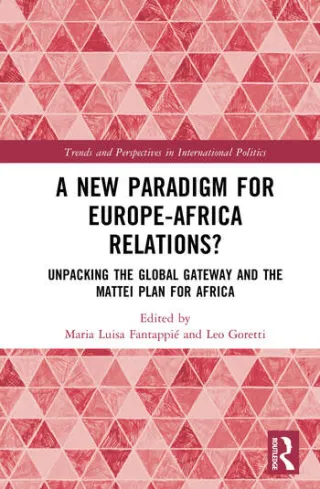
Titolo completo
A New Paradigm for Europe-Africa Relations? Unpacking the Global Gateway and the Mattei Plan for Africa
Attraverso un ampio lavoro di ricerca sul campo, gli esperti che hanno contribuito al volume mettono in luce come i governi e la società civile in Africa percepiscono queste aperture europee che si propongono di superare ogni logica paternalistica. L’analisi abbraccia ambiti politici cruciali – infrastrutture, cooperazione energetica, gestione dei flussi migratori e aiuti allo sviluppo – valutando se gli sforzi europei adottino realmente un approccio che coinvolge l’intera società o se rimangano invece confinati in un dialogo tra élite. Grazie a una prospettiva multidisciplinare che vede la partecipazione di studiosi provenienti da entrambi i continenti, il volume mette in luce la complessa realtà delle relazioni Europa-Africa nel 21° secolo, in un contesto segnato da una crescente competizione geopolitica che coinvolge Russia, Cina, Stati del Golfo e Turchia.
Oltre all’analisi accademica, il testo offre indicazioni pratiche per la definizione di partenariati più inclusivi e sostenibili. Si tratta di una lettura fondamentale per gli studiosi di relazioni internazionali, studi africani, studi europei e studi sullo sviluppo, nonché per politici, operatori del settore e organizzazioni della società civile che desiderano comprendere le relazioni tra Europa e Africa e migliorarle.
Introduction: Make-it or Break-it: Africa-Europe Relations vis-à-vis the Crisis of the LIO, by Leo Goretti and Maria Luisa Fantappiè
Africa-Europe relations: from norms to security?
A post-Western world at work?
The lessons of the distant and recent past
The book’s structure
Part I. The New Wave of European Initiatives towards Africa
1. Re-imagining multilateralism: towards a new global compact that delivers for Africa?, by Darlington Tshuma
1.1 Africa's positioning in a multipolar context: Turning East for prosperity and security, looking West for norms and values?
1.2 Africa’s strategic rebalancing act: European economic and normative engagement in Africa
1.3 Minerals diplomacy: Geopolitics and the global race for Africa’s critical and rare earth minerals
1.4 Security and diplomacy: the increasing weight of military aid in Africa’s engagement with the world
1.5 From the peripheries to the centre: Africa's expanding role in global diplomacy
1.6 Africa at a crossroads and the challenge of internal reform
2. The EU Global Gateway and Africa: the promise and limits of partnership, by Johanne Døhlie Saltnes
2.1 Unpacking partnership claims through political justice theory
2.2. The Global Gateway and Africa
2.3 The Lobito Corridor
2.4 Treading a delicate balance
3. The Mattei Plan for Africa: Old Wine in a New Bottle?, by Maria Luisa Fantappiè, Leo Goretti and Filippo Simonelli
3.1 A new cooperation model? The narrative frame of the Mattei Plan
3.2 The organisational structure and the projects of the Mattei Plan
3.3 The reception of the Plan – in Europe and in Africa
3.4 Turning narrative into reality?
4. Spain’s brokerage role in EUrope–Africa Relations: Framing governance in the 2025–2028 Spain–Africa Strategy, by Diego Caballero-Vélez and Filippo Simonelli
4.1 Conceptualising policy brokerage and entrepreneurship in EUrope–Africa relations
4.1.1 Brokerage
4.1.2 Entrepreneurship
4.2 Brokerage in practice: Migration and the 2025-2028 Spain–Africa Strategy
4.3 The opportunities and limits of brokerage
Part II. Key Policy Domains in EU-Africa Relations
5. Re-entangling aid, investment and migration: the retroliberal logics of EU development assistance to Africa, by Maurizio Carbone
5.1 Retroliberalism and foreign aid
5.2 EU development assistance to Africa
5.3 Aid and investment
5.4 Aid and migration
5.5 A retroliberal development policy
6. Migration in Italy-Africa Relations: The Mattei Plan between domestic and international audiences, by Matilde Rosina
6.1 Migration diplomacy, between the domestic and international level
6.2 The Mattei Plan, and its multiple audiences
6.3 Data analysis: Migration in the Mattei Plan
6.4 Migration as a discursive tool
7. Renewable Energy Infrastructure in Africa: Evaluating Italy’s and the EU’s Africa Energy Partnerships, by Bongiwe Mphahlele
7.1 Energy infrastructure as a test case for Italy-Africa partnership
7.2 Africa’s Energy Transition and Structural Constraints
7.3 Italy-Africa relations: Historical Review
7.4 The Mattei Plan: a partnership with Africa
7.5 The ‘equitable partnership’ discussion
7.6 A still unequal decision-making process
8. The Lobito Corridor: the complexities of development and extraction in contexts of fragility, by Darlington Tshuma and Marianna Lunardini
8.1 The Global Gateway: Europe’s geoeconomic and geopolitical tool?
8.2 What is the Lobito Corridor and why should it matter?
8.3 Corridors of power and influence: Who finances and who benefits?
8.4 Transformative for whom? Rethinking regional integration along the Corridor
8.5 The Global Gateway: A litmus test of European narratives
8.6 The need for local participation and governance
Part III. Assessing the New European Initiatives on the African Ground
9. Migration Routes and Renewable Grids: Persisting Asymmetries in EU-Tunisia Cooperation, by Akram Ezzamouri
9.1 Migration Governance and the 2023 MoU
9.2 Green Transition and Energy Challenges
9.3 Towards Sustainable and Equitable EU-Tunisia Cooperation
10. At Odds in Sudan: Conflict Resolution, Diplomacy and Humanitarian Response vs Migration Management, by Irene Panozzo
10.1 The Sudanese conflicts and the EU’s peace and security focus
10.2 The migration file and its controversies
10.3 The 2018-2019 revolution and 2023 conflict
10.4 The contradicting messages of EU policies
11. Strategic Reset or the Same Old Story: The Global Gateway (GG) Initiative in Ethiopia, by Michele Collazzo and Jesutimilehin O. Akamo
11.1 Conceptual framework: The decentring lens and the capitalism-sustainability paradox
11.2 Agenda 2063 and Ethiopia’s Posture
11.3 The Global Gateway in Ethiopia
11.4 Confronting Reality: Abstract Concerns or Policy Problem
11.5 The same old story of selective engagement
Conclusion: An Asymmetric Partnership of Equals, by Maria Luisa Fantappiè and Leo Goretti