Titolo completo
The Growing Transatlantic Sanctions Divide
|
The EU and United States have often pursued common geopolitical objectives through the coordinated use of economic sanctions. Examples include the joint measures against Russia since 2022 and against Iran in the early 2010s. However, as in many spheres of transatlantic relations, coordination has become much rarer under the second Trump Administration.
Three characteristics of successful economic statecraft are becoming increasingly difficult to attain for ‘Western’ sanctions policy. First, close multilateral cooperation on sanctions is steeply declining. Second, Western sanctions success is becoming less likely as potential targets strategically retreat from the US dollar and financial institutions, seeking to set up alternative infrastructures. Third, while narrow and well-defined policy goals have been shown to be key for sanctions success, the Trump Administration has often adopted sanctions to pursue ‘maximalist’ foreign policy aims.
Beyond these three elements, public opinion is becoming increasingly relevant for major sanctions policy. The extensive restrictive measures on Russia, for instance, have generally been met with support by the transatlantic public. This offers a basis for continuing a forceful sanctions strategy against Russia. Furthermore, sanctions termination remains an intractable issue. Here, the same challenges to close transatlantic cooperation on sanctions imposition extend to using sanctions relief as a strategic bargaining chip.
Overall, the growing transatlantic sanctions divide is a symptom of increasingly divergent US and EU foreign policies.
Sanctions as political tools
Sanctions are “restrictive policy measures that one or more countries take to limit their relations with a target country in order to persuade that country to change its policies or to address potential violations of international norms and conventions”.[1] These restrictions on relations between sanctioning states (senders) and sanctioned states (targets) are most often trade-related or financial. Financial sanctions are a particularly potent tool in the US foreign policy arsenal because most international transactions involve banks with US branches or are cleared in US dollars. As the world’s largest single market, the EU has a comparative advantage in using trade sanctions as a tool to attain its foreign policy objectives.
Today, sanctions are imposed on a broad range of political issues, including interstate war, proliferation of weapons of mass destruction (WMDs), democratic backsliding, domestic repression and cyber-attacks. As measures “between war and words”,[2] sanctions are political tools, in that their imposition and termination are executive (and at times legislative) decisions.[3] For this reason, close and long-term political alignment between senders is a core element of successful multilateral sanctions strategy.
Sanctions can pursue three distinct purposes, and often some combination of all three: coerce, constrain and signal.[4] First, sanctioning states can aim to coerce the target into actively changing a given policy, for instance ending a WMD programme such as Libya in the early 2000s. Next, sanctioning states can aim to constrain the target’s capabilities to pursue a given policy, such as waging a war of aggression less effectively as with Russia since 2022. Finally, sanctions function as a normative signal, such as stigmatising racist domestic policy, as was the case for apartheid South Africa in the 1980s.
Sanctions effectiveness remains a lively topic of public and academic debate.[5] Sanctions generally have a poor record of successfully coercing, even though the coercive goal commonly receives the most public and media attention (“Putin is still waging his war”). Their record on constraining is generally more successful, but less visible and more subtle because limiting action is less observable than active policy change is. For instance, the Russian military is arguably waging a less effective war than it otherwise would be. Finally, it is difficult to empirically assess the signalling effects of sanctions. For instance, China may have drawn lessons on Taiwan with respect to Western resolve in the face of territorial aggression since 2022, but this is very difficult to gauge.
Furthermore, commentators often point to the limited successes of imposed sanctions. However, this omits sanctions threats from the analysis. Once we consider this “hidden hand of economic coercion”,[6] the empirical record of sanctions appears somewhat stronger. From the senders’ perspective, the ‘best’ sanction is one that is only explicitly or implicitly threatened and never imposed, as it entails little or no economic costs.[7]
Conditions for successful sanctions
Among the factors that make sanctions more likely to succeed,[8] three characteristics stand out as having become more difficult to meet because of the growing transatlantic divide.
First, close coordination among allies increases the likelihood of successful coercion, constraint and signalling, as does action through multilateral institutions, especially the UN.[9] The early US/EU Russia sanctions in 2022 and the joint sanctions against Iran over its nuclear programme leading to the 2015 Joint Comprehensive Plan of Action (JCPOA) are generally deemed remarkable policymaking successes.[10] Sanctions mandated by the UN Security Council have a particularly promising record, but are rare today given the deep rifts within the Council.[11] With increasingly large US-EU disagreements on foreign policy objectives and the second Trump Administration’s conduct as a “fundamental breach of trust that cannot be undone”,[12] similarly close transatlantic coordination is difficult to envision in the future. Sanctions are political tools and cannot be effective without joint political goals between key actors.
Second, high pre-sanction trade linkages and financial dependence make success more likely: a country highly dependent on the United States or EU is more likely to give in to sanctions threats or imposed sanctions. However, heavy-handed US financial sanctions policy (by Trump, but also Bush, Obama and Biden) has prompted a slowly growing retreat from the US dollar and US financial institutions and infrastructures.[13] In addition to short-term evasion and coping strategies, sanctioned states are seeking to build alternative financial and trade infrastructures to be less exposed to future Western sanctions (“sanctions-proofing”). This may weaken the US predominance in the financial realm.
Third and finally, narrow and precise policy goals have proven to be more achievable than maximalist and vague ones. For instance, sanctions aimed at achieving ‘regime change’ have a poor record.[14] On the contrary, sanctions with narrow political objectives, clear termination requirements and feasible milestones can ensure greater political utility and flexibility from the sender’s perspective.[15] The EU and especially the UN typically design their sanctions quite precisely, while US political aims are often phrased more ambiguously.[16] The first and second Trump Administrations’ maximalist foreign policy aims are often at odds with the EU’s more targeted and piecemeal approach to sanctions. Without common goals, coordinating pressure campaigns will be more difficult.
On all three counts, the EU and United States are increasingly moving apart on conditions that make sanctions more effective and likely to succeed. This is one symptom of a more general transatlantic divide on foreign policy and the narrowing common ground for joint EU-US action. Close coordination on sanctions of the sort that proved successful against Iran (around the JCPOA) and Russia (in 2022) appears increasingly unlikely. The divergent foreign policy paths of the United States and the EU spell trouble for the effectiveness of joint Western sanctions in the face of increasing geopolitical threats.[17]
Contemporary US-EU relations on sanctions
Economic sanctions have become a self-professed “tool of first resort” in US foreign policy,[18] with the Bush, Obama, Biden and Trump Administrations all extensively using them in pursuit of their foreign policies.
Both Trump Administrations have pursued ‘maximum pressure’ campaigns of economic coercion through wide-ranging primary sanctions alongside secondary sanctions, which exclude from the US market foreign businesses engaging with the target. The Trump Administration’s sanctions have targeted old adversaries such as Cuba, Venezuela and Iran, but it has flip-flopped on Russia. It has also imposed tariffs to support political allies in Brazil and elsewhere.[19] The looming threat of military action aiming at regime change and decapitation strikes – as in Venezuela and Iran, respectively, in 2026 – is another distinct dimension of the Trump administration’s foreign policy approach.
Notably, the United States’ use of sanctions and tariffs has become increasingly blurred. Sanctions have historically been political tools, usually related to foreign and security policy goals and seeking to affect changes in political behaviour. Tariffs are import taxes generally used to protect domestic industry and increase revenues.[20] This distinction between foreign policy and economic objectives has been blurred considerably under the Trump Administration, which often uses tariffs in pursuit of political goals. The US tariffs enacted by the Trump Administration are unpopular in the United States[21] and – unsurprisingly – immensely unpopular in the EU.[22] This use of tariffs in pursuit of political goals, including against allies, signifies a wider retreat from trusting bi- and multilateral relations. Blurring geopolitical and economic aims may adversely affect global markets and previously close allied relationships.[23]
The volatile American sanctions policy against Russia has raised criticism from Europe and among the G7,[24] both by national and EU leadership.[25] In mid-May 2026, to contain the costs of the closure of the Strait of Hormuz following the US-Israeli war against Iran, the Trump Administration enacted temporary waivers on the purchase of Russian and even Iranian oil. The waiver on Russian oil exports in particular has created confusion and frustration among European allies, in that it has weakened the constraining and signalling purposes of the Western sanctions against Moscow. Regardless of future electoral outcomes in the United States, European governments are becoming wary of this type of inconsistent foreign policy. While the United States remains a key player on sanctions, the EU should seek to further strengthen its coordination with the United Kingdom and Canada. That said, some European governments themselves, such as the former Hungarian and the current Slovakian governments, have sought to soften EU sanctions on Russia.
Relatedly, sanctions enforcement often receives little attention from media and policy makers.[26] Enforcement is essentially a game of ‘cat and mouse’, with sanctions targets continually developing new evasion strategies and senders continually updating their enforcement instruments.[27] Enforcement of EU sanctions is particularly challenging because the responsibility lies with the member states, who have different capacities and regulatory frameworks.
Public opinion on sanctions in the EU and US
Public opinion, both in the United States and in Europe, is an important yet underexamined dimension of sanctions policy. Maintaining public support for sanctions while an economy carries their costs remains a central problem in sanctions policy. While, broadly speaking, sanctions are a low-salience issue to EU citizens, those targeting Russia remain an electoral issue in many member states. Public opinion on sanctions is important for at least two reasons. First, Western elites are responsive to public opinion on sanctions.[28] Major sanctions are therefore more likely to be imposed and forcefully upheld if the public strongly favours them. Second, public opinion is an important indicator of a country’s resolve and shapes perceptions of resolve,[29] which, in turn, critically affect that country’s high-stakes international interactions.[30]
EU sanctions against Russia are popular, with about 70 per cent of EU citizens supporting them as of March and April 2026.[31] This level of support has been stable since the start of Russia’s invasion, as illustrated in Figure 1. However, the EU average masks some heterogeneity between EU member states, which is relevant given the EU’s unanimity-based foreign and security policy decision-making. Support ranges from very high levels in Scandinavian states (Denmark and Sweden at 90+ per cent approval) to markedly lower levels in central and southern European states (Cyprus, Greece, Bulgaria, Hungary at around 30-45 per cent).
The Russia sanctions also remain popular in the United States, with only a remarkably small partisan split. Figure 2 illustrates US public support by party identification across time. As of February 2026, 69 per cent of Americans support increasing sanctions on Russia, ranging from 67 per cent of Independents to 69 per cent of Republicans and 75 per cent of Democrats.[32]
To rally initial public and political support for sanctions imposition, their expected effectiveness is often oversold to the public, which may cause disappointment and backlash in the longer term. Challenges and loopholes in the Western sanctions against Russia have emerged, including sophisticated evasion techniques. This makes the overall stable public support even more remarkable. The agreement among the transatlantic public that Russia should be sanctioned offers a basis for continuing forceful Western sanctions as Russia continues to escalate its war of aggression against Ukraine.
Figure 1 | EU public support for sanctions on Russia, 2022-2026
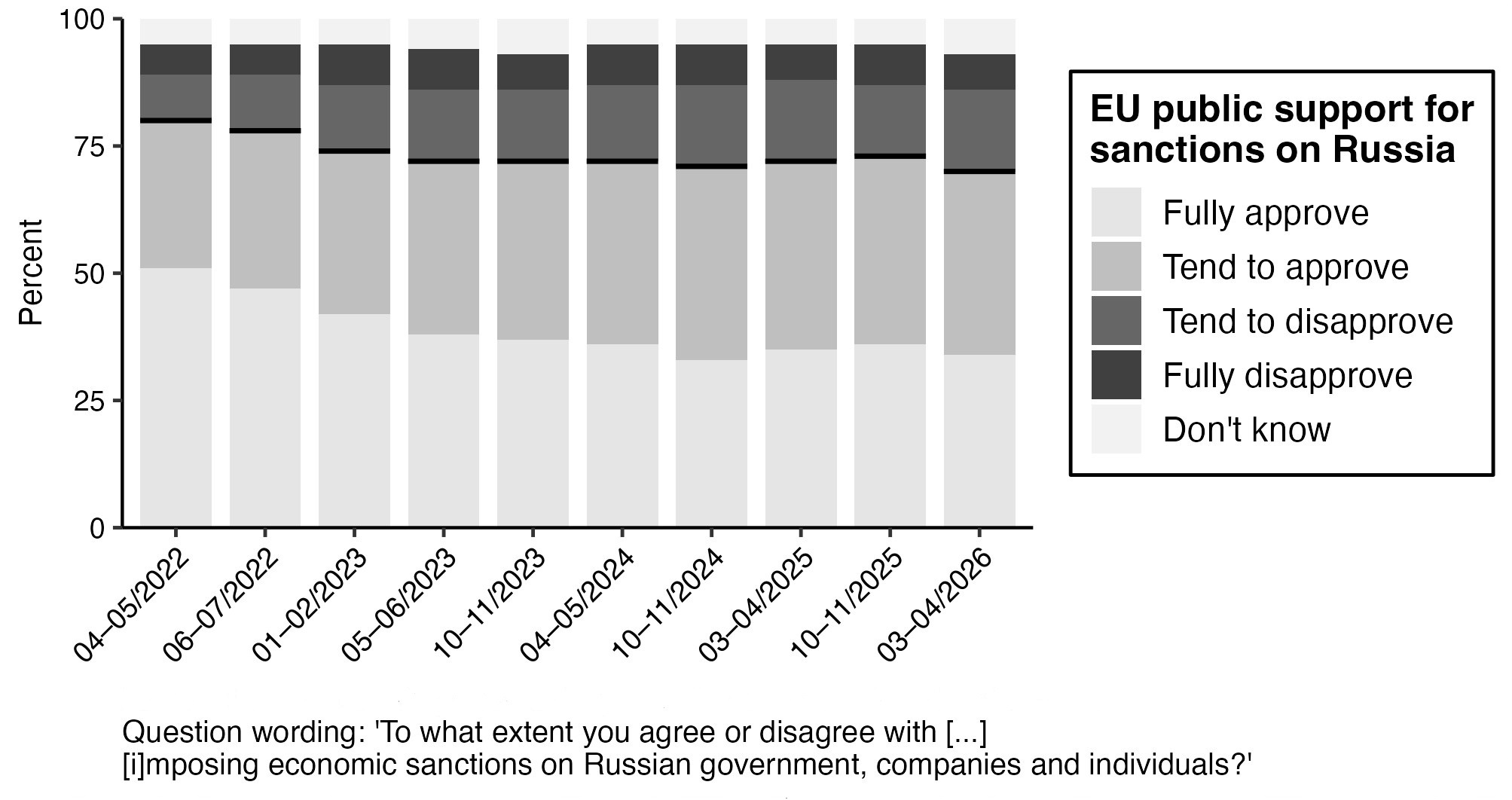
Sources: European Commission, Eurobarometer 2022-2026.
Figure 2 | US public support for increasing sanctions on Russia, 2022-2026
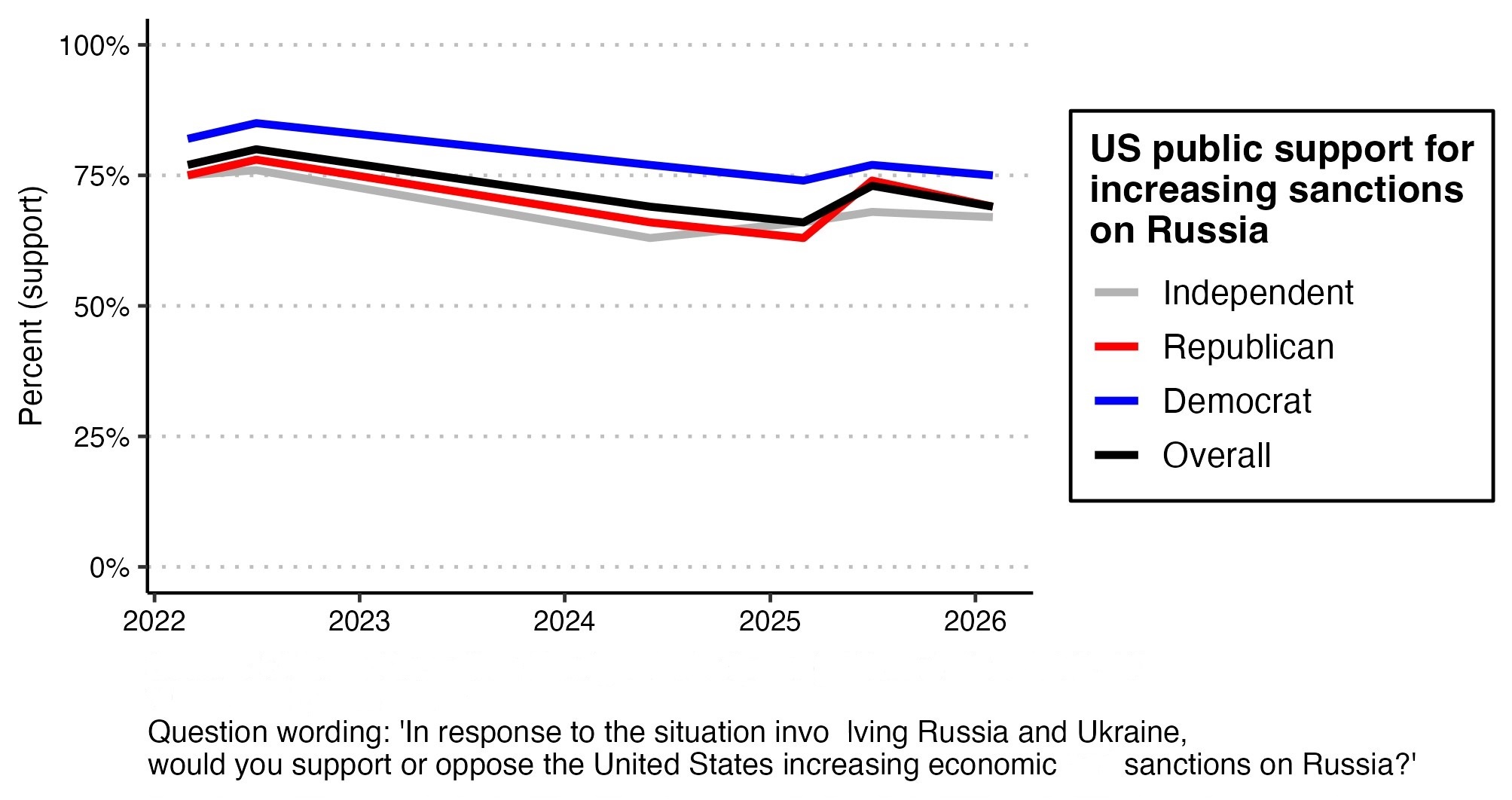
Sources: El Baz, Lama et al., “Americans Oppose Ceding the Donbas to Russia”, cit., p. 11.
Sanctions termination and sanctions relief
Sanctions termination – the formal repealing of sanctions – is an important strategic step in many international negotiations.[33] Beyond its practical effects, sanctions termination has a strong symbolic function, opening the door for former ‘outcasts’ (such as Syria) to be welcomed back into the international arena. However, the formal end of sanctions hardly means a swift return to normal economic relations.[34] Close multilateral coordination is no less important for successful sanctions termination than for sanctions imposition and enforcement.
There are two ideal types of sanctions termination: target compliance and sender capitulation. Between these two extremes lies a middle ground of negotiated settlements providing for gradual sanctions relief.[35] Sanctions relief is an important ‘bargaining chip’ in international negotiations used by the sender to induce the target to effect policy changes. The JCPOA with Iran is a telling example of successfully using sanctions relief in international negotiations. However, in the case of the JCPOA, success should also be attributed to the sender’s commitment to good-faith negotiation.[36]
While formal termination may be a straightforward process, full relief for sanctioned countries depends on private actors taking up business. Private actors rely on the degree of clarity and assurance offered by the governments easing sanctions, as well as on certainty that their activities in target countries will be safe. Regulatory uncertainty in sender countries and politically volatile situations in target countries are often major obstacles. Banks and firms often over-comply with sanctions to avoid running afoul of complex regulations.[37] Overcompliance and very slow recovery from sanctions will further increase if the United States and EU continue to diverge in their sanctions policies, with multinational corporations having to navigate divergent regulations in the two jurisdictions.[38] Increasingly uncoordinated US-EU sanctions strategy also complicates convergent action on sanctions termination and relief. As a result, joint Western strategic leverage in peace negotiations and high-stakes diplomacy will be severely curtailed.
The future of transatlantic cooperation on sanctions
Many of the key conditions for effective EU/US sanctions are not being met. First, multilateral collaboration on sanctions makes them more effective, yet agreement on foreign policy objectives is becoming difficult to maintain given the major disagreements between the US and EU and discord in the UN Security Council. Second, heavy-handed US financial sanctions (not only under Trump) have driven a slowly growing retreat from the US dollar and US financial institutions. Third, the Trump administration’s tendency to link sanctions to maximalist foreign policy aims is at odds with the type of narrowly defined goals that have been found to make sanctions more successful in changing a target’s behaviour. Thus, the outlook for close Western sanctions policy – which has had notable successes on Russia in 2022 and Iran in 2015 – is currently bleak. Furthermore, not only the imposition, but also the termination of sanctions is best done multilaterally to effectively use sanctions relief as leverage in negotiations (as in 2015 with the JCPOA). Here too, trustful US-EU collaboration is increasingly difficult to imagine. However, high public support for the ongoing sanctions on Russia offers an opportunity to continue forceful Western sanctions.
Anton Peez is a political scientist and postdoctoral researcher at Goethe University Frankfurt and Peace Research Institute Frankfurt (PRIF).
Paper produced in the framework of the IAI-Intesa Sanpaolo Partnership. The views expressed in this report are solely those of the author.
[1] Morgan, T. Clifton et al., “Economic Sanctions: Evolution, Consequences, and Challenges”, in Journal of Economic Perspectives, Vol. 37, No. 1 (Winter 2023), p. 3-29 at p. 3, https://www.aeaweb.org/articles?id=10.1257/jep.37.1.3.
[2] Wallensteen, Peter and Carina Staibano (eds), International Sanctions. Between Words and Wars in the Global System, New York/London, Routledge, 2005.
[3] von Soest, Christian and Michael Wahman, “Not All Dictators Are Equal: Coups, Fraudulent Elections, and the Selective Targeting of Democratic Sanctions”, in Journal of Peace Research, Vol. 52, No. 1 (January 2005), p. 17-31, DOI 10.1177/0022343314551081.
[4] Giumelli, Francesco, Coercing, Constraining and Signalling. Explaining UN and EU Sanctions after the Cold War, Colchester, ECPR Press, 2011; Giumelli, Francesco, “The Purposes of Targeted Sanctions”, in Thomas J. Biersteker et al. (eds), Targeted Sanctions. The Impacts and Effectiveness of United Nations Action, Cambridge, Cambridge University Press, 2016, p. 38-59.
[5] For instance, Pape, Robert A., “Why Economic Sanctions Still Do Not Work”, in International Security, Vol. 23, No. 1 (1998), p. 66-77, DOI 10.1162/isec.23.1.66; van Bergeijk, Peter A.G. and Thomas J. Biersteker, “How and When Do Sanctions Work? The Evidence”, in Iana Dreyer and José Luengo-Cabrera (eds), “On Target? EU Sanctions as Security Policy Tools”, in EUISS Reports, No. 25 (September 2015), p. 17-28, https://doi.org/10.2815/710375; Biersteker, Thomas J. et al. (eds), Targeted Sanctions. The Impacts and Effectiveness of United Nations Action, Cambridge, Cambridge University Press, 2016, p. 288-347, DOI 10.1017/CBO9781316460290.015; Giumelli, Francesco, “A Comprehensive Approach to Sanctions Effectiveness: Lessons Learned from Sanctions on Russia”, in European Journal on Criminal Policy and Research, Vol. 30, No. 2 (June 2024), p. 211-228, https://doi.org/10.1007/s10610-024-09585-x.
[6] Drezner, Daniel W., “The Hidden Hand of Economic Coercion”, in International Organization, Vol. 57, No. 3 (Summer 2003), p. 643-659, DOI 10.1017/S0020818303573052; Nooruddin, Irfan, “Modeling Selection Bias in Studies of Sanctions Efficacy”, in International Interactions, Vol. 28, No. 1 (2002), p. 59-75, DOI 10.1080/03050620210394.
[7] See also Niemeier, Thies and Gerald Schneider, “Counterfactual Coercion: Could Harsher Sanctions against Russia Have Prevented the Worst?”, in Research & Politics, Vol. 11, No. 3 (July 2024), Art. 20531680241272668, https://doi.org/10.1177/20531680241272668.
[8] Bapat, Navin A. et al., “Determinants of Sanctions Effectiveness: Sensitivity Analysis Using New Data”, in International Interactions, Vol. 39, No. 1 (2013), p. 79-98, DOI 10.1080/03050629.2013.751298; van Bergeijk, Peter A.G. and Thomas J. Biersteker, “How and When Do Sanctions Work?”, cit.
[9] van Bergeijk, Peter A.G. and Thomas J. Biersteker, “How and When Do Sanctions Work?”, cit.; Peksen, Dursun, “When Do Imposed Economic Sanctions Work? A Critical Review of the Sanctions Effectiveness Literature”, in Defence and Peace Economics, Vol. 30, No. 6 (2019), p. 635-647, DOI 10.1080/10242694.2019.1625250; Abb, Pascal et al., “Nur Mittel zum Zweck: Erfolgsbedingungen von Sanktionen”, in Friedensgutachten 2022, p. 111-131, https://doi.org/10.1515/9783839464038.
[10] Jung, Euijin, “Iran Sanctions: A Successful Episode”, in Trade and Investment Policy Watch, 29 January 2016, https://www.piie.com/node/8867; Chachko, Elena and J. Benton Heath, “A Watershed Moment for Sanctions? Russia, Ukraine, and the Economic Battlefield”, in AJIL Unbound, Vol. 116 (2022), p. 135-139, https://doi.org/10.1017/aju.2022.21; Kolhatkar, Sheelah, “Will Sanctions against Russia End the War in Ukraine?”, in The New Yorker, 24 October 2022, https://www.newyorker.com/magazine/2022/10/31/will-sanctions-against-russia-end-the-war-in-ukraine; Reinert, Manuel, Transatlantic Coordination on Russian Sanctions”, in Transatlantic Policy Center Policy Briefs, 27 October 2023, https://www.american.edu/sis/centers/transatlantic-policy/policy-briefs/20231027-transatlantic-coordination-on-russian-sanctions.cfm.
[11] Peez, Anton and Johannes Scherzinger, “Using LLMs for Measurement in Diplomatic Speeches: The Evolving Politics of UN Sanctions in Security Council Debates”, in The Review of International Organizations, 18 May 2026, https://doi.org/10.1007/s11558-026-09620-y.
[12] Tocci, Nathalie, “The End of Trans-Atlanticism”, in Foreign Policy, 15 June 2026, https://foreignpolicy.com/2026/06/15/trans-atlanticism-europe-united-states-mark-carney-davos-nato.
[13] Tan, Dongan, “The Decoupling Dilemma: How US Sanctions Erode Global Economic Governance”, in International Organization, Vol. 79, No. S1 (December 2025), p. 134-147, https://doi.org/10.1017/S0020818325100994; see also Giumelli, Francesco, “The Proliferation of Sanction Regimes: Impact on the Global Financial System”, in IAI Papers, No. 25|24 (2025), https://www.iai.it/en/node/20491.
[14] Oechslin, Manuel. 2014. “Targeting Autocrats: Economic Sanctions and Regime Change”, in European Journal of Political Economy, Vol. 36 (December 2014), p. 24-40, DOI 10.1016/j.ejpoleco.2014.07.003.
[15] Grauvogel, Julia and Hana Attia, “Easier In than Out: Lessons Learned from the Termination of the Iraq Sanctions Regime”, in Journal of Global Security Studies, Vol. 8, No. 4 (December 2023), Art. ogad021, DOI 10.1093/jogss/ogad021.
[16] Attia, Hana and Julia Grauvogel, “International Sanctions Termination, 1990–2018: Introducing the IST Dataset”, in Journal of Peace Research, Vol. 60, No. 4 (July 2023), p. 709-719 at 715-717, https://doi.org/10.1177/00223433221087080.
[17] Sucher, Jesse, “US-EU Sanctions Divergence Would Spell Trouble for Multinational Companies”, in Econographics, 30 April 2025, https://www.atlanticcouncil.org/?p=843745.
[18] US Department of the Treasury, The Treasury 2021 Sanctions Review, October 2021, https://home.treasury.gov/system/files/136/Treasury-2021-sanctions-review.pdf; Drezner, Daniel W., “How Not to Sanction”, in International Affairs, Vol. 98, No. 5 (September 2022), p. 1533-1552, https://doi.org/10.1093/ia/iiac065.
[19] de Bolle, Monica, “The Latest US Squeeze on Brazil Jeopardizes Its Financial Autonomy”, in Realtime Economics, 9 June 2026, https://www.piie.com/node/18774.
[20] Mohr, Cathrin and Christoph Trebesch, “Geoeconomics”, in Annual Review of Economics, Vol. 17 (2025), p. 563-587 at p. 569, https://doi.org/10.1146/annurev-economics-092424-111952.
[21] Though with a partisan split. See Van Green, Ted et al., “Americans Largely Disapprove of Trump’s Tariff Increases”, in Pew Research Center Reports, 4 February 2026, https://www.pewresearch.org/?p=286675.
[22] European Commission, Standard Eurobarometer, No. 103 (Spring 2025), https://europa.eu/eurobarometer/surveys/detail/3372.
[23] Attia, Hana, “Are Tariffs Becoming the New Sanctions?”, in Fiker Institute Policy Briefs, January 2026, p. 6-7, https://www.fikerinstitute.org/publications/are-tariffs-becoming-the-new-sanctions.
[24] Johnson, Keith, “Europe Plans to Crack Down on Russia—but for Real This Time”, in Foreign Policy, 10 June 2026, https://foreignpolicy.com/2026/06/10/europe-russia-sanctions-package-trump-putin.
[25] “Pistorius: ‚Russland darf nicht von aktueller Lage profitieren‘”, in Deutschlandfunk, 23 March 2026, https://www.deutschlandfunk.de/pistorius-russland-darf-nicht-von-aktueller-lage-profitieren-102.html; Moller-Nielsen, Thomas, “EU Dismayed as US Eases Oil Sanctions on Russia”, in Euractiv, 19 May 2026, https://www.euractiv.com/?p=2400779.
[26] Mortlock, David and Alex Zerden, “The Missing Pieces: Resourcing and Improving OFAC Sanctions Enforcement”, in Atlantic Council Issue Briefs, March 2024, https://www.atlanticcouncil.org/?p=749799.
[27] Early, Bryan R., Busted Sanctions. Explaining Why Economic Sanctions Fail, Stanford, Stanford University Press, 2015.
[28] Peez, Anton and Felix S. Bethke, “Does Public Opinion on Foreign Policy Affect Elite Preferences? Evidence from the 2022 US Sanctions against Russia”, in International Studies Quarterly, Vol. 69, No. 1 (March 2025), Art. sqae145, https://doi.org/10.1093/isq/sqae145.
[29] See Thomson, Catarina et al., “European Public Opinion: United in Supporting Ukraine, Divided on the Future of NATO”, in International Affairs, Vol. 99, No. 6 (November 2023), p. 2485-2500 at p. 2486, https://doi.org/10.1093/ia/iiad241.
[30] Kertzer, Joshua D., Resolve in International Politics, Princeton, Princeton University Press, 2016.
[31] European Commission, Standard Eurobarometer, No. 105 (Spring 2026) - The EU’s Response to the War in Ukraine, p. 20, https://europa.eu/eurobarometer/api/deliverable/download/file?deliverableId=105699.
[32] El Baz, Lama et al., “Americans Oppose Ceding the Donbas to Russia Amid Push for Peace Deal”, in Chicago Council on Global Affairs Public Opinion Surveys, February 2026, p. 9 and 11, https://globalaffairs.org/node/43842.
[33] Attia, Hana et al., “The Termination of International Sanctions: Explaining Target Compliance and Sender Capitulation”, in European Economic Review, Vol. 129 (October 2020), Art. 103565, DOI 10.1016/j.euroecorev.2020.103565; Pucek, Kaspar et al., “Hard to Unwind: The Complex Road to Undoing Sanctions Regimes”, in Clingendael Alerts, June 2025, https://www.clingendael.org/node/19402.
[34] Gutmann, Jerg et al., “The Economic Effects of International Sanctions: An Event Study”, in Journal of Comparative Economics, Vol. 51, No. 4 (December 2023), p. 1214-1231, DOI 10.1016/j.jce.2023.05.005.
[35] Attia, Hana et al., “The Termination of International Sanctions”, cit.
[36] Abb, Pascal et al., “Nur Mittel zum Zweck”, cit.
[37] Early, Bryan R. and Timothy M. Peterson, “The Enforcement of U.S. Economic Sanctions and Global De-risking Behavior”, in Journal of Conflict Resolution, Vol. 68, No. 10 (November 2024), p. 2048-2075, DOI 10.1177/00220027231214748; see also Grauvogel, Julia et al., “Public Opinion on Sanctions Compliance and Evasion: Experimental Evidence from the 2022–23 Russia Sanctions”, in Conflict Management and Peace Science, 20 July 2026, https://doi.org/10.1177/07388942261458232.
[38] Sucher, Jesse, “US-EU Sanctions Divergence Would Spell Trouble for Multinational Companies”, cit.