Titolo completo
Beyond the Chokepoints: The Arctic and the Making of a Networked Heartland
|
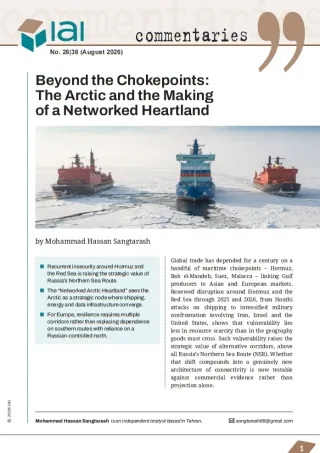
Global trade has depended for a century on a handful of maritime chokepoints – Hormuz, Bab el-Mandeb, Suez, Malacca – linking Gulf producers to Asian and European markets. Renewed disruption around Hormuz and the Red Sea through 2025 and 2026, from Houthi attacks on shipping to intensified military confrontation involving Iran, Israel and the United States, shows that vulnerability lies less in resource scarcity than in the geography goods must cross. Such vulnerability raises the strategic value of alternative corridors, above all Russia’s Northern Sea Route (NSR). Whether that shift compounds into a genuinely new architecture of connectivity is now testable against commercial evidence rather than projection alone.
From chokepoints to corridor competition
Twentieth-century energy geopolitics asked who held reserves. The defining question today is who controls the route to market: a producer unable to move output to buyers wields diminished power. The less reliable southern chokepoints become, the more valuable northern geography becomes by default.
The Arctic’s rising salience predates current Middle Eastern instability: retreating sea ice, expanding ice-class shipping and sustained Russian investment had already extended the navigable season. Climate change alone does not produce a strategic shift; it is the combination of a more accessible north and a less reliable south that moves the underlying economics.
In August 2026 the Chinese carrier Sea Legend Line began its first scheduled seasonal NSR container service between China’s Ningbo and the British port of Felixstowe, cutting the conventional 40-day Suez transit to roughly 20 to 22 days, after a single 2025 trial voyage. South Korea moved in parallel, backing carrier PanStar Line’s first Arctic container trial from the coastal city of Busan to Europe in August 2026, with a regular service targeted by 2030. Japan’s interest, by contrast, is so far linked more to supply-chain resilience than to operating its own services. Reuters reported that, as of mid-August 2026, tanker cargoes carrying around 6 million barrels of Russian crude were moving toward Asia via the NSR this season, nearly half the volume shipped over all of 2025.
Scale should not be overstated. Total NSR cargo fell in 2025 to 37.02 million tonnes, down roughly 2 per cent on 2024’s record and a fraction of Suez’s roughly 1 billion tonnes of annual transit. Preliminary data reported by Atomflot point to a possible rebound above 40 million tonnes in 2026, but this remains a forecast, not a settled outcome, and the cargo mix is reported to stay overwhelmingly Russian liquefied natural gas (LNG), oil and gas condensate. Neither figure settles the argument. The NSR is not replacing Suez; it is moving, unevenly, toward a genuine instrument of diversification for high-value, time-sensitive cargo, used by more actors than at any point in its history.
Russia: Leverage without dominance
Russia is the most direct beneficiary. It holds the longest Arctic coastline, the bulk of existing NSR infrastructure, the world’s only fleet of nuclear-powered icebreakers and substantial Arctic hydrocarbon reserves. Rising southern insecurity raises the value of that geography twice over: through energy prices that partly offset sanctions pressure, and through a northern corridor that reduces dependence on chokepoints whose vulnerability – as the Houthis and Iran have shown – reflects the interaction of several actors, not the control of any single power.
Yet this is structural leverage, not uncontested control. NSR cargo remains less than half the 80-million-tonne target set by presidential decree in 2018 for 2024; Arctic LNG 2, Novatek’s Siberian LNG hub, stays constrained by sanctions and a shortage of ice-class vessels; hydrocarbons still dominate NSR tonnage; and the corridor’s economics increasingly depend on Chinese demand, giving Beijing leverage over a route Moscow is meant to control. Russia is best described not as arbiter of a new order but as the principal, and most exposed, gatekeeper of one still under construction.
China: Diversification, not defection
For China, Arctic shipping is best understood as portfolio diversification, not a pivot away from established routes. Its economy remains deeply reliant on Indian Ocean and Suez trade; what has changed is a northern option, moving from a single trial voyage in 2025 to scheduled service in 2026, that reduces exposure to any one pathway. A mid-2026 memorandum with Rosatom has extended Arctic cooperation to India, widening the circle of stakeholders without displacing China’s southern routes. The Arctic functions as a second layer of supply-chain security, not a replacement system.
The Networked Arctic Heartland
These developments invite a theoretical question. British geographer Alfred Mackinder’s Heartland – the Eurasian interior whose control he saw as key to global hegemony – was a land-power concept. The Arctic does not fit that model: it is a maritime, not continental, space, and no state controls it outright. More cautiously, the Arctic may be evolving into a different kind of strategic node, performing functions analogous to the Heartland under radically different conditions: one whose importance derives not from territorial depth but from the convergence of energy flows, shipping routes, ports and a growing military and satellite presence, linking Europe, Russia, North America and East Asia at once. The network is not purely maritime: subsea cables and satellite links increasingly give the Arctic a role in moving data as well as goods and energy.
This “Networked Arctic Heartland” should be read as a hypothesis, not a settled fact. It would weaken if NSR volumes decline, if insurance and sanctions costs continue to deter non-Russian and non-Chinese shippers, or if the current wave of trial voyages fails to convert into sustained scheduled service by the early 2030s.
A tri-layered connectivity architecture
If the hypothesis holds even partially, it points toward a differentiated architecture organised more by function than geography. A first layer comprises states with direct Arctic access, infrastructure or major security responsibilities: Russia, Canada, the United States and the Nordic Arctic states. A second layer comprises connector and rerouting states capable of redirecting or diversifying flows: China, South Korea, Japan, India, Turkey, Iran and major European states sit here, in functionally distinct positions. A third layer comprises economies whose supply chains are structurally exposed to Hormuz, Bab el-Mandeb, Suez and Malacca – a category of exposure, not economic weakness. The point is to classify states by function – access, connectivity, exposure – not by latitude or income.
Why this matters for Europe
For Europe the relevant question is not whether the Arctic will “win” over southern routes, but what strategic autonomy requires under southern volatility and rising northern connectivity. First, Arctic shipping growth is structured around Russian-controlled infrastructure; expanding reliance on the NSR without diversification would substitute one chokepoint dependency for another, this time under Moscow’s regulatory control. Second, European interests – port access in Norway, container flows to Rotterdam and Hamburg – increasingly intersect with Chinese commercial presence and Russian infrastructure, a combination EU governance and sanctions policy are not yet built to manage. Third, genuine resilience means holding several corridors in parallel: southern maritime routes, the costlier Cape of Good Hope alternative, Eurasian and Central Asian land corridors, and Arctic shipping. Italy illustrates the point: though not an Arctic state, it has a comparable stake as a Mediterranean logistics power whose ports, from Genoa to Trieste, sit at the southern end of routes reshaped by both chokepoint volatility and northern rerouting.
Toward a multi-corridor order
The most defensible reading is neither “the Arctic replaces the south” nor “nothing has changed”. Suez, Hormuz, Bab el-Mandeb and Malacca will remain central to global trade for the foreseeable future. Alongside them, the Northern Sea Route, Eurasian land corridors and Cape-route shipping are becoming permanent features of a more distributed system – a shift in the range of options, not in geopolitical centre. Whether that shift consolidates into a genuine Networked Arctic Heartland, or recedes as ice, insurance and sanctions reassert themselves, remains open through the 2030s. For Europe, the task is not to wait for the answer but to build the multi-corridor resilience that makes it, either way, less costly.
Mohammad Hassan Sangtarash is an independent analyst based in Tehran.