Titolo completo
India’s Multi-Alignment: Still a Winning Strategy?
|
Since its independence, India has positioned itself as the moral conscience of the Non-Aligned Movement. In the 1960s, as the United States and the Soviet Union carved the world into rival ideological and military blocs, India chose to stand apart. The Nehruvian foreign policy, championed by India’s first Prime Minister Jawaharlal Nehru, embraced broader goals of peaceful coexistence, decolonisation and solidarity among the nations of the developing world. In this era, non-alignment was not just a strategy, but a badge of sovereign identity maintained at a high cost, including economic hardship and diplomatic isolation.
Over the last decade, however, the government of Prime Minister Narendra Modi has steered Indian foreign policy away from the moral idealism and strict non-alignment of the Nehruvian tradition, pivoting toward a pragmatic and proactive multi-aligned stance. To sustain the delicate balance across competing geopolitical arenas, New Delhi has avoided binding alliances in favour of flexible, interest-driven partnerships.
This transactional framework allows India to engage simultaneously with bitter rivals: deepening tech and security ties with the West, maintaining vital energy and defence links with Russia, and anchoring multilateral forums alongside China. A parallel balancing act plays out in the Middle East, where India carefully calibrates relations with Israel, Iran and the Gulf states to underwrite its national security and accelerate its domestic growth.
Bound by trade: The illusion of economic sovereignty
Yet, this diplomatic hedging is facing structural strains. Throughout 2025, intensifying geopolitical polarisation and Washington’s demands for clearer strategic alignment exposed the limits of New Delhi’s room for manoeuvre. Despite the nationalist rhetoric of Atmanirbhar Bharat – the self-reliance initiative launched by Modi in 2020 to forge a self-sustaining economic powerhouse – India remains deeply anchored in the Western financial and commercial architecture for capital and technology. This structural dependence is most evident in India’s relationship with the United States, which is not only India’s largest export destination – accounting for 20 per cent of India’s exports in the FY2025 (October 2024-September 2025) – but also the largest source of remittances, contributing to 28 per cent of total inward flows.
These figures underscore a fundamental contradiction in New Delhi’s economic approach. While the government champions autonomy, its strategy to position India as the primary “China Plus One” alternative in global supply chains inherently deepens its reliance on Western consumer demand. The asymmetry has been sharply exposed by Washington’s recent imposition of sweeping tariffs, turning India’s key economic driver into its most vulnerable fault line.
The tariff shock and geopolitical friction
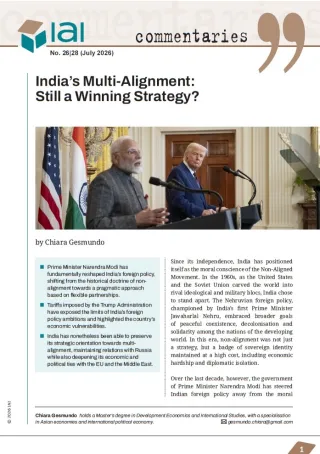
In August 2025, the Trump Administration imposed tariffs up to 50 per cent on selected Indian imports. While Washington officially framed the measures as a response to New Delhi’s continued procurement of discounted Russian crude, the move signalled a broader, more coercive shift in bilateral relations. The underlying friction runs deeper: Washington remains frustrated by India’s increasingly active role within the BRICS bloc, as well as by its reluctance to align with US geopolitical preferences. In addition. President Donald Trump was particularly irritated by Modi’s refusal to give him any credit for ending the short confrontation between India and Pakistan in spring 2025.
The episode underscored a critical reality: even a “strategic partner” remains exposed to economic coercion with an asymmetrical interdependence. For India, it served as a reminder that its integration into Western-led markets – central to its “China Plus One” ambitions – also increases its vulnerability to external pressure, highlighting the structural limits of its economic autonomy.
Multi-alignment in an increasingly polarised world
Despite Washington’s aggressive playbook, New Delhi has managed to navigate this volatile environment without offering significant policy concessions. Its resilience rests on two factors. First, the leverage of US bargaining power has been somewhat diluted by Washington’s willingness to open multiple economic and strategic fronts simultaneously against both rivals and traditional allies. Second, India has aggressively accelerated its trade diversification to cushion the tariff blow.
Crucially, the aggressive American stance has catalysed a global shift, forcing third-party nations to actively seek trade alternatives to mitigate their own exposure to US protectionism. By capitalising on this widespread desire for diversification, India managed to navigate an increasingly volatile external environment without making significant policy concessions. Following a trade agreement with the UK in July 2025, New Delhi secured a landmark accord with the EU in January 2026, breaking a 13-year negotiation deadlock. This diplomatic momentum quickly extended into the Asia-Pacific, with the signing of a historic free trade agreement with New Zealand in April 2026, followed closely by the entry into force of the India–Oman Comprehensive Economic Partnership Agreement (CEPA) in June 2026. Concurrently, New Delhi is also exploring a new export corridors through Mexico. Taken together, these aggressive market expansions show an agile India actively leveraging a global marketplace eager to construct systemic hedges against Washington’s protectionism.
At the same time, New Delhi has avoided public confrontation with Washington, maintaining steady diplomatic engagement. India initially accommodated US concerns by reducing its purchases of Russian crude (at least until March 2026, when imports began to rise again following disruptions linked to the closure of the Strait of Hormuz) and by increased imports of US oil and liquefied natural gas, thereby narrowing its trade surplus.
Yet, while the imposition of tariffs exposed India’s external vulnerability, it also revealed the practical limits of American leverage. Although Washington retains the systemic capacity to impose sweeping punitive duties, it has stopped short of targeting sectors central to its own economic interests. By exempting Indian pharmaceuticals and primary agricultural products, Washington has implicitly acknowledged that aggressive economic coercion faces a hard ceiling when it threatens to fuel domestic US inflation.
Adjustment without realignment
From US tariff measures to European attempts to embed stringent climate compliance clauses into trade agreements, and broader Western pressure to degrade historical ties with Moscow, the outcome has remained uniform: New Delhi is fundamentally unwilling to trade its sovereign policy autonomy for external validation.
Herein lies the central miscalculation of Western policymaking. Washington and Brussels have often seemed to assume that shared democratic values or institutional partnerships – or, alternatively, the need to counterbalance China – would naturally translate into strategic alignment. This perspective misinterprets the nature of Indian diplomacy. New Delhi’s foreign policy is not driven by shared ideology or a desire to join geopolitical blocs. On the opposite, it is deeply rooted in an uncompromising realism.
At the core of this pragmatism lies a clear set of structural priorities. Energy affordability is treated as a non-negotiable prerequisite to sustaining macroeconomic growth and lifting millions out of poverty, while unhindered access to cost-effective defence material remains vital for managing complex border vulnerabilities with Pakistan and China. And thus, despite external turbulences, long-standing partners like Russia remain structurally indispensable to New Delhi’s immediate security and energy needs, ensuring that Western strategic expectations remain subservient to national interest.
From this perspective, attempts to exert economic or diplomatic pressure have done little more than underscore the structural limits of Western influence in an increasingly multipolar order. Whether India’s balancing act will succeed over the long term remains an open question, but the Trump Administrations has not succeeded in triggering the rigid, clear-cut bloc formation that some in Washington envisioned a year ago. Instead, by introducing friction into traditional alliances, the weaponisation of trade has created the strategic runway for New Delhi to recalibrate its external positioning. India has absorbed short-term shocks while turning global economic uncertainty into opportunities for new bilateral partnerships. Whether this strategy remains sustainable will depend less on India’s diplomatic agility than on the future trajectory of great-power competition. For now, however, New Delhi has managed to preserve the flexibility at the heart of its multi-alignment strategy.
Chiara Gesmundo holds a Master’s degree in Development Economics and International Studies, with a specialisation in Asian economies and international political economy.