Titolo completo
A New Era of Aid: Acting Together, from G7 2026 to G20 2027
|
1. Introduction: The triple crisis of ODA, debt and multilateralism
The international development landscape is sailing under turbulent waters, threatened by a “polycrisis” triggered by energy and food insecurity, unsustainable debt and significant cuts in public funding availability. After a 32 per cent increase of Official Development Assistance (ODA) from 2019 to 2023 as a result of the Covid-19 pandemic and the response to the war in Ukraine, the trend dramatically reversed. ODA fell by 6.1 per cent in 2024 and 23.1 per cent in 2025,[1] and most of these cuts (95 per cent) were enacted by G7 countries which represent 70 per cent of global ODA. This contraction brought ODA back to the 2015 level, when the UN 2030 Agenda was adopted, making the achievement of the Sustainable Development Goals a daunting challenge.
Two distinguishing layers of this polycrisis are emerging with stronger evidence. Firstly, the deepening debt distress is hitting hard on some low- and middle-income countries (LMICs), particularly in sub-Saharan Africa. While public debt levels are stagnating at around 60 per cent of GDP,[2] interest rates are rising and more than half of African countries are now spending more on interest payments than on healthcare and education (18.2 per cent in 2025, increasing from 15.4 per cent in 2024).
Figure 1 | Net ODA from DAC countries, 2020-2025 and 2026 (projected), in billion US dollars (constant 2024 prices)
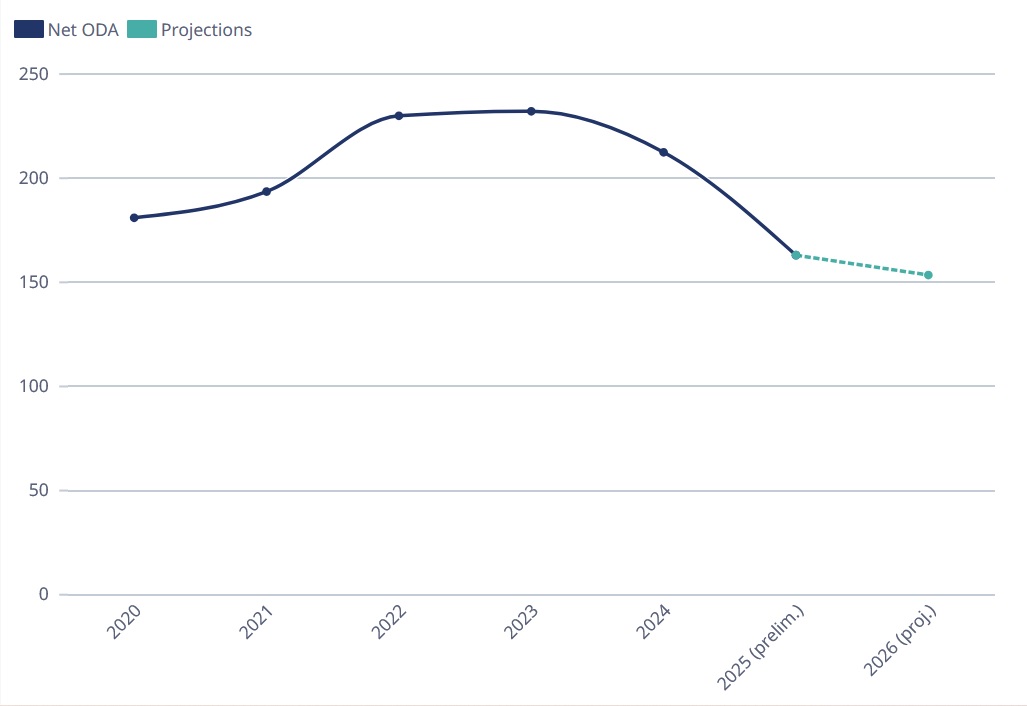
Source: OECD website: Official Development Assistance (ODA), https://www.oecd.org/en/topics/official-development-assistance-oda.html.
Secondly, another global food crisis looms on the horizon. Global fertilisers’ trade is under severe strain due to disruptions in the Strait of Hormuz. The Gulf region accounts for 46 per cent of global seaborne urea trade, over 15 per cent of global ammonia, and nearly half of all global seaborne sulphur,[3] thus directly threatening African agricultural productivity and surging food prices.[4] The higher fertilizer costs will not only drive food price inflation, but will probably exacerbate the debt service pressure, exposing fragile economies to a vicious cycle where food deficits drain already scarce foreign exchange reserves and increase debt distress.
The G7 still provides a platform to address global development issues. Despite the non-binding nature of its documents and the disengagement of the US Administration from the global development agenda, the G7 represents a club of largely like-minded partners with the potential of mobilising consensus and designing financial solutions to tackle global problems, especially when this is done in coordination with the G20. However, the G7 often fails to match political declarations with actual disbursement of the promised funds. This calls for prioritising the implementation and scaling-up of existing initiatives over the launch of new ones.
2. Results of the French G7 Ministerial Meeting
2.1 A concise analysis of the Development Ministerial Meeting
The 2026 G7 Development Ministerial Meeting in France produced an important Communiqué with four deliverables focusing on (i) the OECD Development Assistance Committee (DAC) review; (ii) Domestic Resource Mobilization (DRM); (iii) the health common framework; and (iv) the new approach on economic corridors.[5] The document shows a growing consensus to shift from a traditional aid-based model, towards a new one consisting of “mutually beneficial partnerships”. This can be achieved by a stronger sovereignty on key sectors such as health, education or infrastructures, an increased efficiency to address fragmentation and by supporting international solidarity through concessional resources to the least developed countries.
This new development narrative can be tracked in the final Communiqué across three main thematic clusters: resources’ mobilisation; infrastructure; and global health initiatives. The Communiqué urges an ambitious review of the OECD (DAC) in 2027 to better reflect non-traditional forms of development finance and help track public and private capital flows. This vision strongly aligns with recent analyses by the Agence française de développement (AFD), which emphasise that traditional ODA metrics no longer capture the complex ecosystem of mobilized sustainable development finance.[6] In addition, the Communiqué calls for a more strategic use of ODA to unlock private sector investments through risk-sharing instruments, guarantees and blended finance to address the diminishing availability of concessional funding. This new development narrative reflects the launch by several G7 members of new initiatives towards Africa (e.g. Italy’s Mattei Plan for Africa or France’s Africa Forward summit),[7] where far ODA is viewed as the catalytic tool used to de-risk projects and crowd in private investment. Moreover, the Communiqué pays special attention to DRM, emphasising the importance of supporting partner countries to strengthen their own tax systems and ability to finance their development to foster true sovereignty. The document also calls for a radical rationalisation of vertical funds[8] and improved efficiency, transparency and cost-effectiveness within the UN development sphere.
The Partnership for Global Infrastructure and Investment (PGII) remains the cornerstone of the G7 strategy to support infrastructures and industrial development in partner countries. However, the Communiqué also emphasises the importance of economic corridors, stating their role not as mere resource extractors, but rather as drivers of regional economic integration and regulatory alignment. In this regard, the Communiqué also pledges to strengthen reconstruction in fragile and conflict-affected environments.
Finally, the Ministerial Meeting reaffirms the solidarity component of ODA by urging the mobilisation of concessional resources where they are most needed, particularly in most vulnerable countries – including but not limited to those exposed to natural disasters – and in sectors of human development such as nutrition, food systems, health and education. On health, one of the annexes of the Communiqué unveils a new initiative for a common framework to finance health sovereignty, by preventing aid fragmentation and reducing dependence on external aid, as well as by helping targeted countries reform and strengthen their domestic health systems. In this sense, G7 members commit to promoting financial tools that allow for rapid responses to future health crises as well as country platforms for better coordination and alignment.
2.2 From aid to partnership: Comparing the latest G7 Development Ministerial meetings
Looking at the last three G7 Development Ministerial meetings, a new international consensus seems to emerge on the need to move beyond donor-recipient dynamics in view of supporting the economic security and sovereignty of partner countries. The table below provides a comparative word analysis of the Development Ministerial meetings under the Italian, Canadian and French presidencies.
Table 1 | A comparative word analysis of the last G7 Development Ministerial meetings Communiqués
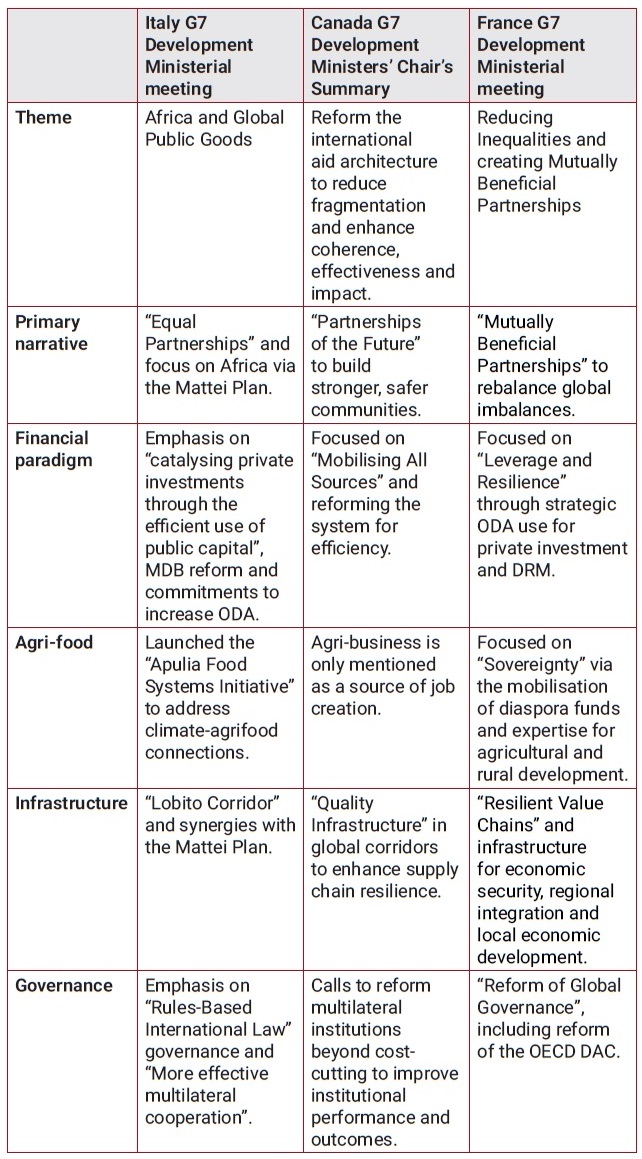
Source: Author’s elaboration.
Two main considerations can be drawn from this comparative analysis. First, there is a clear shift from a regional focus on Africa to global connectivity. Under the Italian 2024 presidency, the Pescara Declaration had a clear regional focus,[9] coinciding with Italy’s strong political investment in the Mattei Plan for Africa, which aims to move toward equal-to-equal partnerships, with a focus on food, energy and health sovereignty. In 2025 the Canadian Development Ministers’ Chair’s Summary shifted the narrative toward supporting supply chain resilience (with a strong focus on critical minerals) and fostering economic prosperity across multiple regions, including through the Luzon and Trans-Caspian corridors.[10] In both documents, infrastructure was viewed not just as aid, but as a mechanism for securing global trade routes and building stronger and safer communities. The 2026 French Communiqué expands these concepts into a systemic critique of global imbalances, advocating a new narrative that seeks to strengthen global governance, specifically targeting the inefficiencies and fragmentation of the international financial architecture.
Second, a growing consensus has emerged that the traditional “donor-recipient” aid model is no longer fit for purpose in a world of budget constraints and heightened geopolitical competition. This includes the pledge to reform of the OECD DAC rules to better account for private capital flows and non-traditional financing, moving away from a narrow focus on concessional resources. Sovereignty is treated both as a goal – ensuring partner countries have resources to support public goods (health services, food systems, etc.) – and a means – fostering DRM and local savings to reduce dependency on volatile external aid. Development cooperation is also being reframed as a tool for economic security designed to counter external influences and help partner countries to build the industrial and regulatory foundations necessary for full ownership of the development process.
3. Pros and cons of economic security- and sovereignty-based partnerships
The shift toward nominally mutually beneficial partnerships is a significant evolution of the G7 approach, yet the practical implementation of the development agenda will continue to face a complex landscape with persistent hurdles. Several positive and critical elements can be outlined.
3.1 Inclusivity, technical coordination and value chain resilience
One of the most significant “pros” of the current G7 development process is the continued improvement in diplomatic and technical inclusivity. The French Presidency involved the G20 Troika, but also key partners such as South Korea, Kenya, Morocco and Ivory Coast, alongside relevant international development organisations such as the UN Development Programme, Multilateral Development Banks, the Organization for Economic Cooperation and Development throughout the preparatory meetings, and not just in the final Ministerial meeting. This inclusive approach involves that the consensus on the need to overcome the donor-recipient model is widely spread across development actors.
On a more technical level, there is a growing convergence among national public development banks (PDBs), multilateral development ones (MDBs) and international financial institutions (IFIs) to work as a system and reduce development finance fragmentation. As an example, the PDB Guarantee Hub launched with the support of the Finance in Common and the World Bank[11] (via the Multilateral Investment Guarantee Agency) provides opportunities to develop local financial markets in emerging and developing economies and improve the projects’ bankability. This coordination between PDBs and MDBs is essential for the success of complex infrastructure projects like the Lobito or the Luzon Corridors. By harmonising standards and improving interoperability within the G7 should facilitate the emergence of a more efficient ecosystem for project preparation. As an example, in the agri-food sector, coordination can allow for a series of services – energy, digital connectivity and transport – essential to strengthen agricultural value chains to be bundled together. In turn, this shall ensure that corridors do not just transport minerals but also foster local food sovereignty and territorial resilience.
Finally, looking at the “sovereignty of means”, the French G7 Presidency put an unprecedented emphasis on supporting partner countries to strengthen DRM and local savings (estimated at 4 trillion dollars in LMICs) to support national development. It is not a coincidence that the G7 Development Ministerial meeting had a dedicated session on remittances, whose flows to LMICs in 2024 reached 685 billion dollars, larger than FDI and ODA combined.[12] However, using remittances or local savings to support regional development is not an easy process. The return of private capitals takes time and trust on public finance management, but the G7 can work synergically with the G20 to operationalise the G20 Roadmap for Enhancing Cross-border Payments[13] to reduce the average costs of migrant remittances to 3 per cent by 2030, thus improving the speed of funds availability. Another proposal would be to interlink instant payment systems for remittances to reduce LMICs’ reliance on volatile external aid.
3.2 Fragmentation, debt purgatory and the risks of strategic diversion
Despite these advancements, some critical elements remain. There are still too many administrative layers imposed by the IFIs – specifically regarding complex procurement rules, multi-stage environmental and social safeguard compliance, and the requirement for successive ‘no-objection’ letters[14] – which hamper or slow down projects design, increase transaction costs and make it harder to support quality and bankable projects. In addition, extreme fragmentation of public and private funders persists. This is why the French G7 Presidency, in coordination with the Foundations 7 engagement group, tried to address the proliferation of vertical funds and the uncoordinated work of private philanthropic actors that often leads to resource dispersion and high transaction costs for recipient nations.
In addition, there persists a lack of ambition of G7 countries to push forward structural global solutions to debt distress, for instance by proposing a reform of existing G20 mechanisms for debt distress such as the Common Framework, a G20 and Paris Club initiative of late 2020 to help low-income countries restructure their unsustainable sovereign debt.[15] Although recent debt treatment initiatives are making progress in sovereign debt management in countries like Zambia, Ethiopia and Ghana,[16] the cost of capital has risen, driving debt payments to record highs.[17] In addition, long relief negotiations have pushed debtor countries into a “debt purgatory”, with higher sovereign reputation risks and credit rating downgrades, scaring off private capitals, that are essential to implement the infrastructure projects that both the G7 and the G20 are promoting. In this sense, the old institutional rivalry between the G7 “Development” and “Finance Track” keeps slowing down these processes, with Development Ministers often finding themselves undertaking Sisyphean tasks. On the one hand, they attempt to design solutions for countries with debt traps, while on the other they lack the operational tools to address the debt distress, since structural negotiations are cordoned off within the “Finance Track”.
Finally, there is a re-emergence of ‘tied’ aid among donors, with ODA being repurposed to serve interests of donor countries’ investors and economic operators rather than genuine poverty reduction in partner nations. This diversion risks prioritising donors’ technology exports – such as heavy agricultural machinery or specific digital platforms – over local economic ownership and estimates show that it can drive up the cost of procured goods and services by 15 per cent to 30 per cent.[18] In addition, such an approach contradicts the emphasis on “mutually beneficial partnerships” and can lead to increased competition and fragmentation within the G7, with donors competing with one another to ensure better conditions for their own companies.
4. Conclusions and policy recommendations for the G7 and G20
Development cooperation is going through a seismic shift, which is likely to structurally change the way it operates and the tools it employs. The French G7 Presidency has incisively promoted a new ODA narrative. We are heading towards a review of the OECD DAC in 2027 and the next months will be key to continuing the debate over the strategic direction of global aid. ODA is facing centripetal forces, with some insisting on its traditional role to support international solidarity and the global public goods agenda, particularly in fragile countries, while others are pushing to transform it into a leverage to unlock private investments, as well as mobilise resources from recipient countries (e.g. via DRM, local savings or LMICs sovereign funds). As aid is going through severe cuts or repurposing, clarifying the mission and scope of ODA is crucial to avoid further cuts, while increasing effectiveness.
Against this backdrop, the G7 and G20 should work not only to ensure high-level strategic alignment, but also to promote an actionable reform of the international finance architecture. The two groups need to address existing fragmentation and foster a “system-wide” architecture that leverages trilateral synergies, multilateral reform and DRM. Synchronising the French G7 commitments with the incoming British G20 policy agenda is key to bridging the 4 trillion-dollar annual investment gap[19] to achieve the UN’s Sustainable Development Goals by 2030. Priority should be given to five key areas:
• First, future G7 Presidencies should keep an inclusive approach, involving emerging and development partners in the entire policy supply chain (i.e. from G7 Working Groups to final Ministerial meetings), to ensure that the proposed solutions are fully in line with the needs of the partners.
• Second, the G7 needs to foster stronger cross-European and trilateral synergies. In view of the incoming UK G20 Presidency, France (holding the G7 Presidency in 2026), Italy (which held the Presidency in 2024) and the UK should establish a joint de-risking facility for African industrial development, coordinating PDBs such as AFD, Cassa Depositi e Prestiti and British International Investment to provide guarantees for private investments in the strategic corridors, for instance by fully implementing strengthening the PDB Guarantee Hub.
• Third, the G7 and G20 must work with global financial institutions to unlock resources for high-quality infrastructure and industrial projects. This requires cutting unnecessary administrative burdens, lowering transaction costs for recipient nations and investing in local capacity building. A crucial next step is to fully implement the G20 Roadmap towards Better, Bigger and More Effective MDBs.[20]
• Fourth, the G7, the Paris Club and the G20 should work synergistically to improve the Common Framework, with stricter, time-bound negotiation windows, but also leveraging domestic legislation in financial hubs (e.g. London, New York) to ensure that private creditors participate in relief on terms comparable to official creditors. In this sense, the new Sevilla Forum on Debt and the Borrowers’ Forum[21] and the upcoming Paris Forum on debt can offer a good chance to rebalance the power dynamics between creditors and debtors while standardising tools like debt pause clauses and swaps.
• Finally, the G7 and G20 should both prioritise DRM through technical assistance to modernise tax administrations and build a transparent social contract between LMICs elites and their citizens. Sub-Saharan Africa holds over 4 trillion dollars in domestic capital (e.g. local pension and insurance funds) that often remains in the informal system. G7 and G20 partners should work with local partners to support the “Scale Imperative”[22] recently discussed at the Africa CEO Forum 2026 which aims to channel local wealth into long-term prosperity.
Daniele Fattibene is Associate Fellow at the Istituto Affari Internazionali (IAI) and Coordinator of the European Think Tanks Group.
This brief was produced in the framework of the research project “Development goal: Strengthening Italy’s development cooperation in times of international crisis” supported by Focus 2030, Fondazione CSF and Fondazione Compagnia di San Paolo. The brief draws on the findings of a high-level roundtable titled “Acting together, from G7 2026 to G20 2027” hosted at IAI on 6 May 2026. The author would like to express his most sincere gratitude to all panelists and participants, as their inputs were key to producing this publication.
[1] OECD, “A Historic Decline in Foreign Aid: Preliminary 2025 ODA Data”, in OECD Insights, 9 April 2026, https://www.oecd.org/en/data/insights/data-explainers/2026/04/a-historic-decline-in-foreign-aid-preliminary-2025-oda-data.html.
[2] Approximately 20 African countries are currently classified as being in or at high risk of debt distress, with many, such as Kenya, Zambia, Ethiopia and Ghana, facing significant difficulties.
[3] Geldard, Rebecca, “The Strait of Hormuz Crisis Affects More than Just Oil. Here Are 9 Other Commodities”, in World Economic Forum Stories, 1 April 2026, https://www.weforum.org/stories/2026/04/beyond-oil-lng-commodities-impacted-closure-hormuz-strait.
[4] The FAO Food Price Index, which tracks monthly changes in the international prices of a basket of globally traded food commodities, averaged 130.7 points in April, up 1.6 per cent from its revised March level and 2.0 per cent higher than a year ago. See FAO, FAO Food Price Index Up for Third Consecutive Month Largely on Rising Vegetable Oil Prices, 8 May 2026, https://www.fao.org/newsroom/detail/fao-food-price-index-up-for-third-consecutive-month-largely-on-rising-vegetable-oil-prices/en.
[5] G7, Ministerial Communiqué, G7 Development Ministers’ Meeting, Paris, 30 April 2026, https://www.g7.utoronto.ca/dev/260430-communique.html. The deliverables can be accessed here: https://www.g7.utoronto.ca/summit/2026evian/road.html.
[6] AFD, ODA and Beyond: Toward an Integrated Approach to Financing for Development. The Case of the AFD Group, 27 April 2026, https://www.afd.fr/en/node/14752.
[7] Among the main results of the summit we can mention: i) a call to action from African countries on the G7 to address global macroeconomic imbalances; ii) a joint Africa-France declaration on international partnerships that link to the new approach to development promoted in the G7; iii) a statement on peace and security; iv) a final declaration reflecting the main conclusions of the summit.
[8] Vertical funds are global programmes for allocating ODA that focus specifically on an issue or theme. They contrast with more traditional channels for development assistance, which focus on the needs of each partner country through country-based, horizontal, funding allocations. See Gartner, Davis and Homi Kharas, “Scaling Up Impact: Vertical Funds and Innovative Governance”, in Laurence Chandy et al. (eds), Getting to Scale: How to Bring Development Solutions to Millions of Poor People, Washington, Brookings Institution Press, 2013, p. 103-137, https://www.brookings.edu/books/getting-to-scale.
[9] G7, Communiqué, G7 Development Ministers’ Meeting, Pescara, 23 October 2024, https://www.g7.utoronto.ca/dev/2024-communique.html.
[10] G7, G7 Development Ministers’ Chair’s Summary – Fostering Partnerships for Economic Prosperity, Washington, 21 October 2025, https://www.g7.utoronto.ca/dev/2025-summary.html.
[11] NDC Partnership et al., IDFC, MIGA and NDCP Launch the Public Development Bank Guarantee Hub (PDB Guarantee Hub) at COP30, 14 November 2025, https://www.idfc.org/wp-content/uploads/2025/11/press-release-pdb-guarantee-hub-fv.pdf.
[12] Ratha, Dilip et al., “In 2024, Remittance Flows to Low- and Middle-Income Countries Are Expected to Reach $685 Billion, Larger than FDI and ODA Combined”, in People Move blog, 18 December 2024, https://blogs.worldbank.org/en/peoplemove/in-2024--remittance-flows-to-low--and-middle-income-countries-ar.
[13] Financial Stability Board, G20 Roadmap for Enhancing Cross-border Payments Consolidated Progress Report for 2025, 9 October 2025, https://www.fsb.org/?p=58293.
[14] A no-objection letter is a formal green light from an IFI (e.g. the World Bank Group) or from a designated national authority. It confirms the institution has reviewed and approved a major project step – such as consultant hiring or a resettlement plan – allowing the borrower to proceed without breaching funding agreements.
[15] The G20 Common Framework brings together traditional Western creditors, emerging nations like China and private investors into a single coordinated process. See Italian Ministry of Economy and Finance website: The Common Framework for Debt Treatment beyond the DSSI, https://www.mef.gov.it/en/G20-Italy/common-framework.html.
[16] African Development Bank, African Development Bank “Spotlight” on Debt Management Highlights Momentum in Debt Restructuring and Other Fiscal Reforms in Africa, 10 July 2025, https://www.afdb.org/en/node/85287.
[17] Jong Yungong, Theophilus and Iolanda Fresnillo, “The G20 Has Failed on Debt. Time to Look to the UN”, in IPS News, 24 November 2025, https://www.ipsnews.net/?p=193234.
[18] Concord, AidWatch 2025, 2025, https://aidwatch.concordeurope.org/?p=24722.
[19] UN Sustainable Development Group, Developing Countries Face Staggering $4 Trillion Investment Gap in SDGs, 5 July 2023, https://unsdg.un.org/node/102035.
[20] G20, G20 Roadmap towards Better, Bigger and More Effective MDBs, October 2024, https://www.iadb.org/document.cfm?id=EZIDB0000565-150387113-355.
[21] Olivié, Iliana et al., “From Sevilla to Implementation: The Post-FfD4 Agenda on Financing for Development”, in ETTG Policy Briefs, No. 1/2026 (March 2026), https://ettg.eu/sevilla-to-implementation.
[22] Di Scala, Chiara, “Scale or Fail: Why Kigali’s Africa CEO Forum Matters”, in Decode39, 13 May 2026, https://decode39.com/14757.