Titolo completo
Washington’s and Tehran’s Gambles Plunge the Middle East into Crisis
|
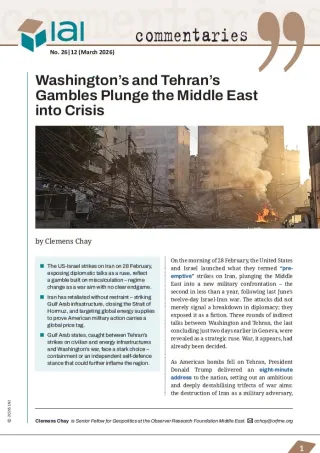
On the morning of 28 February, the United States and Israel launched what they termed “pre-emptive” strikes on Iran, plunging the Middle East into a new military confrontation – the second in less than a year, following last June’s twelve-day Israel-Iran war. The attacks did not merely signal a breakdown in diplomacy; they exposed it as a fiction. Three rounds of indirect talks between Washington and Tehran, the last concluding just two days earlier in Geneva, were revealed as a strategic ruse. War, it appears, had already been decided.
As American bombs fell on Tehran, President Donald Trump delivered an eight-minute address to the nation, setting out an ambitious and deeply destabilising trifecta of war aims: the destruction of Iran as a military adversary, the dismantlement of its nuclear programme, and regime change.
By day five, the endpoint of this campaign remains as unclear as its ultimate objectives. Already, Trump’s gamble is unravelling in ways he did not anticipate. His own admission that his “biggest surprise” has been the indiscriminate nature of Iran’s retaliation against Arab states – both in target selection and intensity – speaks to a fundamental miscalculation at the heart of this operation. A new front has opened with Hezbollah resuming attacks on Israel, while aviation networks have ground to a halt and energy prices are soaring.
The deeper danger lies in Tehran’s perception of this conflict as existential. A cornered adversary fighting for survival does not fight rationally – it fights desperately. But Tehran is also making its own calculated gamble. By striking Gulf Arab states and targeting the arteries of an interdependent global economy, Iranian retaliation unveils a message: that Washington’s war will not be contained, that American military action carries a global price tag, and that the world will be made to feel it.
Trump’s war, America’s burden
The current hostilities are a war of choice, not a war of necessity. Despite Trump’s claims of “imminent threat”, his own officials acknowledged in closed-door briefings with congressional staff that no intelligence existed suggesting Iran planned to strike first. Among those briefed was Senator Mark Warner – one of the Gang of Eight, the congressional leaders privy to the most sensitive classified intelligence – who rejected the “imminent threat” framing outright and stated that “the timing of this war was dictated by Bibi Netanyahu”. A Senate vote to rein in Trump’s war-making authority subsequently failed, largely along party lines, leaving the president unchecked.
The war is also, in no small part, a creation of Trump’s own making. In his first term, he tore up the hard-earned JCPOA – the deal that constrained Tehran’s nuclear programme in exchange for sanctions relief, restricting uranium enrichment to 3.67 per cent until 2031. The consequences were predictable: Iranian stockpiles surged by over 50 per cent between October 2024 and February 2025. His “maximum pressure” campaign of 2019, designed to cripple the regime through sanctions, achieved the opposite – entrenching the leadership while deepening popular resentment.
The more immediate trigger was a trap of Trump’s own construction. By massing US military assets in the region – his theatrical “armada” – Trump framed the deployment as coercive diplomacy. But for a leader whose political identity is built on the performance of victory, failed talks left only one offramp: military action. The catalyst came from US-Israel intelligence, gathered after months of surveillance, fixing the location of senior military figures alongside Khamenei. What makes this particularly damning is that, meanwhile, three rounds of indirect US-Iran talks had taken place, with Oman serving as the mediating party. Oman, which typically conducts its diplomacy with studied discretion, broke from form: Foreign Minister Sayyid Badr Albusaidi publicly affirmed that a deal was within reach and that Iran had agreed to “zero stockpiling”. Without stockpiled material, nuclear weaponisation is impossible. The diplomacy was working, but Trump gave the order anyway.
What has been achieved thus far is significant but incomplete. Unlike last June’s “intentionally limited strikes” on nuclear capabilities, the current campaign is far broader in scope – yet air power alone is unlikely to achieve regime change in a country three times the size of Iraq in 2003. The most consequential development remains leadership decapitation: Supreme Leader Ayatollah Ali Khamenei is among the casualties, alongside the systematic destruction of the Islamic Revolutionary Guard Corps’ (IRGC) command structure. US forces have struck approximately 2,000 targets across Iran’s military and strategic infrastructure, with officials declaring “decisive offensive progress” and complete control of Iranian airspace described as imminent. Yet the question that hangs over all of it remains unanswered: to what end?
The endgame remains dangerously vague. Trump has offered timelines ranging from a few days to four weeks – a variance that itself signals the absence of a coherent plan. If regime change is the objective, the timeline is fanciful; history offers no examples of imposed regime change achieved in weeks. The latest reports of the US arming Kurdish groups to spark a popular uprising are a foreboding sign, risking civil war and, at worst, another failed state in the Middle East.
Iran’s desperate calculus
Facing the threat of collapse, the Iranian regime has responded without shackles. Stripped of its proxy network and forward shield in the post-7 October campaign, Iran has abandoned the calculated restraint that previously characterised its retaliations. What is unfolding now is categorically different: a regime with nothing to lose, determined to drag both the region and the world into a quagmire.
Iran’s retaliation has escalated in deliberate steps. The first two days saw strikes on US bases hosted on neighbouring soil; within days, the targets shifted to civilian infrastructure – Dubai International Airport, Kuwait International Airport, the Era Tower in Bahrain and sites across Riyadh. The intent is clear: to force Gulf Arab neighbours into pressuring Washington to halt the spiral. Tehran’s gamble is that these states’ access to Trump makes them the most viable de-escalating actors. The price is steep, however. These strikes cross red lines for neighbours who, after years of rapprochement with Tehran, had agreed not to permit their airspaces to be used for offensive operations against Iran. Strong statements have already been issued by the Gulf Cooperation Council.
For now, the Gulf states are relying on defence systems that have performed commendably. But if Tehran’s desperation translates into sustained attacks on civilian areas and energy facilities, that calculus will shift. As the UAE’s Diplomatic Adviser to the President, Anwar Gargash, has indicated, an “active self-defence stance, independent of the US-Israel campaign” cannot be ruled out. The Gulf will respond in action, not just words.
By days three and four, Iran escalated further, targeting the energy infrastructure of Gulf states – another major red line crossed. QatarEnergy, one of the world’s largest LNG suppliers, suspended production following attacks on its facilities at Ras Laffan and Mesaieed Industrial City. Saudi Aramco confirmed the temporary shutdown of its Ras Tanura refinery – processing around 550,000 barrels per day – after a drone strike. Most consequentially, Iran has effectively closed the Strait of Hormuz, warning it would “burn any ship” attempting to transit – a chokepoint through which nearly a fifth of the world’s oil exports pass. European gas prices have surged 45 per cent, a severe blow to a continent still navigating its transition away from Russian energy. Global markets are rattled.
With Iran’s top brass eliminated, the Islamic Republic’s resolve now rests on its “mosaic defence” strategy – dispersing power to junior commanders through a deliberately decentralised structure. The regime has moved quickly to signal institutional continuity, establishing an Interim Leadership Council, though reports on succession remain unsettled, with Khamenei’s son Mojtaba emerging as the frontrunner. Simultaneously, Iranian intelligence has reportedly made secret outreach to Washington seeking an offramp. What is clear is this: Iran will continue to absorb strikes like a sponge – endurance as strategy – while threatening global connectivity. The regime is severely wounded, but not yet broken.
Two gambles, no winners
Trump has, in effect, dropped a loaded machine gun – and it is now firing in all directions. Convinced that the enemy does not get a vote, the American president is discovering what Iraq and Afghanistan already demonstrated: regime change is far harder than it looks, and wars unfold in ways no plan survives. For a president who campaigned against endless wars, this conflict offers no end date – and may yet define his legacy. His brand of muscle-and-money diplomacy will also cast a long shadow over Arab allies who believed they understood how to navigate his dealmaking instincts.
For Iran, the threat remains existential – and a cornered adversary does not surrender its remaining arsenal quietly. Despite US claims of “localised air superiority”, a destroyed navy, and an 86 per cent reduction in ballistic missile attacks, Iran’s cheap one-way Shahed drones continue to overwhelm air defences. That Iran has now extended strikes beyond the Middle East – targeting Turkey, Cyprus and Azerbaijan – signals a regime still capable of strategic disruption, however desperate.
What this war will ultimately reshape is threat perception. For Arab states, the existential menace is shifting – from Israel’s unchallenged military dominance to Iran’s unshackled retaliation. Gulf leaders have made it clear that Tehran’s conduct is exhausting regional patience and eroding hard-won friendships – leaving the Islamic Republic increasingly isolated at precisely the moment it can least afford to be. Should a power vacuum emerge in Tehran, regional instability will compound. Whatever the outcome, trust in an unpredictable American president – among even his closest allies – will not easily be restored.
Clemens Chay is Senior Fellow for Geopolitics at the Observer Research Foundation Middle East.