Titolo completo
How to Build Digital Citizenship in the 21st Century
|
Digitalisation is reshaping economies, politics and societies worldwide, creating both opportunities for inclusion and risks of deepening inequality. While digital literacy frameworks exist, they remain fragmented and insufficiently connected to broader goals of citizenship education. Without equipping teachers and learners with the competencies to think critically, act ethically and participate constructively in digital spaces, democratic institutions and individual well-being are at risk. Building on UNESCO’s Global Citizenship Education and Digital Literacy Global frameworks, this brief argues that integrating digital literacy into citizenship education, standardising teacher training across contexts and promoting international cooperation – particularly through the G20 – are key to ensuring that all citizens become empowered, responsible and globally connected digital actors.
Current state of digitalisation and citizenship education
The transformation of the global economy and international relations by digitalisation and emerging technologies[1] mandates that digital literacy education be linked to global citizenship education by a standard that is internationally transferable and operable. Online disinformation campaigns, viral conspiracy theories and cyberwarfare threaten democracy by eroding trust in institutions. Cyberbullying, hate speech and ill-defined work-life relationships with technology erode each individual’s mental and emotional well-being.[2] Economies and development between the ‘Global South’ and the ‘Global North’ around the world are seeing a rise in inequality between not only those who have access to technology and those who do not, but also between those who know how to use technology civically and those who do not. A major hurdle to teaching digital literacy, in any country, is whether or not the teachers themselves know how to use and teach about new and common technologies. The pace of technological change happens so rapidly that even well-meaning teachers and resource-abundant countries struggle to educate themselves and educate their growing population of digital natives on how to smartly, ethically and mindfully use technology for the good of the individual and the (global) community.[3] The G20 consortium of the world’s most powerful economies can set a clear and inclusive standard for global digital cooperation by passing policies that prioritise the linkage between digital literacy education and global citizenship education.
At the 2024 G20 summit in Brazil, important assertions were made regarding both digitalisation and education. The declaration on “Digital Inclusion for All” pointed the compasses of both economic development and public good towards a framework of digitalisation that empowers citizens, sharpens their effective use of technologies and provides more high-quality access to the internet for the general population.[4] Meanwhile, the G20 Education Working Group shaped their priorities in a compatible direction, highlighting teacher education, digitalisation of educational resources and social justice-oriented education as necessary components of a thriving, literate and peaceful populace. The Working Group took their discussions directly into the UN Educational, Scientific and Cultural Organisation (UNESCO)’s Global Education Meeting, culminating in the Fortaleza Declaration, which reaffirmed UN member countries’ commitment to equitable and just education for all.[5] But the question remains how to synergise and operationalise such ambitious agendas.
Building on these commitments, the 2025 G20 process further consolidated education and digital inclusion as mutually reinforcing policy priorities. Under South Africa’s G20 Presidency, the Education Working Group elevated teacher professional development and future-ready skills as central to inclusive digital transformation. The Johannesburg Leaders’ Declaration reaffirmed commitments to bridging digital divides, including reducing gendered access gaps, while explicitly highlighting the need to equip educators with the competencies required to foster ethical, participatory and critical engagement with digital technologies.[6] This continuity across G20 presidencies strengthens the case for leveraging the G20 as a platform not only for coordination on infrastructure and access, but also for harmonising standards for digital citizenship education and teacher training across diverse national contexts.
There are already unifying frameworks from which to pull inspiration. The Digital Literacy Global Framework (DLGF), developed by the UNESCO Institute of Statistics (UIS) defines a set of digital competencies that are critical for societal cohesion in the digital era.[7] UNESCO’s Global Citizenship Education (GCED) framework encourages the development of knowledge, skills, values and attitudes essential for learners to contribute to creating a more just, peaceful, tolerant, inclusive, secure and sustainable world.[8] However, the reality of digitalising societies in the 21st century demands a new synthesis of these frameworks be created in order to tackle contemporary development challenges and help citizens manage their individual and societal well-being.
Citizenship education
Citizenship education provides a comprehensive approach to engender not simply knowledge of the respective political systems (civic education) and an understanding and respect for rights, but a more active and participatory model for being a citizen. The role of citizenship education is recognised by international institutions, such as the Organisation for Economic Cooperation and Development (OECD), which emphasises that education should not only prepare young individuals for the workforce but also ensure they acquire the skills necessary to be proactive, responsible and engaged citizens.[9]
Citizenship education involves both theoretical principles and practical applications aimed at fostering a specific type of citizenship within a given society. The concept of citizenship, which denotes belonging to a political community, is multifaceted, encompassing dimensions such as status, identity and participation.[10] Each of these dimensions poses distinct challenges to citizenship education, leading to varied interpretations of its essence. In the first dimension, education plays a crucial role in imparting the knowledge and skills necessary for individuals to comprehend their status and effectively exercise the rights and fulfil the responsibilities tied to it.[11] The second dimension, identity, delves into the sense of belonging and unity among community members. Educational efforts in this realm aim to nurture these emotions, fostering loyalty and solidarity toward the community. The third dimension, participation, encompasses civic virtues – defining the desired behaviours and attitudes of exemplary citizens – and agency – determining the level of critical reflection, engagement and independent action expected. This aspect stands out as a prominent focus of citizenship education, aiming to cultivate the abilities and attitudes that empower citizens to actively and willingly participate in society as desired. The challenge of citizenship in the 21st century is that status, identity and participation, as well as membership and duty towards one’s community, now have digital dimensions and thus require a new form of literacy to perform citizenship effectively in digital spaces.
Digital literacy
Digital citizenship, digital rights and digital literacy are closely related, and each complements the others. Digital citizenship and digital rights flow from digital literacy. The European Commission’s Key Competences for Lifelong Learning, uses the term ‘digital competence’ to express what we mean here by ‘digital literacy’: “the confident, critical and responsible use of, and engagement with, digital technologies for learning, at work, and for participation in society”.[12] Digital citizenship experts, Pangrazio and Sefton-Green, argue “digital literacy is perhaps foundational for digital citizenship and digital rights: individuals cannot participate or claim their digital rights if they are not ‘literate’ in the first place”.[13]
Digital citizenship refers to the way in which a series of tasks or acts, such as interpreting streams of local and global information or curating a digital identity on social media enables a relationship beyond the individual. An untold number of interactions take place online every day, and it is through each digital action that the digital citizenship of the individual is crafted.[14] Digital actions take place in a digital space, allowing for participation at a scale and frequency not easily comprehended by the human mind. Yet, we find coherence in the digital space through collectives,[15] through reifying our digital identity, and through contributions to the global digital public sphere.
Digital rights are not considered a set of rights in and of themselves and are related to other rights such as human rights, freedom of speech and privacy.[16] Moreover, what may be considered a digital right in one part of the world may not be considered as such in another. The individual may be the subject of digital rights claims, yet there is a strong reliance on institutions and organisations to support the rights of the individual. As such, digital rights are thus different from digital literacy and digital citizenship. Digital literacy and digital rights focus on individual forms of action, whilst digital citizenship connects practices to a collective. However, digital rights cannot be claimed in the absence of the ability to use digital technologies. In other words, of these three concepts, digital literacy comes first and is the foundation for the invocation of rights and citizenship.
This integrated understanding of digital literacy and citizenship is increasingly reflected in multilateral policy processes. In late 2025, the United Nations General Assembly reaffirmed the role of digital literacy as a core capacity for sustainable development, calling on states to integrate inclusive digital competencies into education systems for both learners and educators.[17] These commitments position digital literacy not merely as a technical skillset, but as a foundational enabler of participation, rights awareness and civic agency in digital societies. Aligning digital literacy education with global citizenship objectives therefore reflects not only pedagogical necessity, but also emerging international policy consensus.
Herein, UNESCO’s sibling frameworks, the DLGF and the GCED framework, together provide a roadmap for highlighting the challenges of citizenship in a globalised, digital world and for guiding policymakers to update education policies that are outdated or unadapted. GCED enables learners to cultivate the following competencies:
• an attitude supported by an understanding of multiple levels of identity, and the potential for a ‘collective identity’ that transcends individual cultural, religious, ethnic or other differences;
• a deep knowledge of global issues and universal values such as justice, equality, dignity and respect;
• cognitive skills to think critically, systemically and creatively, which includes adopting a multi-perspective approach that recognises the different dimensions, perspectives and angles of issues;
• non-cognitive skills including social skills such as empathy and conflict resolution, communication skills and aptitudes for networking and interacting with people of different backgrounds, origins, cultures and perspectives; and
• behavioural capacities to act collaboratively and responsibly to find global solutions for global challenges and to strive for the collective good.
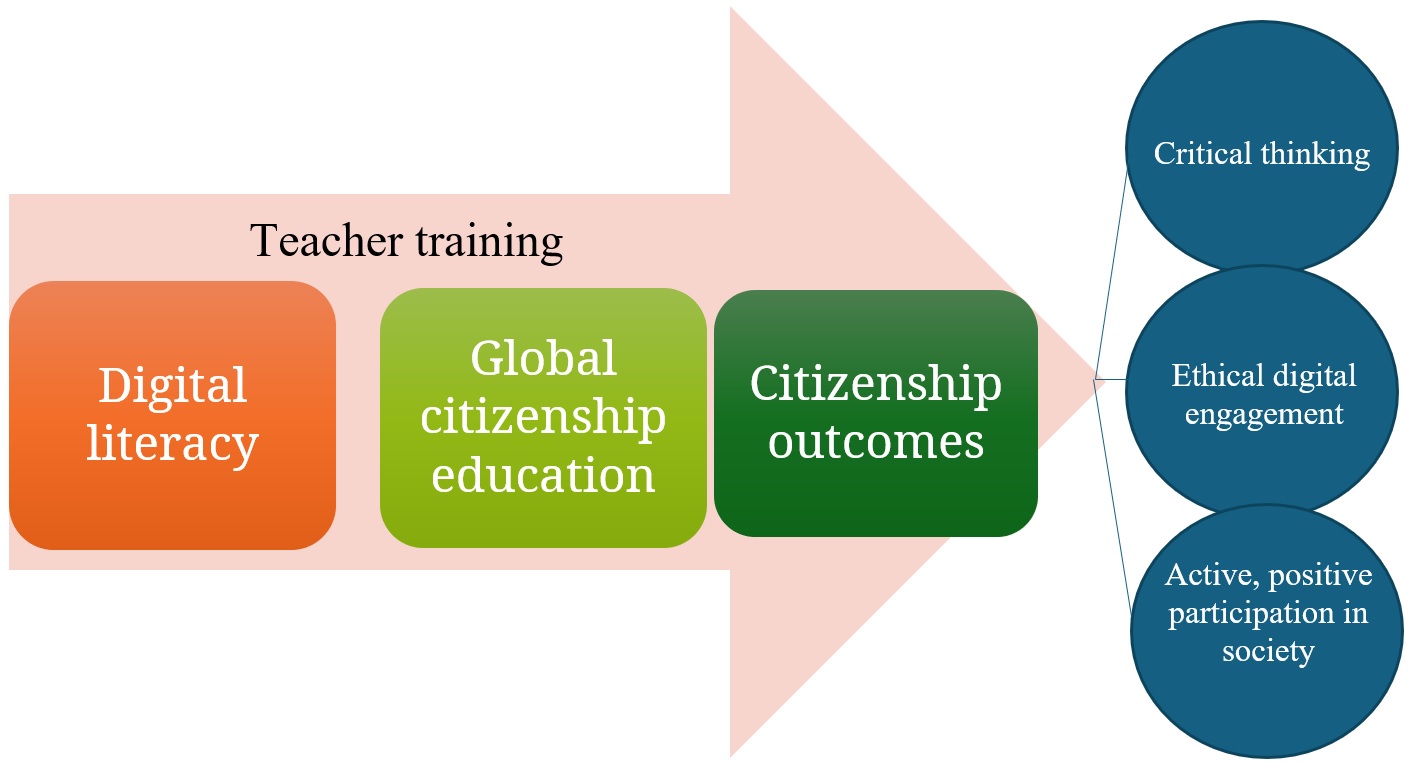
Combined with the competencies of the DLGF – hardware and software operations; information and data literacy; communication and collaboration; digital content creation; online safety; problem-solving; and career-related competencies – learners become digitally literate and effective global digital citizens. Education does not happen on its own. The competencies of digital citizenship are encountered as early as primary school and throughout one’s formal and informal education thereafter. Therefore, teachers, educators and trainers in primary, secondary, upper secondary, university and vocational schools are the target group for new policies concerning digital citizenship education (Figure 1).[18]
Figure 1 | Illustration of outcomes from integrating digital literacy and global citizenship education into teacher training
Education for teachers
The DLGF and the GCED frameworks target the conceptual qualities that learners should cultivate. Frameworks such as the ICT Competency Framework for Teachers (ICT CFT) and the European Framework for the Digital Competence of Educators (DigCompEdu) act as clear guides for understanding what policies need to be in place to support educators towards teaching digital citizenship effectively.[19]
Recent global policy developments further underscore the centrality of teachers in advancing digital citizenship education. In 2025, UNESCO convened the World Summit on Teachers, culminating in a global consensus on the need to reinvent the teaching profession for the demands of 21st-century education systems. The resulting Santiago Consensus reaffirmed that teacher training, continuous professional development and institutional support are preconditions for effective digital and global citizenship education. Importantly, the consensus emphasised the need for coherent, scalable training models that can be adapted across contexts, reinforcing the urgency of moving beyond fragmented national approaches toward internationally aligned educator training standards.[20]
The ICT CFT refers to six aspects of teacher professional practice in any of the three phases of teacher professional development (pre-service, in-service and on-going formal and informal pedagogical and technical support), highlighting the following competencies: 1) understanding ICT in education policy; 2) curriculum and assessment; 3) pedagogy; 4) application of digital skills; 5) organisation and administration; 6) teacher professional learning. These aspects are organised over three successive stages of teacher development regarding ICT: knowledge acquisition, knowledge deepening and knowledge creation, summing 18 ICT competencies and skills.
Similarly, the DigiCompEdu framework proposes six competencies: 1) professional engagement; 2) digital resources; 3) teaching and learning; 4) assessment; 5) empowering learners; 6) facilitating learners’ digital competence. Rather than categorising the competencies by the state of the educator’s career, the DigiCompEdu framework divides the competencies into categories based upon the “educators’ professional competencies”, “educators’ pedagogic competencies” and “learners’ competencies”.[21]
There is an array of other frameworks that did not make it into this discussion. On the one hand, the plethora of options provides an opportunity for selecting the best practices to be implemented more widely and coherently across regions. On the other hand, the lack of global consensus and standards for the delivery and teaching of these frameworks creates a discrepancy in the quality of teaching and resources between countries in the OECD and the least developed countries, exacerbating the digital divide into a digital chasm.
Policy recommendations
Developing a common training programme for educators across the G20 membership is both a challenge and a necessity. Whilst individual countries (especially within the OECD) may already have developed more advanced programmes, we are mindful of the need to develop a set of policies that would make it possible to train educators in the least developed world, given both time and financial constraints. Synthesising the concepts and frameworks highlighted in this text, we propose a very simplified menu of policy advice, including key questions to discuss with learners as a means of providing a rudimentary basis for the development of learners’ digital literacy.
• Integrate digital and global citizenship education: Policies should link digital literacy with global citizenship education (GCED), emphasising the development of critical thinking, ethical use of technology and the capacity to engage in global problem-solving. The UNESCO frameworks for digital literacy and GCED offer a robust foundation for such integration.
• Standardised educator training programmes: Implement globally consistent teacher training standards based on frameworks like UNESCO’s ICT CFT and the EU’s DigCompEdu. These frameworks address essential competencies in pedagogy, digital resource utilisation and fostering learners' digital capabilities.
• Focus on equity and accessibility: Address digital divides by ensuring access to technologies and training for both educators and learners, particularly in underserved regions. Policies should prioritise equitable access to devices, connectivity and culturally relevant digital content.
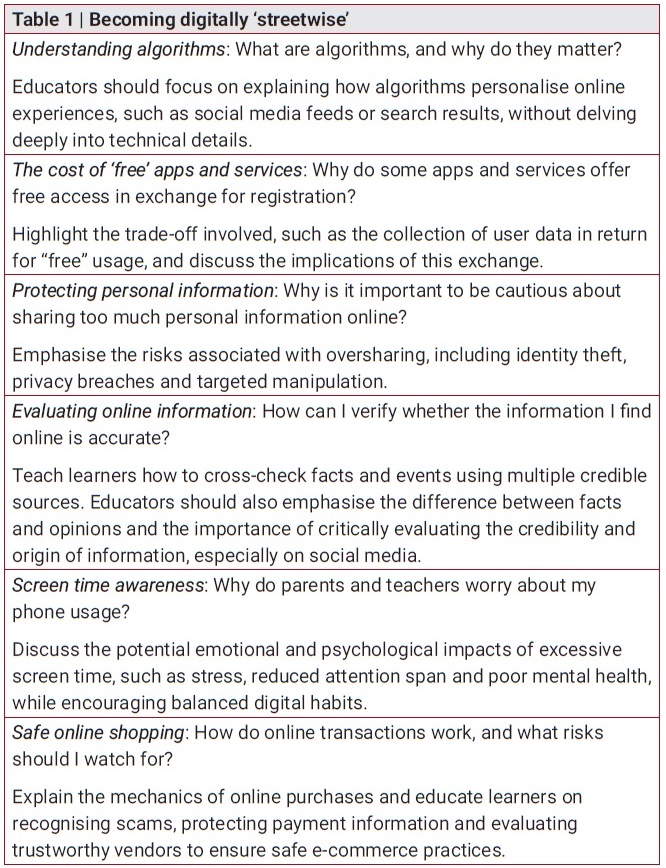
• Incorporate foundational digital literacy education early: Develop curricula that introduce basic digital competencies – such as understanding algorithms, online safety, fact-checking and ethical digital practices – starting from primary school. This foundation ensures that learners become “digitally streetwise” and capable of navigating complex digital environments responsibly. As emerging technologies such as artificial intelligence increasingly shape learning environments and information ecosystems, digital citizenship education must also equip learners with the critical, ethical and civic capacities to understand and engage with algorithmic systems in ways consistent with human rights and democratic values.[22]
• Promote lifelong digital skills development: Encourage the incorporation of ongoing digital skills education into secondary, tertiary and vocational training systems. This includes adapting curricula to technological advancements and labour market needs.
• Establish global policy cohesion: Leverage G20 platforms to create internationally transferrable standards and frameworks for digital citizenship education. Harmonised approaches reduce inequalities and ensure a consistent level of digital competency globally.
• Encourage multi-stakeholder collaboration: Facilitate partnerships between governments, private sector stakeholders and civil society to promote innovation in digital education tools and resources, ensuring that policies remain relevant in rapidly evolving digital landscapes.
• Establish “digital streetwise” curricula (see Table 1).
Table 1 | Becoming digitally ‘streetwise’
Alessia Chiriatti is Head of the Educational programme and Researcher at the Istituto Affari Internazionali (IAI). Benjamin Stewart is Researcher at the German Institute of Development and Sustainability (IDOS) and a PhD Candidate with the University of Bonn. Janis van der Westhuizen is Professor of Comparative Political Economy at Stellenbosch University. Juliana Mansur is former Professor of Psychology and Organisational Behaviour at Fundação Getúlio Vargas - Brazilian School of Public and Business Administration (FGV EBAPE).
This brief builds on insights gathered through a series of focus groups conducted within the framework of the PRODIGEES project, of which IAI was a partner. PRODIGEES promotes international collaboration and knowledge exchange on global governance and the conditions for steering digitalisation towards the Sustainable Development Goals of the 2030 Agenda, fostering dialogue between European countries and emerging powers of the Global South. This project has received funding from the European Union’s Horizon 2020 research and innovation programme under the Marie Skłodowska-Curie grant agreement No 873119.
[1] United Nations, Global Digital Compact, New York, 22 September 2024, https://www.un.org/digital-emerging-technologies/node/1123.
[2] European Commission, A Multi-Dimensional Approach to Disinformation: Report of the Independent High Level Group on Fake News and Online Disinformation, Luxembourg, Publications Office of the EU, 2018, https://doi.org/10.2759/739290.
[3] UNESCO, Global Education Monitoring Report 2023. Technology in Education: A Tool on Whose Terms?, 2023, https://doi.org/10.54676/UZQV8501.
[4] G20, G20 Maceió Ministerial Declaration on Digital Inclusion for All, 13 September 2024, https://www.g20.utoronto.ca/2024/240913-digital-ministerial-declaration.html.
[5] UNESCO, Fortaleza Declaration: Unlocking the Transformative Power of Education for Peaceful, Equitable and Sustainable Futures, 31 October-1 November 2024, https://unesdoc.unesco.org/ark:/48223/pf0000391862.
[6] G20, G20 South Africa Summit: Leaders’ Declaration, Johannesburg, 22 November 2025, https://www.g20.utoronto.ca/2025/251122-declaration.html.
[7] UNESCO Institute for Statistics, A Global Framework of Reference on Digital Literacy Skills for Indicator 4.4.2, 2018, https://unesdoc.unesco.org/ark:/48223/pf0000265403.
[8] UNESCO, Preparing Teachers for Global Citizenship Education. A Template, 2018, https://unesdoc.unesco.org/ark:/48223/pf0000265452.
[9] Hämäläinen, Juha and Elina Nivala, “Citizenship Education”, in Oxford Bibliographies, 21 February 2023, https://doi.org/10.1093/obo/9780199756810-0298.
[10] O’Byrne, Darren J., The Dimensions of Global Citizenship. Political Identity beyond the Nation-State, London/New York, Routledge, 2003.
[11] Dewey, John, Democracy and Education. An Introduction to the Philosophy of Education, New York, Macmillan, 1916.
[12] European Commission, Key Competences for Lifelong Learning, Luxembourg, Publications Office of the EU, 2019, p. 10, https://doi.org/10.2766/569540.
[13] Pangrazio, Luci and Julian Sefton-Green, “Digital Rights, Digital Citizenship and Digital Literacy: What’s the Difference?”, in Journal of New Approaches in Educational Research, Vol. 10, No. 1 (2021), p. 15-27 at p. 21, https://doi.org/10.7821/naer.2021.1.616.
[14] Isin, Engin and Evelyn Ruppert, Being Digital Citizens, 2nd ed., London/New York, Rowman & Littlefield, 2020, https://research.gold.ac.uk/id/eprint/29321.
[15] Jenkins, Henry and Nico Carpentier, “Theorizing Participatory Intensities. A Conversation about Participation and Politics”, in Convergence, Vol. 19, No. 3 (2013), p. 265-286, https://doi.org/10.1177/1354856513482090.
[16] UN Human Rights Council, The Promotion, Protection and Enjoyment of Human Rights on the Internet (A/HRC/RES/32/13), 1 July 2016, https://digitallibrary.un.org/record/845727.
[17] UN General Assembly, Information and Communications Technologies for Sustainable Development (A/RES/80/118), 18 December 2025, https://digitallibrary.un.org/record/4097019.
[18] Esteve-Mon, Francesc M. et al., “Digital Teaching Competence of University Teachers: A Systematic Review of the Literature”, in IEEE Revista Iberoamericana de Tecnologias del Aprendizaje, Vol. 15, No. 4 (2020), p. 399-406, https://doi.org/10.1109/RITA.2020.3033225; de Paulo Moura, Késsia Mileny, “Systematic Review on Digital Literacy in Teacher Training”, in Texto Livre: Linguagem e Tecnologia, Vol. 12, No. 3 (2019), p. 128-143, https://doi.org/10.17851/1983-3652.12.3.128-143.
[19] UNESCO, ICT Competency Framework for Teachers, 2018, https://unesdoc.unesco.org/ark:/48223/pf0000265721; Punie, Yves (ed.), European Framework for the Digital Competence of Educators, Luxembourg, Publications Office of the EU, 2017, https://doi.org/10.2760/159770.
[20] UNESCO, World Summit on Teachers, Santiago de Chile 2025: Santiago Consensus adopted on 29 August 2025, https://unesdoc.unesco.org/ark:/48223/pf0000395718.
[21] Punie, Yves (ed.), European Framework for the Digital Competence of Educators, cit., p. 8.
[22] UNESCO, AI and Education: Guidance for Policy-makers, 2021, https://doi.org/10.54675/PCSP7350.