Titolo completo
What Role for Italy’s Infrastructure Diplomacy? Lessons from the Lobito Corridor
|
The Lobito Corridor is an infrastructural project linking the namesake port of the Angolan coast with mineral-rich regions of the Democratic Republic of the Congo (DRC) and Zambia’s Copperbelt regions travelling through Angolan and DRC mainland. The project’s ambition is to create a fast infrastructure to connect a westward-looking port infrastructure, such as the one in Lobito, to parts of DRC and Zambia, which are particularly rich in mineral resources and rare earths, as the importance of the latter is going to increase exponentially in the coming years.
When completed, the infrastructure should amount to 1,300 kilometres of railroad built upon pre-existing tracks of the Benguela Railway. This railway, originally built from 1902 to 1931, was already conceived as a means for exporting minerals from Zambia towards Europe and the United States. During its moments of peak efficiency, it was estimated to generate revenues of 30 million US dollars.[1] A huge part of the infrastructure was severely damaged by 27 years of conflict during the Angolan civil war that lasted from 1975 to 2002. By that date, it was estimated that less than 3 per cent of the Angolan part of the infrastructure was still usable, and by that time, Zambia had already found alternative means of exporting its resources through the alternate route of the Tanzania-Zambia Railway (TAZARA), which headed eastward and was financed mostly by China, its greatest beneficiary.
The project was launched officially in 2023 with the signature of a memorandum of understanding (MOU) between the European Commission, the United States of America, the Governments of the Republic of Zambia, Angola, DRC, the African Development Bank (AfDB) and the Africa Finance Corporation (AFC).
On a broader strategic perspective, it may be seen as one of the key parts of the Western attempt to respond to the challenge posed by China with its Belt and Road Initiative projects. In this scenario, Italy is trying to carve itself a leading role: Rome’s commitment to this project is quite substantial in terms of economic resources. This commitment is included in Italy’s wider attempt to reshape its role and presence in Africa through the Mattei Plan, searching for space and opportunities to reframe Rome’s cooperation with African partners on a so called peer-to-peer basis.[2] According to the report presented by the Italian government to parliament at the end of June 2025, Italy has committed 250 million euros in the next ten years.[3] This figure is even more significant when one considers that the total value of the project is estimated at between 1 and 2.3 billion US dollars, which greatly increases Italy’s weight within it.[4] Compared to other projects in the Mattei Plan, the Lobito Corridor deserves attention for several factors. Firstly, Italy is investing in a project in which, to date, no Italian companies are involved, a substantial change from the standards adopted until now. The entity of the investment may hint that Italy is willing to insert the Mattei Plan into a broader multilateral framework.
Furthermore, the Lobito Corridor renews the partnership with the African Development Bank, the African institution most involved and with which Italy has maintained a fruitful dialogue from the outset for the success of the Plan. In addition, this investment may be seen as part of a long-term attempt to strengthen Italy’s position in the West in view of the broader Sino-American confrontation on the continent.[5]
Team Europe approach for sustainable partnerships
It is impossible to understate the importance of a project such as the Lobito corridor: as the world accelerates a transition from fossil to clean energy, the Lobito Corridor has emerged as a strategic political and economic arena. Moreover, major global actors such as the EU, the United States, China and others seek to gain leadership in critical industries, such as electric vehicles (EVs) and artificial intelligence (AI), the growth of which is closely linked to the availability of critical raw materials (CRMs). Global South countries are well-aware of the competitive dimension that CRMs have worldwide. The recent G20, led by South Africa in 2025, raised the need to ensure that countries rich in minerals will benefit from their resources.[6] The envisaged partnership should be defined by “an additive rather than an extractive relationship” as President Cyril Ramaphosa stated in Davos.[7]
The Lobito Corridor is furthermore a key project for the EU supply chain and, consequently, the Italian one. The EU and Italy are backing the project in the context of the G7’s Partnership for Global Infrastructure and Investment (PGII). A renewed interest in infrastructures is at the centre of the G7 initiative, strongly supported by the former US administration led by Joe Biden. With a focus on environmental sustainability and development, PGII fosters the mobilisation of private capital to support the realisation of high-impact infrastructure partnerships. The Lobito Corridor represents a concrete example of the joint effort, confirmed by the Trump administration in 2025. While the shift from Biden’s to Trump’s political agenda has, for some, reshaped US intentions towards a less-driven climate-interested approach to a more competitive environment driven by industrial security and control over critical minerals, the EU has kept its vision on supporting international partnerships for green transition.[8] Through its 2021 global strategy, the Global Gateway, the EU has engaged with African countries, such as Angola, DRC and Zambia, to support renewables and low-carbon value chains. The agenda for the Lobito Corridor is built on the premise that this vast infrastructure will serve more than just the CRM sector. In the EU vision, it aims to foster an enabling environment that stimulates local economies and supports sustainable agri-food value chains. To this end, through the Global Gateway and its Team Europe approach, the EU has declared investments for over 2 billion euros in the three African countries.[9] Agriculture, trade and logistics are the sectors where the EU is investing in partnership with Angola, DRC and Zambia (see Table 1). The Corridor should be a catalyst for the economic development of the region, boosting jobs for Africans and economic opportunities. On one side, the agricultural sector, especially the more developed one in Angola, is attracting EU investments; on the other, renewables are also a joint interest. The recent EU-Zambia Lobito Corridor Business Forum (12-14 November 2025) has confirmed the EU-Zambia partnership in solar power plants with additional allocation of 26.5 million US dollars to fund a 32-megawatt solar power plant in Zambia’s Western Province.[10]
Table 1 | Global Gateway projects in Angola, Zambia and DRC related to the Corridor
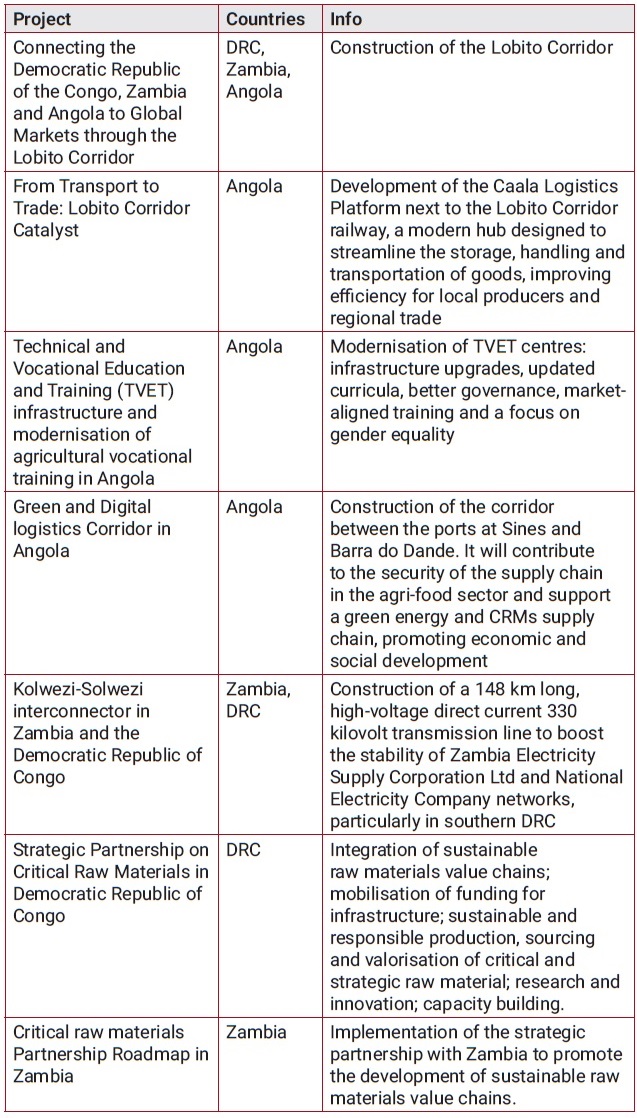
Source: authors’ elaboration on European Commission DG for International Partnerships website: Global Gateway Projects, https://international-partnerships.ec.europa.eu/node/2623_en.
US-EU efforts are also aimed at counteracting Chinese investments in the area. The challenge is arduous. Beijing’s presence is already well diffused with Chinese companies involved in around 30 per cent of the major infrastructure projects in Africa and operating in over a third of African ports, including Lobito.[11] For instance, in the Lobito port, the China International Trust Investment Corporation (CITIC) Construction Group and Shandong Port Group hold a 20-year concession for port operations.[12] Compared to the Lobito Corridor, China’s efforts are concentrated on the revitalisation of the TAZARA railway, a strategic infrastructure project designed to secure a direct route for Congolese and Zambian copper and cobalt through the port of Dar es Salaam. While political rhetoric often frames the Lobito Corridor (West) as a direct competitive response to the TAZARA (East), the reality demands a more nuanced approach. EU partners, including Italy, must carefully assess the local context in order to counter China’s dominant position in the CRM refining and EV battery sectors. While the EU advocates for a development model, more focused on socio-economic inclusiveness, competing effectively at the global level will require a structural and comprehensive strategy. Increasing the refining capacity in the EU, for instance, is one of the strategies to pursue, as the 2024 CRM Act stated.[13] Strengthening public-private partnerships is another key challenge that will test the capacities of each EU member state to mobilise domestic resources.
Testing the goals of Italy-Africa partnership: The Lobito case
Italy has a crucial role in this context. This project is the Mattei Plan’s highest-priority effort based on resource allocation.[14] The decision to participate in the collaboration proves Italy’s dedication to tackling Africa’s infrastructure gap. It boosts Italy’s participation in supply chains, in partnership with the US, a renewed commitment confirmed after the election of the new administration. Washington has pledged a loan of around 553 million US dollars, through the US International Development Finance Corporation, with a total of 4 billion to invest in projects related to agriculture, renewable energy and manufacturing.[15] Participating with such a consistent pledge to one of the cornerstones of US-Africa cooperation may have a considerable impact for both US-Italy and Africa-Italy partnerships, potentially positioning Rome as a strategic ally for economic partnerships. For African leaders, it confirms the Italian will to collaborate for common goals. The project is not only a priority in terms of US-EU presence in global supply chains but also for the three African countries involved. Already in 2011 the Southern African Development Community (SADC) designated the Corridor a regional priority infrastructure project.
However, the Mattei Plan remains beset by several unknowns, ranging from the limited initial public funding to the vague planning of its overall structure and the need to confirm a long-term sustainability of the Plan confined initially to a four-year framework. On one side Italy’s participation is a strategic asset within the EU and in the alliances with the US and Africa; on the other side, it could represent an opening gate for different economic opportunities coming from the realisation of the Corridor. As mentioned, the Lobito Corridor project has the aim to create jobs for the young generation of Africans and boost trade among the three countries. In the vision of the partners involved, significant private investment opportunities will be unlocked from the development of the Lobito Corridor, with private engagement being key to drive diversification and economic opportunities.
Italy’s private sector, the inclusion of which is a pivotal element of the Mattei Plan, could support the process. Within the Italian Plan, not only does infrastructure have a central role, but also agriculture is a fundamental pillar of the initiative. Several Italian agri-food companies are already involved in the Plan, as for instance Bonifiche Ferraresi, and have relevant expertise and know-how to share with African counterparts. In addition, the digital dimension of the Lobito Corridor should be closely examined by the Italian public-private partnerships to foster a more sustainable and inclusive development model. As proven by the AI Hub,[16] Italy is currently highly invested in Africa’s digital transformation and should develop a comprehensive approach where the Lobito Corridor is aligned with its digital strategy in Africa.
To this aim, Italian authorities should work closely with the private sector in order to follow the evolution of the initiative. The partnership with Angola, DRC and Zambia should consider not only the realisation of the infrastructure but also analyse the socio-economic and environmental impact of the Corridor, highlighting risks and opportunities coming from the project. A comprehensive strategy should be fostered where the internal economic conditions, especially for Angola and Zambia, both recovering from a heavy debt burden and currently managing a delicate economic situation, should be taken into consideration by the Italian counterparts. The Mattei Plan has already shown a focus on the debt condition of African countries and the supporting countries dealing with a heavy debt burden, such as Angola, can enhance the different approach of Western partners.[17] Prime Minister Giorgia Meloni has recently declared a commitment to convert 235 million euros of debt into development projects over the next ten years.[18] Synergies should be created within the Mattei Plan to leverage the potential benefits and maximise the effectiveness of the initiatives. Moving from declaration to concrete initiatives is vital to demonstrate a tangible commitment with African partners.
Through its collaboration with the UNDP, Italy is actively supporting Digital Public Infrastructure (DPI) in Africa as a core pillar of the Mattei Plan. The Lobito Corridor project could benefit significantly from the expertise and technical know-how developed through this partnership. DPIs have proven to benefit sustainable development by modernising national systems and enhancing operational efficiency in many sectors, from digital payments to personal identification. Implementing integrated digital solutions along the Corridor would foster deeper regional integration between Angola, Zambia and the DRC, harmonising regulations and platforms to ensure more transparent monitoring and control of the entire CRM supply chain. With a positive impact on transparency, implementing digital tools could diminish the risk of corruption and provide easier market access for local entrepreneurs. Italian tech companies could support the development and deployment of DPI in the region, collaborating with African countries to strengthen and integrate their national systems. More synergy between the different initiatives within the Mattei Plan is a test to show steady commitment to the collaboration with Africa, avoiding a siloed logic in the Italian strategy.
The Lobito Corridor within a weaker transatlantic bond
As the Lobito Corridor remains one of the central projects under the PGII initiative, it is necessary to point out the issues surrounding the relationship between Western countries that are perceivably at an all-time low now. If the transatlantic bond is to be shaken again in the next months, it is likely that wider cooperation projects may be impacted as well, and the Lobito Corridor risks suffering a similar fate. On the other hand, it remains a central infrastructure in the global competition between the United States and China; for as much as the Trump administration is disengaging from Africa, the focus on the global rivalry with Beijing remains seemingly consistent and this could provide a stronger argument for Washington to keep supporting the project. The European pathway to the Lobito Corridor, however, remains clear. First, the companies involved are European, showing that the bloc, often dismissed by its critics as lagging behind, has the will and the technological capabilities to bring ambitious projects into existence; second, it may provide a stronger basis for dialogue between European countries, European institutions and African multilateral institutions, looking for mutual benefits in a renewed framework. The key in this process is to maintain consistency over time and brace for potential changes on the other side of the Atlantic. Finally, Italy could set an example: the willingness to invest in such a project by Rome, as said before, may become the proof of the seriousness of the Italian commitment to the continent and to European cooperation with global south partners, providing an example to other countries and showing reliability to future partners.
Marianna Lunardini is a Research Fellow in the ‘Multilateralism and global governance’ programme at the Istituto Affari Internazionali (IAI). Filippo Simonelli is Junior Researcher in the “Italian foreign policy” programme at IAI and Ph.D. candidate at the University of Siena.
This brief was produced in the framework of the research project “Italy at the forefront of infrastructure diplomacy: the Lobito Corridor case”, conducted by IAI with the support of the Italian Ministry of Foreign Affairs and International Cooperation, Fondazione CSF and Fondazione Compagnia di San Paolo. All opinions expressed in this document are solely and exclusively those of the author.
[1] UN Economic Commission for Africa (UNECA) et al., Potential Impact of the Lobito Corridor and Support to the Regional Transformation Agenda, October 2024, https://hdl.handle.net/10855/50261.
[2] For a series of comprehensive assessments on the Mattei Plan, see, for an Italian perspective: Carbone, Giovanni et al., Il Piano Mattei: rilanciare l’Africa Policy dell’Italia, Rome, Aspen Institute Italia, CeSPI, ECFR, IAI, ISPI, August 2024, https://www.esteri.it/wp-content/uploads/2024/07/ISPI_FPC-Piano-Mattei.pdf. For an African perspective, see: Jaldi, Abdessalam and Alessandro Cercaci, “The Mattei Plan: Recasting Cooperation through Strategy and Branding”, in PCNS Policy Briefs, Vol. 38. No. 25 (August 2025), https://www.policycenter.ma/node/9670.
[3] The commitment has been formalised as a dual investment by Italian public company Cassa Depositi e Prestiti (CDP) and public insurer SACE. See: CDP, Cassa Depositi e Prestiti and SACE Provide EUR250 Million to Africa Finance Corporation, 20 June 2025, https://www.cdp.it/sitointernet/page/en/cassa_depositi_e_prestiti_and_sace_provide_eur250_million_to_africa_finance_corporation?contentId=CSA51453.
[4] Estimates were provided by press sources such as Deutsche Welle, Bloomberg and Harvard Business Review. For a comprehensive assessment, see: King, Isabelle, “Refining the Lobito Corridor: The Future of Cobalt in Sub-Saharan Africa”, in Harvard International Review, 22 August 2024, https://hir.harvard.edu/refining-the-lobito-corridor-the-future-of-cobalt-in-sub-saharan-africa.
[5] An additional reading could be to include this effort as part of the series of italian initiatives to regain American trust, which began with the non-renewal of the MOU with which Italy had joined China’s Belt and Road Initiative.
[6] Chime, Vivian, “South Africa’s G20 Push for Local Processing of Transition Minerals Faces Barriers”, in Climate Home News, 17 February 2025, https://www.climatechangenews.com/?p=67520.
[7] World Economic Forum, Davos 2025: Special Address by Cyril Ramaphosa, President of South Africa, 21 January 2025, https://www.weforum.org/stories/2025/01/davos-2025-special-address-cyril-ramaphosa-president-south-africa.
[8] Vines, Alex, “Caught in the Corridor: Angola, Europe and America”, in ECFR Commentaries, 18 December 2025, https://ecfr.eu/?p=147246.
[9] European Commission DG for International Partnerships, “EU-Angola Partnership Advanced through Major Investments in the Lobito Corridor”, in Global Gateway Forum, 9 October 2025, https://global-gateway-forum.ec.europa.eu/node/72_en.
[10] Kunda, James, “EU Mobilizes $2.3B to Fund Works on Transport Corridor Linking Zambia, Angola, DR Congo”, in Anadolu Agency, 12 November 2025, http://v.aa.com.tr/3742226.
[11] Nantulya, Paul, “China’s Critical Mineral Strategy in Africa”, in Africa Center Spotlights, 9 December 2025, https://africacenter.org/?p=1017087.
[12] Ibid.
[13] Karkare, Poorva and Bruce Byiers, “The Lobito Corridor: Between European Geopolitics and African Agency”, in ECDPM Papers, 16 April 2025, https://ecdpm.org/work/lobito-corridor-between-european-geopolitics-and-african-agency.
[14] Capacci, Alessio, “A che punto è il Piano Mattei?”, in Osservatorio CPI, 9 May 2025, https://osservatoriocpi.unicatt.it/ocpi-pubblicazioni-a-che-punto-e-il-piano-mattei.
[15] Ekanem, Solomon, “Trump Renews Push for Africa’s $4 Billion Regional Rail Corridor despite Rising Tariff Tensions”, in Business Insider Africa, 7 April 2025, https://africa.businessinsider.com/fzn79dx.
[16] Endorsed by the Italy-led G7, in collaboration with UNDP, the AI Hub for Sustainable Development is a “collaborative initiative for steering private sector collective action to accelerate sustainable development in local AI ecosystems”. See the official website: https://www.aihubfordevelopment.org.
[17] Angola has historically been China’s largest African debtor, representing 40 per cent of its total debt. See “As China Buys Less Oil, Angola Struggles to Repay Debt”, in ADF Magazine, 3 September 2024, https://adf-magazine.com/?p=117141.
[18] Ribezzo, Maria Elena, “Mattei Plan: Meloni–von der Leyen Summit Yields €1.2 Billion in Agreements, Unveils Strategy to Tackle Africa’s Debt”, in EUnews, 20 June 2025, https://www.eunews.it/en/2025/06/20/mattei-plan-meloni-von-der-leyen-summit-yields-e1-2-billion-in-agreements-unveils-strategy-to-tackle-africas-debt.