Titolo completo
Taking Stock of Canada’s 2025 G7 Presidency in the Digital Domain
|
Over the last years, digital transformation and technological innovation have rapidly become powerful drivers impacting geoeconomic and geopolitical dynamics and contributing to a gradual shifting of balance in the international distribution of power. Progress in domains such as artificial intelligence and cloud computing offers significant advantages for economic growth, competitiveness and the capacity to achieve progress and prosperity (AI is expected to contribute up to 7 trillion US dollars to global GDP by 2030).[1]
However, competition for technological supremacy in those domains entails the risk of deepening existing disparities and intensifying international rivalries. Competition in the digital order is no longer confined to development and deployment of cutting-edge technologies; it extends to governance, standard-setting and regulation. Technological leadership through regulatory influence has increasingly translated into geopolitical leverage. This makes the digital sphere a highly contested field in a context of growing uncertainty and fragmentation, marked by mounting strains within transatlantic relations, increasingly assertive technocratic systems and the rise of new actors pursuing ambitious digital agendas.
Against this backdrop, international fora such as the G7 – which this year held its fiftieth summit – have a crucial role to play in facilitating dialogue aimed at reconciling divergent perspectives and interests, as well as at steering convergence toward a coherent, responsible and democratic digital governance framework. In line with this mission, Canada’s 2025 G7 Presidency, under Prime Minister Mark Carney, has placed AI at the very top of its agenda.[2]
Assessing the results of Canada’s Presidency
Canada’s 2025 G7 Presidency stands out for what can be defined as a true “digital exception”. While the G7 leaders’ failure to approve a final Communiqué highlighted persistent divergences on traditional geopolitical and trade issues, there was a remarkable convergence around digital matters.
Consensus was reached on two technology-focused documents: the G7 Leaders’ Statement on AI for Prosperity and the Kananaskis Common Vision for the Future of Quantum Technologies (17 June 2025).[3] Moreover, the Chair’s Summary acknowledged the Leaders’ commitment to advancing secure, responsible and trustworthy AI adoption across both public and private sectors, presenting it as essential for driving the next wave of economic growth and narrowing digital divides.[4]
The G7 Leaders’ Statement on AI for Prosperity
The leaders recognised the potential of a human-centric approach to AI to foster prosperity and address global challenges, emphasising the need for secure, responsible and trustworthy AI that delivers societal benefits, mitigates negative externalities and supports national security. They also committed to strengthening innovation ecosystems in partnership with emerging markets and developing countries and pledged to deliver an AI Adoption Blueprint outlining policy options and sector-specific case studies, including a special focus on environmental sustainability.
On the public-sector front, the Statement emphasised the need to leverage AI to enhance efficiency and improve service delivery. To accelerate the adoption of AI across public services worldwide, the leaders announced the launch of the G7 GovAI Grand Challenge,[5] with the support of the G7 AI Network (GAIN) of AI adoption experts.
For the private sector, especially SMEs, the G7 committed to scaling AI adoption programmes, supporting access to compute and digital infrastructure. Central to this effort is the launch of the G7 AI Adoption Roadmap, designed to help SMEs integrate AI into their operations and fully benefit from advanced computing resources.
Canada’s work aligns closely with the legacy of Italy’s G7 Presidency in 2024. The first (14-15 March 2024) and second (10 October 2024) G7 Industry, Technology and Digital Ministerial Meeting[6] under Italy’s Presidency highlighted the mutually reinforcing roles of AI and cloud computing, particularly in enhancing SME access to big data analytics at lower costs and with up-to-date technology.[7] Nevertheless, cloud adoption remains uneven due to limited awareness, data security and privacy concerns, and insufficient provider support. Canada’s Presidency moved beyond this diagnosis, seeking to operationalise solutions and broaden access to digital infrastructures and capabilities.
A critical component of the Canadian Presidency was a renewed focus on trust building, particularly through efforts to operationalise the Data Free Flow with Trust (DFFT) and to advance the Hiroshima AI Process (HAIP).[8]
The DFFT, initially introduced under Japan’s G20 Presidency in 2019, was subsequently endorsed by the G7 under the UK’s and Germany’s presidencies and further advanced by Japan and Italy, including through the establishment of the Institutional Arrangement for Partnership (IAP) under Italy’s Presidency in 2024. The main challenge remains finding a globally coordinated approach to data governance, particularly in view of reconciling the promotion of cross-border data flows (which has the potential to foster innovation, international trade and economic growth) with the privacy and security of personal and sensitive data, in a digital environment marked by differing national priorities on security, regulatory reach and economic competition.
Regarding the HAIP, which produced a Comprehensive Policy Framework under Japan’s 2023 G7 Presidency[9] and was further advanced by Italy in 2024,[10] Canada reaffirmed the G7’s commitment to build on these achievements to foster trust and promote awareness of the HAIP Code of Conduct Reporting Framework, currently being implemented by the OECD, with the first wave of submissions having been received in 2024. Alongside the Seoul AI Safety Commitments, HAIP, which has secured cross-industry support, promotes a transparency-led approach to international AI governance.
The Kananaskis Common Vision for the Future of Quantum Technologies
Beyond AI, the Kananaskis Common Vision for the Future of Quantum Technologies marked another milestone. The document acknowledges the transformative potential of quantum technologies – which include computing, sensing and communications – to bring significant and transformative benefits to societies worldwide. The G7 also highlighted the need to accelerate the commercialisation of those technologies, accelerating practical applications in sectors such as finance, health and energy. However, the document recognises that quantum technologies pose security risks, including the potential to “threaten current data-protection systems”.
Taken together, the accomplishments of Canada’s Presidency have reaffirmed the G7’s role as a stabilising anchor in an increasingly volatile geopolitical environment, underscoring the effort to move beyond principles toward concrete implementation of AI.
Assessing the impact of the engagement groups (B7 and Tech7)
A defining feature in this year’s G7 discussions on digital governance has been the structured dialogue with G7 engagement groups. In particular, the Business7 (B7) and the Tech7 played a pivotal role in channelling private-sector expertise and conveying the priorities of industry and technological communities. Notably, the two groups exhibited strong convergence on core priorities, signalling a shared vision of what is required to sustain competitiveness in an increasingly digital global economy.
The first pillar of alignment concerned the promotion of AI: both B7 and Tech7 communiqués[11] identified AI as an essential driver of productivity, innovation and economic growth across G7 nations. The second concerned regulatory interoperability: both groups stressed that fragmented regulatory frameworks create significant barriers – whether by constraining digital trade and cloud services, as highlighted by Tech7, or by complicating the trade of goods and services that are now deeply digitalised, as noted by the B7.
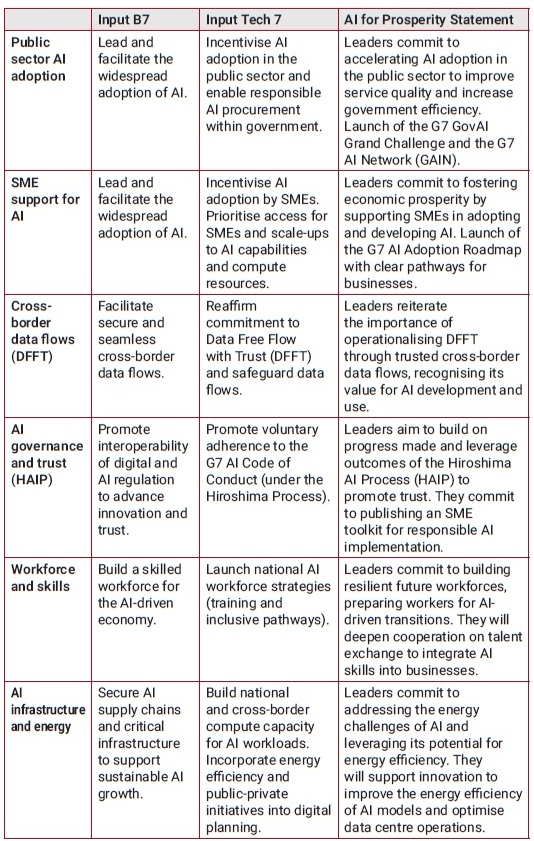
These priorities are also pointed out in the G7 Leaders’ Statement on AI for Prosperity which draws on several recommendations made by the B7 and the Tech7.[12] A key commitment is to support SMEs in adopting AI. The G7 AI Adoption Roadmap echoes calls from B7 and Tech7 to expand access to AI solutions, compute resources and digital infrastructure. Equally important is the emphasis on trust, governance and regulatory interoperability: the G7 pledged to build on the Hiroshima AI Process to strengthen consumer confidence through voluntary, standards-based frameworks. The DFFT’s support for secure and seamless cross-border data flows was also reaffirmed. This indicates that recommendations from industry and technological communities have significantly contributed to shaping ongoing G7 discussions on digital governance, helping to ensure that commitments remain economically grounded, technologically informed and responsive to global challenges.
The Tech7 2025 Joint Declaration is an important step forward in the efforts to define sovereign cloud infrastructure as a strategic asset rather than a protectionist barrier. Under Section 6 (“Building Resilient Digital and AI Infrastructure”), the Tech7 sets out a framework that emphasises “secure and interoperable cloud infrastructure that protect[s] commercial and government data while enabling innovation”. This approach aims to position sovereign cloud capabilities as foundational to digital competitiveness, AI model training and energy-efficient scaling.
Tech7’s framework is grounded on several core principles: security and interoperability must go hand in hand; cloud infrastructure should protect both commercial and government data; energy efficiency and sustainability must be embedded into infrastructure planning; and sovereign cloud capabilities should enable rather than constrain innovation. This vision rules out requirements based on vendor nationality or ownership structure – instead, the emphasis is on technical capabilities, operational security and contractual protections that governments can leverage to maintain strategic autonomy. Modelled on recent best practices, cloud architectures should protect data while enabling innovation.
Conclusions and recommendations
In 2025, the G7 has reaffirmed its role as a key platform for advancing convergent approaches to digital governance. This continuity – visible across successive presidencies from Japan to Italy and, most recently, Canada – stems from a deliberate effort to build on previous achievements and sustain momentum. A central lesson is that effective digital governance cannot rely only on intergovernmental coordination. The quick pace, high complexity and transnational nature of technological innovation demand continuous and structured engagement with all main actors of the digital ecosystem that can offer critical insights into areas such as AI safety, cloud infrastructure, data governance and cybersecurity.
The overarching takeaway is that, after years of defining principles, the strategic priority should focus on strengthening voluntary frameworks that enable businesses (especially SMEs) and governments to concretely leverage emerging digital technologies. Looking ahead, the G7 should continue supporting solutions that – also by taking market considerations into account – ensure trustworthy adoption, resilient compute infrastructures and effective mitigation of risks posed by frontier technologies such as quantum computing, while preserving the competitive dynamics that drive innovation.
To achieve this, the G7 should reinforce voluntary initiatives like HAIP and DFFT that have proven effective in building trust while maintaining open, competitive markets. This includes supporting standards for accelerated cross-border data flows that balance innovation with security considerations. At the same time, AI and quantum infrastructures should be treated as strategic long-term assets developed through public-private partnerships, with expanded secure, sustainable and energy-efficient compute capacity at both national and transnational levels. In addition to that, competitive cloud markets, underpinned by technical security standards, are essential for ensuring that businesses and governments can access the infrastructure needed for AI adoption and digital transformation. Given the potential risks posed by frontier technologies, voluntary adherence to security best practices and frameworks developed with contributions from industry and other key actors in the digital ecosystem will be critical to safeguarding data and communication networks while preserving the innovation ecosystems that drive economic growth.
Three policy recommendations ahead of France’s 2026 G7 Presidency
1) Adopt a framework for cloud infrastructure based on technical standards and controls – France should champion “secure and interoperable cloud infrastructure that protects commercial and government data while enabling innovation” – as suggested by the Tech7 2025 Joint Declaration – to ensure that G7 nations achieve open strategic autonomy. In doing so, it is crucial that strategic autonomy is achieved through technical controls (hardware-enforced isolation, operational independence, contractual protections and encryption capabilities).
2) Operationalise DFFT through voluntary commitments – France should strengthen DFFT operationalisation by reinforcing voluntary commitments to implement standards that enable secure cross-border data flows while preserving competitive markets. This approach builds on the successful methodology established originally under Japan’s Presidency, endorsed by the UK and Germany, and enshrined in Italy’s IAP, which Canada has sustained in 2025 despite deepening political turbulence.
3) Establish G7 AI adoption infrastructure as a strategic priority – France should position AI adoption infrastructure – including compute capacity, data centre ecosystems and cloud capabilities – as a strategic G7 priority that requires competitive markets to achieve scale, sustainability and democratic access. This builds directly on Canada’s G7 AI Adoption Roadmap and Italy’s recognition of cloud computing as an essential enabler for AI democratisation among SMEs and the public sector.
In addition, progress on AI adoption at G7 level could be achieved can also be made by harmonising the methods used by national statistics agencies to measure AI adoption. A harmonised approach would help develop comparative analyses and benchmarking. The OECD has been developing a Handbook for Measuring AI in ICT surveys. A G7-level alignment on this initiative would be a significant achievement.
Annex | Comparison of priority areas highlighted by the B7 and Tech7 engagement groups and their corresponding uptake in the G7 Leaders’ Statement on AI for Prosperity
Federica Marconi is a researcher in the “Multilateralism and global governance” programme at IAI.
[1] B7, Bolstering Economic Security and Resilience. 2025 B7 Communiqué, May 2025, https://chamber.ca/2025-b7-communique.
[2] Canada, Prime Minister Carney Announces Canada’s G7 Priorities ahead of the Leaders’ Summit, 7 June 2025, https://g7.canada.ca/en/news-and-media/news/prime-minister-carney-announces-canadas-g7-priorities-ahead-of-leaders-summit.
[3] G7, G7 Leaders’ Statement on AI for Prosperity, 17 June 2025, https://www.g7.utoronto.ca/summit/2025kananaskis/250617-ai.html; G7, Kananaskis Common Vision for the Future of Quantum Technologies, 17 June 2025, https://www.g7.utoronto.ca/summit/2025kananaskis/250617-quantum.html.
[4] G7, G7 Chair’s Summary, 17 June 2025, https://www.g7.utoronto.ca/summit/2025kananaskis/250617-summary.html.
[5] G7 website: G7 GovAI Grand Challenge, https://www.canada.ca/en/government/system/digital-government/digital-government-innovations/responsible-use-ai/ai-grand-challenge.html.
[6] G7, G7 Industry, Technology and Digital Ministerial Meeting, Ministerial Declaration, Verona and Trento, 15 March 2024, https://www.g7.utoronto.ca/ict/2024-declaration.html; G7 Industry and Technology Ministers Convene in Rome to Advance Industrial Competitiveness, Digital Innovation, and Sustainable Digital Transformation, Chair’s Summary, Rome, 10 October 2024, https://www.g7.utoronto.ca/ict/241010-industry-tech-summary.html.
[7] G7, G7 Report on Driving Factors and Challenges of AI Adoption and Development among Companies, Especially Micro and Small Enterprises, 10 October 2024, https://www.g7.utoronto.ca/ict/2024-FINAL_REPORT_AI_MSMEs_Ministerial_10_Oct_2024.pdf.
[8] OECD website: Data Free Flow with Trust, https://www.oecd.org/en/about/programmes/data-free-flow-with-trust.html; OECD, Launch of the Hiroshima AI Process (HAIP) Reporting Framework (webinar), 7 February 2025, https://www.oecd.org/en/events/2025/02/launch-of-the-hiroshima-ai-process-reporting-framework.html.
[9] The 2023 G7 Hiroshima AI Process (HAIP) delivered a Comprehensive Policy Framework that included: i) the International Guiding Principles for Organizations Developing Advanced AI Systems (https://www.mofa.go.jp/files/100573471.pdf); the International Code of Conduct for Organizations Developing Advanced AI Systems (https://www.mofa.go.jp/files/100573473.pdf), and project-based co-operation on AI; the OECD’s report Towards a G7 Common Understanding on Generative AI (https://doi.org/10.1787/bf3c0c60-en); project-based co-operation on AI.
[10] Following the commitments outlined in the Trento Declaration (https://www.g7.utoronto.ca/ict/2024-declaration.html) and the Apulia G7 Leaders Communiqué (https://www.g7italy.it/wp-content/uploads/Apulia-G7-Leaders-Communique.pdf), the OECD was urged to identify and develop appropriate mechanisms for monitoring the voluntary adoption of the Hiroshima AI Process International Code of Conduct by organisations choosing to implement it.
[11] B7, Bolstering Economic Security and Resilience, cit.; Tech7, Enabling Trust, Innovation, and Prosperity in the Digital Age, Tech7 Joint Declaration, June 2025, https://technationcanada.ca/en/?p=15352.
[12] For more details, see the Annex.