Titolo completo
Thinking the Unthinkable: The Consequences of Trump’s Decision to Resume Nuclear Testing
|
On Thursday 30 October, US President Donald Trump announced his intention to immediately resume nuclear testing “on an equal basis” on the Truth Social platform, marking a significant break in policy following the US’s nearly 30-year adherence to the Comprehensive Test Ban Treaty (CTBT), which the US signed in 1996 but never ratified. While the CTBT never entered into force as it has not been ratified by the US and China, everyone adhered to the moratorium. Thus, Trump’s announcement carries serious potential geopolitical consequences, particularly for the fragile global arms control regime and US-Russia relations.
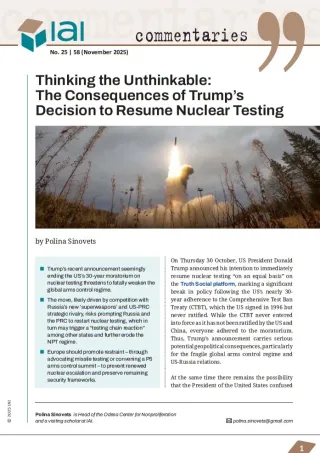
At the same time there remains the possibility that the President of the United States confused missile systems with nuclear. Trump’s comments were likely a reaction to Russia’s announcement of successfully testing two highly publicised ‘super weapons’. The first, the Burevestnik cruise missile – dubbed the ‘Doomsday Machine’ by Russian media – is a thermonuclear-powered missile with the capacity to remain airborne for extended periods and designed to penetrate any missile defence system, according to President Putin. The second, the Poseidon unmanned underwater torpedo, is also powered with a thermonuclear engine and can carry a nuclear warhead capable of generating a massive tsunami to destroy coastal cities. Despite Moscow’s dramatic portrayal, these weapons are unlikely to change the overall military balance or to undermine the US’s second-strike capabilities.
Trump’s statement appears to be a calculated attempt to demonstrate that the US is not unprepared for these new Russian weapons. Another possible motivation is to strengthen the US bargaining position ahead of his upcoming visit to the People’s Republic of China (PRC), which also has neither ratified the CTBT nor participated in arms control agreements with the US and Russia.
The President’s statement also contained several anomalies. First, since Russia had not tested any of the nuclear warheads there is no “equal basis” or rational justification for the US to resume nuclear testing. This raises the possibility that Trump may have been referring to missile systems tests, as the Department of War (formerly Defense) oversees missile testing, while the Department of Energy handles the development, maintenance and testing of nuclear warheads. Notably, the last thermonuclear test was conducted by North Korea in 2017, an event unconnected to Trump’s announcement.
While most of the experts believe that the situation is not as serious as Trump’s post suggested, uncertainty remains. The announcement could be interpreted by elements of the US state machine as a directive to act. Indeed, Pete Hegseth, the US War Secretary, has publicly supported Trump’s position, claiming that resuming US nuclear testing would make nuclear conflict less likely. Still, US Energy Secretary Chris Wright contradicted both Trump and Hegseth saying that the US does not plan to test nuclear warheads, restraining itself to non-nuclear (“non-critical”) explosions. Furthermore, in the meanwhile, the US tested its Minutemen III intercontinental ballistic missile, which, to a certain extent, can provide substance to Trump’s statement on testing.
Why the resumption of nuclear testing could be extremely dangerous
First, the global arms control regime has already been weakened significantly in recent years. Not least, Russia revoked its CTBT ratification in 2023 as part of coercive measures against the West in its war on Ukraine. A resumption of US nuclear testing could therefore constitute the ‘last nail in the coffin’ of the Treaty.
Second, a response statement has already been issued by Moscow, declaring that should Washington resume nuclear testing Russia will follow suit with “reciprocal measures”. Technically, Russia’s underground nuclear test site at Novaya Zemlya is ready for this. Any breach of the nuclear test moratorium by the US could therefore provoke an immediate Russian reaction, even more dramatic than one could expect. That said, more generally, with the ongoing war in Ukraine, there are concerns that Putin may be influenced by radical ideas such as those proposed by Sergey Karaganov in 2023, who suggested using a nuclear strike to ‘sober up’ the West, and later vented the idea of conducting an atmospheric nuclear test. Although Putin does not follow all of Karaganov’s proposals, he sometimes draws inspiration from extreme ideas. For example, in 2023 Karaganov called for a lowering of the nuclear threshold, a change that was reflected in the November 2024 updates to Russia’s Nuclear Doctrine.
Moreover, an atmospheric nuclear test – rather than an underground one – would constitute a dramatic show of Russian strength and violate the Partial Test Ban Treaty (PTBT), which has been in force since 1963 and prohibits atmospheric nuclear testing. The impact on public opinion would be significant, especially in Europe where anti-nuclear sentiments remain strong and fears of Russian aggression persist amid the war in Ukraine. NATO’s readiness and response capabilities would also be tested.
Finally, Trump’s decision could embolden the PRC to resume nuclear testing. Unlike the US and Russia – which conducted hundreds of nuclear tests – Beijing has conducted fewer than a hundred and may seek to bolster its deterrence credibility through additional tests.
Navigating the escalatory risks
Should nuclear testing be resumed by the US, this would shake the whole architecture of the Nuclear Non-Proliferation Treaty (NPT), paving the way for other states to start or resume nuclear testing.
Making nuclear tests part of the ‘daily routine’ may reduce the urgency of the nuclear taboo and increase the risk of nuclear escalation. Tensions with non-nuclear states would also be fuelled, with those that are members of the Treaty on the Prohibition of Nuclear Weapons (TPNW) blaming the NPT’s complete inefficiency. But in a world with nine nuclear powers, the TPNW itself is highly unlikely to be universalised. The most likely result of the collapse of the NPT would rather be, nuclear anarchy without commonly agreed rules- bringing along all its consequences.
European states could play a critical role in avoiding this potentially escalatory chain of events. They might advise the US president to pursue more prudent alternatives, such as missiles testing. Alternatively, Europe could take the initiative by calling on the US, Russia and the PRC to convene a P5 arms control summit aimed at preserving the international security architecture and mitigating tensions. Ultimately, the goal must be to navigate these challenges without undermining NATO, eroding the global arms control framework, or causing any party to lose face.
Polina Sinovets is Head of the Odesa Center for Nonproliferation and a visiting scholar at IAI.